Galaxies are vast cosmic cities, home to billions or even trillions of stars. Our own galaxy, the Milky Way, is a busy place, constantly building new stars from huge clouds of gas and dust. These star-forming regions are like giant nurseries, creating the next generation of suns. For a long time, this process of birth and renewal was seen as the normal life of a galaxy.
But astronomers noticed something strange. When they looked out into the universe, they saw many galaxies that were completely quiet. They were not forming any new stars at all. These galaxies are often described as “red and dead.” They are red because they are filled only with old, reddish stars, and “dead” because their star-factories have been closed for billions of years. This discovery raised a huge question: What could possibly have the power to stop an entire galaxy from making stars?
The evidence pointed to a surprising culprit: the supermassive black hole hiding in the galaxy’s center. At first, this seemed to make no sense. These black holes are tiny compared to the size of the whole galaxy. It would be like a single pebble at the center of a giant city somehow stopping all construction in every single neighborhood. Scientists realized there must be a powerful connection at play, a way for the black hole to “communicate” with the entire galaxy.
So, how exactly does this tiny central object manage to shut down star formation across thousands of light years?
What Do Stars Need to Form in the First Place?
To understand how to stop star formation, we first need to know the recipe for making a star. It is actually quite simple, but the conditions have to be just right. The main ingredient is gas, mostly hydrogen, which is the most common element in the universe. But just having gas is not enough. The gas must be extremely cold and very dense.
Think of it like trying to make a snowball. If you grab a handful of light, fluffy snow, you cannot pack it into a ball. It just floats apart. But if you have heavy, wet, cold snow, you can easily pack it into a dense snowball. The gas in a galaxy works the same way. If the gas is hot, its tiny particles are moving very fast and spread out, like steam. This hot gas cannot be packed together. The gas must be very cold, just a few degrees above absolute zero, so the particles are slow and lazy.
When a giant cloud of this cold, dense gas floats in space, something wonderful happens. Gravity, the force that pulls everything together, starts to take over. It pulls the slow-moving gas particles toward each other. The cloud begins to shrink and collapse under its own weight. As it collapses, it breaks into smaller, denser clumps. The center of each clump gets squeezed more and more, becoming incredibly hot and pressurized. When the pressure and temperature at the core get high enough, a process called nuclear fusion begins. This is the moment a star is born. It ignites and starts to shine, pushing back against gravity’s pull.
So, the rule is simple: no cold, dense gas, no new stars. If you want to shut down a galaxy’s star factory, you have two options. You must either heat up all the cold gas, or you must somehow get rid of it completely.
What Is a Supermassive Black Hole?
Before we talk about how black holes stop this process, let’s be clear on what we are dealing with. When many people hear “black hole,” they think of a star that has died and collapsed. Those are called stellar-mass black holes, and they might be a few times heavier than our sun. The objects we are talking about are on a completely different scale.
These are “supermassive” black holes, or SMBHs. They are the monsters of the universe. They are not just a few times heavier than the sun; they are millions or even billions of times more massive. Scientists are confident that one of these giants lives at the center of almost every large galaxy, including our own Milky Way. Our local SMBH is called Sagittarius A-star (or Sgr A*), and it has the mass of about four million suns.
For a long time, astronomers thought these giant black holes were mostly quiet. They just sat in the middle of their galaxies, and the only things they affected were the stars and gas that got unluckily close. We imagined them as a cosmic drain, only consuming what fell directly into them. But this picture has changed completely. We now know that an SMBH is not a passive object. It is a critical part of the galaxy’s ecosystem. It is connected to the entire galaxy’s evolution and can have a profound effect on its future. It is not just a drain; it is more like the galaxy’s engine, and sometimes, that engine can overheat.
What Happens When a Black Hole Starts ‘Eating’?
A supermassive black hole is not always active. In fact, most of them, like ours, are “dormant” or sleeping. They are quiet because there is not much material falling into them. But sometimes, a black hole “wakes up” and begins to feed. This can happen when two galaxies collide, or when a large cloud of gas wanders too close to the galactic center.
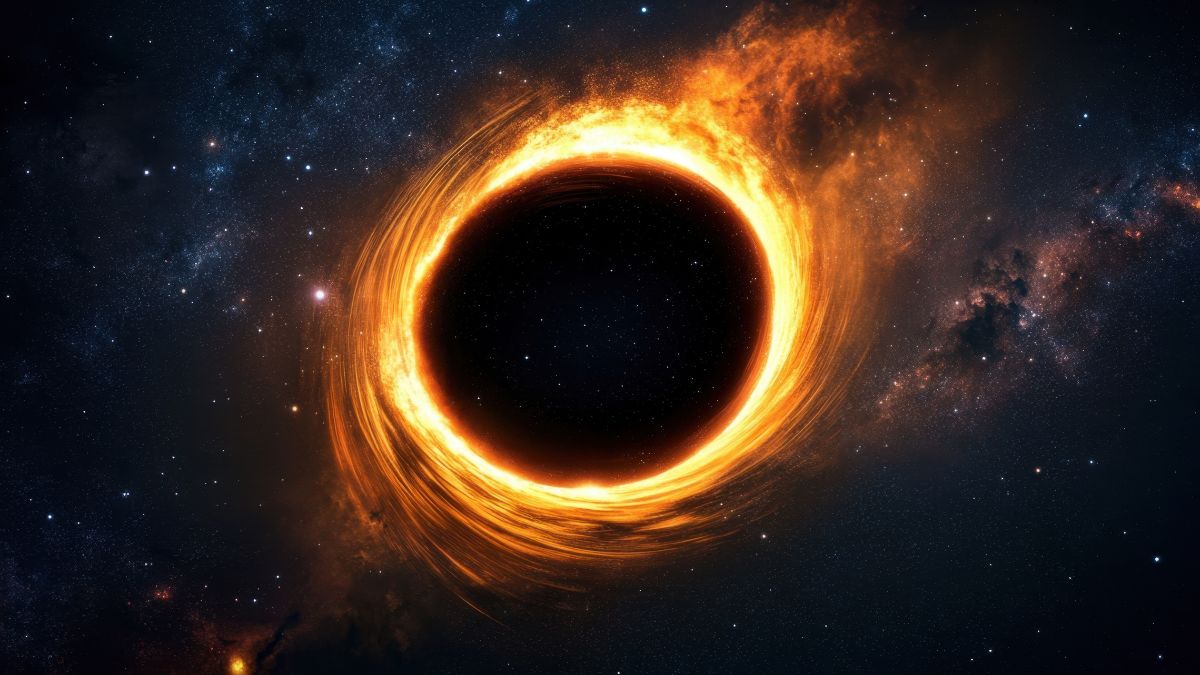
When a large amount of gas and dust spirals toward the black hole, it does not fall straight in. Instead, it forms a huge, flat, spinning disk around the black hole. This is called an “accretion disk.” Think of it like water swirling around a drain, but on a mind-boggling scale and moving at incredible speeds. The material in this disk circles the black hole faster and faster as it gets closer.
This process is incredibly violent. The friction between the different layers of gas in the disk, all rubbing against each other at nearly the speed of light, generates an astonishing amount of heat. The accretion disk can reach temperatures of millions of degrees, making it glow with unbelievable brightness. This tiny central region, powered by the black hole, can become so bright that it outshines all one hundred billion stars in its host galaxy combined.
When a black hole is actively feeding and shining this brightly, scientists call it an “Active Galactic Nucleus,” or AGN. The very brightest and most powerful AGNs are known as “quasars.” This “active” phase is the key. This is the moment the black hole stops being a quiet neighbor and starts to have a galaxy-wide impact. The energy it releases is so immense that it cannot be contained. This outpouring of energy is what scientists call “AGN feedback.”
How Do Black Hole Jets Heat Up a Galaxy?
AGN feedback, the process of the black hole influencing its galaxy, comes in two main flavors. The first one is often called “kinetic feedback” or “radio mode.” This method is less like a giant explosion and more like a constant, powerful heating system that keeps the galaxy’s gas too hot to form stars.
This happens when the black hole is feeding at a steady, but not extreme, rate. As material swirls in the accretion disk, powerful magnetic fields get tangled up. These fields act like giant particle accelerators. They grab some of the superheated gas from the very edge of the black hole and, instead of letting it fall in, they shoot it out. This material is blasted away from the black hole’s poles (its “top” and “bottom”) in two narrow, focused beams.
These are not gentle streams; they are “relativistic jets.” This means they are traveling at a significant fraction of the speed of light. These jets are some of the largest and most energetic phenomena in the universe. They can travel for hundreds of thousands of light years, stretching far beyond the visible edge of the galaxy itself.
As these incredibly fast jets plow through the galaxy, they slam into the sparse gas that fills the space between stars (the interstellar medium). This collision creates massive shockwaves, like a continuous sonic boom rippling through the galaxy. These shockwaves carry enormous amounts of energy and heat. They spread through the galaxy’s gas halo, warming everything up. The jets effectively act as a giant thermostat for the galaxy. Any cold gas that tries to cool down and form stars gets “reheated” by the energy pumped out by the black hole’s jets. This process keeps the galaxy’s gas reservoir in a hot, fluffy state, making it completely useless for building new stars.
How Do Black Hole Winds Blow Away Star Fuel?
The second method is even more dramatic and is known as “radiative feedback” or “quasar mode.” This happens when the black hole is in its most extreme feeding phase, like when it becomes a quasar. It is eating so much material so quickly that its accretion disk is shining with unimaginable intensity.
In this mode, the light itself is so powerful it can physically push things. This is a real concept called “radiation pressure.” A single particle of light, a photon, does not have mass, but it has momentum. When it hits something, it gives it a tiny push. Now, imagine not just a few photons, but the most intense flood of light and energy in the universe, all coming from one tiny spot.
This flood of radiation blasts outward from the accretion disk in all directions. It creates a ferocious, galaxy-wide “wind.” This wind is not like a gentle breeze. It is a tsunami of high-energy particles and radiation moving at millions of miles per hour. This cosmic hurricane is so powerful that it does not just heat the gas; it physically ejects it.
This wind acts like a giant cosmic leaf-blower. It sweeps through the galaxy, gathering up the cold gas clouds—the precious fuel for star formation—and shoves them completely out of the galaxy. This gas is blown into the vast emptiness of intergalactic space, where it is lost forever. This process is incredibly effective. In a relatively short amount of time, astronomically speaking, the quasar can strip its entire galaxy bare of all the cold gas it needs to make new stars. Once the fuel is gone, the star factories shut down permanently.
Why Do ‘Dead’ Galaxies Look Different From Ours?
This brings us back to what astronomers see in their telescopes. This entire process of AGN feedback perfectly explains why we see two main types of large galaxies in the universe: blue, active spirals and red, dead ellipticals.
A galaxy like our Milky Way is a spiral galaxy. It has beautiful, sweeping arms, and its color is a vibrant blueish-white. That blue color is the tell-tale sign of active star formation. It comes from the light of massive, young, extremely hot stars. These stars burn very bright and very blue, but they also die very young. The fact that we see them at all means our galaxy is constantly making new ones. We are “alive” and full of cold gas.
Now, let’s look at a “quenched” galaxy. These are almost always elliptical galaxies. They do not have spiral arms; they are just huge, smooth, football-shaped collections of stars. Their most obvious feature is their color: a pale yellow or reddish-orange. This “red and dead” color is the key. It tells us that all the young, hot, blue stars died off billions of years ago. The only stars left are the old, cool, long-lived red stars, like red dwarfs.
These galaxies are red because they are not making any new blue stars. And why not? Because their supermassive black holes have, at some point in the past, shut them down. Whether through the long-term heating of jets or a violent wind that blew all the gas away, the result is the same. The cold gas reservoir is gone. The star nurseries are closed. All that is left is an aging population of old stars, slowly fading from blue to red over cosmic time.
Does This Mean the Black Hole ‘Kills’ Its Galaxy?
Saying the black hole “kills” its galaxy sounds very negative. In recent years, scientists have started to see it differently. It is not so much an act of destruction as it is an act of regulation. This feedback process is a natural and essential part of a galaxy’s life.
In fact, AGN feedback solves a major puzzle. According to old theories, galaxies should be much, much bigger than they are. With so much gas in the universe, gravity should just keep pulling it in, and galaxies should just keep forming stars at a furious rate, growing into truly enormous sizes. But they do not. Something stops them. That “something” is the black hole.
The black hole and the galaxy are in a kind of dance, a self-regulating cycle. As cold gas flows into the galaxy, it fuels two things: star formation and the black hole. The galaxy starts making lots of new stars. The black hole starts to “eat” and grow. But as the black hole eats more, its feedback (jets or winds) gets stronger. This feedback then heats or ejects the gas. This shuts off the star formation and cuts off the black hole’s own food supply.
The black hole effectively starves itself to death. Once the gas is gone, the black hole becomes dormant again. The galaxy stops forming stars and just… ages. This process prevents the galaxy from growing too large and shapes its final size and structure. So, the black hole does not “kill” its galaxy. It manages it. It is a fundamental part of its life cycle, determining when it grows and when it retires.
Are All Black Holes Stopping Stars Right Now?
It is important to remember that this is not happening in every galaxy all the time. Most supermassive black holes, including our own, are “sleeping.” Our Milky Way’s black hole, Sagittarius A*, is currently very quiet. It nibbles on tiny wisps of gas, but it is not having a major feeding “event.” This is why it is not producing powerful jets or winds. And that is a very good thing for us! It is the reason our galaxy is still a healthy, active, star-forming spiral.
The active, or AGN, phase is a specific, and often temporary, stage in a galaxy’s long life. It is like a short, violent “growth spurt.” What triggers it? A major disruption. The most common trigger is a galaxy merger. When two galaxies collide, their gravitational pulls throw everything into chaos. This collision slams huge amounts of gas and dust from both galaxies into the central region, “waking up” the sleeping giant.
This “feast” turns on the AGN, and the feedback process begins. The black hole blasts out energy, heating and clearing out the gas from the newly merged galaxy. This is why many of the giant “red and dead” elliptical galaxies we see are thought to be the products of ancient galaxy mergers. They had a final, huge burst of star formation, which fed the black hole, which then turned on and shut the whole thing down for good.
What New Discoveries Are Scientists Making About This?
This is one of the most exciting fields in astronomy, and our understanding is growing every year, especially thanks to new technology. The James Webb Space Telescope (JWST), which launched a few years ago, is a game-changer for this research. JWST is special because it sees the universe in infrared light. This allows it to do two things: look through the thick dust clouds that hide star formation and look back in time to see the universe’s very first galaxies.
In 2024 and 2025, scientists using JWST have been publishing amazing new results. They are seeing this process of black hole feedback happening in galaxies that are incredibly young, when the universe was only a fraction of its current age. This means that this “self-regulation” by black holes is not a new thing; it started almost as soon as the first galaxies were born.
JWST has been able to directly observe the powerful winds of gas being blown out of these young galaxies. It has seen “outflows” of gas moving at incredible speeds, confirming that these quasar winds are even more powerful and common than we previously thought. These new observations are helping scientists refine their models of how galaxies form. We are moving from a simple picture of “gravity builds galaxies” to a much more complex and interesting one, where gravity builds galaxies and black holes regulate them.
Conclusion
So, the story of how a black hole stops star formation is a story of power and balance. Supermassive black holes are not just quiet objects sitting in the dark. When they are fed, they become the most powerful engines in the universe. They “shut down” star formation in two main ways: by launching powerful jets that act like a giant heater, keeping all the gas too hot to form stars (kinetic feedback), or by unleashing ferocious winds of radiation that physically blow the star-forming fuel right out of the galaxy (radiative feedback).
This process, called AGN feedback, is not an act of destruction but a vital part of a galaxy’s life. It regulates the galaxy’s growth, determines its final size and shape, and explains why some galaxies, like our own, are alive and blue, while others are “red and dead.” It is a beautiful example of the deep connection between the very largest and smallest things in the cosmos.
As we continue to peer into the universe with new eyes like the James Webb Space Telescope, what other amazing details will we learn about this cosmic dance between galaxies and their giant black holes?
FAQs – People Also Ask
Why is cold gas needed to make stars?
Stars form when gravity pulls giant clouds of gas together. If the gas is hot, its particles move too fast for gravity to grab them. The gas must be very cold so its particles move slowly, allowing gravity to overcome their motion and collapse the cloud into a dense, hot core where a star can be born.
Is the black hole in the Milky Way active?
No, the supermassive black hole at the center of our Milky Way, called Sagittarius A*, is considered dormant or “sleeping.” It is not actively feeding on large amounts of gas, so it is not producing the powerful jets or winds that would stop our galaxy’s star formation.
What is the difference between an AGN and a quasar?
An Active Galactic Nucleus (AGN) is the general term for any galactic center where the supermassive black hole is actively feeding and releasing a huge amount of energy. A quasar is a specific type of AGN—it is the most powerful and brightest kind, shining with such intensity that it can outshine its entire host galaxy.
Can star formation ever restart in a ‘dead’ galaxy?
It is very difficult, but perhaps not impossible. If a “dead” elliptical galaxy manages to capture a new, large supply of cold gas, for example by merging with a smaller, gas-rich galaxy, it could trigger a new, short burst of star formation. However, this process would also feed the central black hole again, which might quickly turn back on and shut the process down.
How do scientists know a black hole is ‘active’?
Scientists cannot see the black hole itself, but they can see the effects of its feeding. They look for the incredibly bright light, X-rays, and radio waves coming from the “accretion disk” of superheated gas swirling around it. They can also detect the massive jets and gas winds that the active black hole shoots out into the galaxy.
What is an elliptical galaxy?
An elliptical galaxy is a type of galaxy that is shaped like a smooth, stretched-out sphere or football. Unlike spiral galaxies (like the Milky Way), they have no spiral arms and very little cold gas or dust. They are mostly made of very old, reddish stars and are not actively forming new ones.
Do all galaxies have supermassive black holes?
Scientists believe that nearly all large, massive galaxies, including our own Milky Way and all other spiral and elliptical galaxies, have a supermassive black hole at their center. Very small, irregular “dwarf” galaxies may not have them, or may have much smaller “intermediate-mass” black holes.
How fast are black hole jets?
The jets of material shot out by an active black hole are incredibly fast, moving at “relativistic” speeds. This means they travel at a significant fraction of the speed of light—often 99% of the speed of light or even faster.
What is ‘AGN feedback’?
“AGN feedback” is the general term for the process by which an Active Galactic Nucleus (the feeding black hole) releases enormous amounts of energy that “feed back” into the host galaxy. This energy, in the form of jets or winds, heats or ejects the galaxy’s gas, which regulates the galaxy’s growth and stops star formation.
Does the James Webb telescope study black holes?
Yes, absolutely. While the James Webb Space Telescope (JWST) cannot see black holes directly, it is a perfect tool for studying their effects. It uses infrared light to see the powerful winds of gas being blown out by active black holes and to study the bright accretion disks (quasars) in the very early universe, helping us understand how they and their galaxies first formed.