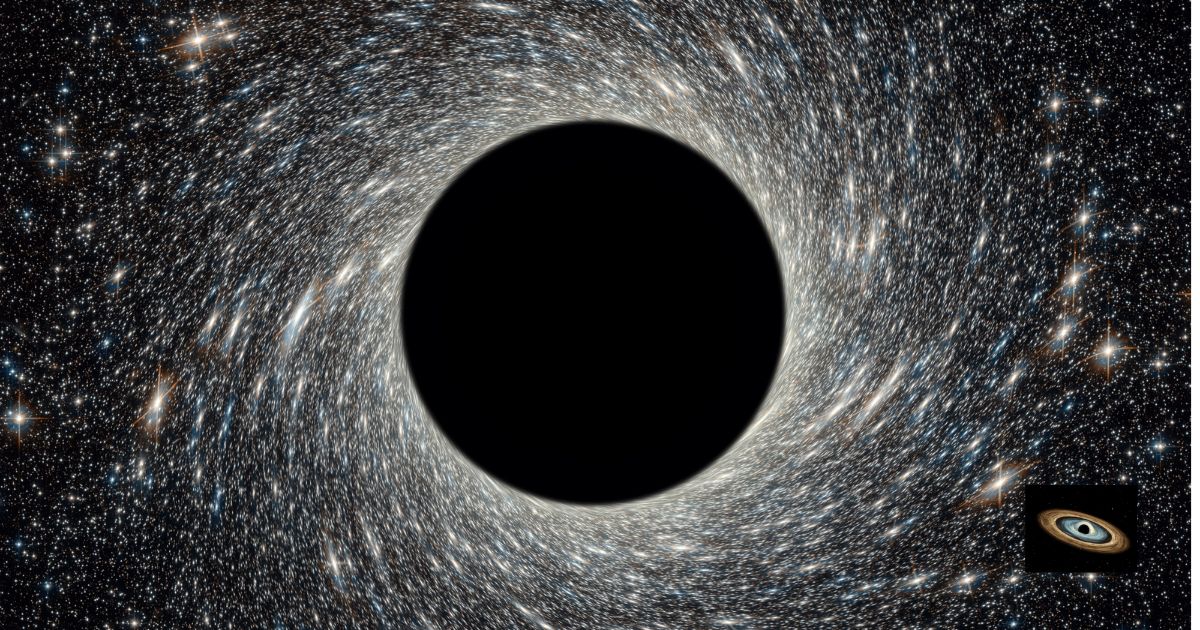
Our Solar System is a place we think we know well. We have eight planets, countless asteroids, and a clear boundary past Neptune called the Kuiper Belt. For decades, school books have shown us a neat, orderly picture of our cosmic neighborhood. However, in the deepest, darkest edges of this neighborhood, something is causing trouble. Astronomers have found a puzzle that suggests our system is not as simple as we thought, and the solution to that puzzle might be the most strange and exciting thing we could ever imagine: a black hole orbiting our Sun.
The entire idea started with a handful of small, icy worlds that orbit the Sun far beyond Pluto. These worlds, called Trans-Neptunian Objects (TNOs), move in ways that defy normal physics. Their long, stretched-out paths around the Sun are all strangely clustered together, pointing in the same general direction. To make these objects move like this, a massive, unseen force must be pulling on them. This force points to a hidden object, something big enough to act as a kind of gravitational “shepherd” for these distant, tiny worlds. Scientists call this hidden object Planet Nine.
For years, the Planet Nine idea has dominated astronomy news. But what if the object is not a planet at all? What if it’s something far more exotic and harder to spot? A wilder, but still completely scientific, theory has suggested that the mystery object is actually a tiny black hole, a remnant of the early universe. This is not the kind of giant black hole that sits at the center of a galaxy. Instead, it would be a small, ancient, and extremely dense relic. The most recent plans to find this object, often called the “New 2026 Theory,” are about to put this incredible idea to the test. Will we find a new planet or our first up-close look at a cosmic monster?
Why Do Scientists Think There’s Something Missing in Our Solar System?
The evidence for an extra body in our solar system comes purely from gravity and motion. We can’t see the object directly, but we can see the effects of its pull on other things. Think of it like a detective watching a crime scene. You didn’t see the thief, but you see that all the doors were forced open in the same way, which tells you something about the tool the thief used. In space, our “forced open doors” are the strange, clustered orbits of the most distant Trans-Neptunian Objects, or TNOs.
These TNOs are small, icy, rocky worlds that live far past Neptune. Most objects in the Solar System orbit in a relatively flat disk, like a frisbee. They also point their closest approach to the Sun in a wide variety of directions. However, a select group of these very distant TNOs have orbits that are all tilted similarly and, even more strangely, their closest points to the Sun are all clustered in one sector of the sky. It’s as if a huge, invisible hand is gently guiding them into this unusual alignment. The chance of this alignment happening by random luck is extremely small, possibly less than one in a hundred. This powerful statistical clue is what led to the hypothesis of a massive, hidden object—something much bigger than Pluto—out there. To explain the specific clustering, the object would need to be very massive and have a highly tilted, stretched-out orbit of its own, reaching hundreds of times farther than the Earth is from the Sun. This gravitational signature is the undeniable fact that forces scientists to believe something is missing, whether it’s a planet or something else entirely. Without this missing mass, the orbits simply don’t make sense.
What Exactly Is This Mysterious Object Called Planet Nine?
The most straightforward and traditional explanation for the TNO clustering is that the hidden object is a ninth planet. This hypothetical world, first proposed in detail in 2016 by astronomers Konstantin Batygin and Michael Brown, earned the nickname Planet Nine. Based on the amount of gravitational pull needed to line up the distant TNOs, scientists estimated that Planet Nine would be quite large, falling somewhere between the size of Earth and Neptune. Its mass is thought to be about five to ten times the mass of Earth.
If it is a planet, it would likely be what is called a “Super-Earth” or a “Mini-Neptune,” a common type of planet found orbiting other stars, but one we do not have in our inner system. Its orbit would be enormous and incredibly long, taking it anywhere from 10,000 to 20,000 years to complete just one trip around the Sun. At its farthest point, it could be $1000$ times farther from the Sun than Earth is, or more. This enormous distance is exactly why we haven’t found it yet. It would be incredibly dim, reflecting very little sunlight, and moving very slowly against the background stars. To find Planet Nine, astronomers have been using huge telescopes to scan the exact regions of the sky where its orbit is predicted to be, patiently hoping to spot a tiny pinprick of light moving over time. The search is a monumental task, covering a vast, dark region of space where finding a dim, distant world is like looking for a single grain of sand on a dark beach.
Why Would a Black Hole Be Proposed Instead of a Planet?
While the Planet Nine idea is logical, some scientists began to wonder if there could be a more extreme explanation for the unseen mass. This is where the idea of a Primordial Black Hole (PBH) comes in. Unlike the black holes we typically hear about—which form when a giant star dies and collapses—primordial black holes are ancient. The theory suggests they were formed in the very first moments of the universe, less than a second after the Big Bang, from extreme pressure fluctuations in the rapidly expanding early cosmos.
The reason a black hole is a serious alternative to a planet is that both objects can have the exact same amount of mass and, therefore, exert the same gravitational pull, but they are dramatically different in every other way. A planet, even a dim one, reflects some light and has a surface. A black hole, by its nature, emits no light. It is completely invisible. This lack of light solves the main mystery: why is the object so hard to find? If Planet Nine were a world of rock and ice, it should have been spotted by now in some of the large sky surveys. The fact that the object remains elusive has led some astronomers, notably Dr. Avi Loeb and his student Amir Siraj at Harvard, to propose that its invisibility is the answer itself. If the gravitational evidence is strong, but the visual evidence is zero, then the object might be invisible by design, making a primordial black hole a compelling and elegant alternative to the missing planet. It’s a completely radical idea, but one that fits the evidence perfectly.
How Big Would a Solar System Black Hole Actually Be?
When most people hear the words “black hole,” they imagine a massive, sun-swallowing monster, maybe one with a huge ring of gas spiraling around it. The primordial black hole proposed as a replacement for Planet Nine is nothing like that. If the hidden object has a mass about five times that of the Earth, as the Planet Nine hypothesis suggests, its physical size would be incredibly small—almost impossibly so.
This is because a black hole’s size is determined by its Schwarzschild Radius, which is the boundary of no return, the point where gravity becomes so strong that nothing, not even light, can escape. For an object with the mass of a large mountain, the radius is tiny. For an object with the mass of the Earth, the radius is only about one centimeter. This is roughly the size of a single marble. If the hidden object is about five to ten Earth masses, as Planet Nine is estimated to be, this primordial black hole would be no larger than a grapefruit, perhaps with a radius of a few inches. This is a monumental difference: a planet with five Earth masses would be about twice the diameter of Earth, a vast object in space. A black hole with the same mass is a tiny, super-dense sphere. This size difference is key to understanding why it’s so hard to find. It’s a tiny, dark object orbiting at a distance of hundreds of times the Earth’s distance from the Sun, making it effectively a speck of dust in the vast darkness of space. Finding it is therefore not about spotting a dim planet, but about detecting the tiny, powerful effects of an incredibly dense, small object.
What Is the New 2026 Hunting Plan to Find the Object?
Since a primordial black hole is too small to reflect enough sunlight for a normal telescope to see, scientists have developed a new plan to find it—one that specifically looks for the black hole’s unique “eating” behavior. This is the heart of the “New 2026 Theory” proposed by astronomers like Avi Loeb. The plan involves looking for a tiny, powerful flash of light that would happen very rarely.
The key is the Oort Cloud, a vast, spherical cloud of trillions of icy objects (like comets) that surrounds our Solar System far past the orbit of Planet Nine. The theory is that if the primordial black hole is orbiting out there, it will sometimes, very rarely, pass close to one of these icy objects. The black hole’s immense gravity would rip the comet apart in a process similar to what happens when a star is shredded by a supermassive black hole, but on a much smaller scale. As the comet’s material spirals into the small black hole, it would be heated to extreme temperatures, creating a bright flare of X-rays and ultraviolet light. This flash would only last a short time, maybe a few hours, but it would be bright enough for powerful telescopes to catch it. The key to this hunt is the Vera C. Rubin Observatory, which is scheduled to start its main survey soon and is a major reason why 2026 is considered a critical year. This telescope, with its enormous mirror and wide field of view, will be able to repeatedly scan the likely regions of the sky and look for these brief, energetic flares. Scientists believe that if the black hole is indeed out there, the Rubin Observatory’s survey could detect the telltale flash within the first year or two of operation, giving us a definitive answer very soon.
Could a Wandering Black Hole Ever Harm Earth?
It’s natural to feel a shiver of fear when you hear the words “black hole” and “Solar System” in the same sentence. However, the idea of a black hole orbiting us is not a danger to life on Earth. There are two main reasons why we are perfectly safe.
First, the key rule of gravity is that it depends on mass and distance. The theoretical black hole has a mass of about five to ten times that of Earth. If you replaced our Sun with a black hole of the exact same mass, all the planets would continue to orbit it exactly as they do now. The object itself is only dangerous if you get very, very close to it. Since the hidden object has much less mass than the Sun and is incredibly far away—hundreds of times farther than Neptune—its overall gravitational influence on the inner Solar System is negligible. Its pull is only strong enough to slightly nudge the distant, small TNOs, which are its closest neighbors. Earth, hundreds of times closer to the Sun, feels the Sun’s gravity overwhelmingly, but the tiny, distant pull of the black hole is far too weak to change our orbit or pull us away. Second, the black hole is incredibly tiny, only a few inches across. The chances of an object that small hitting the Earth, which is constantly moving through space, are so small that they are effectively zero. If a black hole with the mass of a grapefuit were to pass through the Earth, the effect would be minimal. While it would pass through the planet without harming its structure, it would simply tunnel through and leave. There is no danger of it “sucking up” Earth. It’s safe to say that a distant, tiny, primordial black hole is scientifically exciting, but completely harmless to our world.
What Do Other Theories Say About the Clustered Orbits?
While the Planet Nine and Primordial Black Hole theories are the most popular and radical explanations, it is important to know that astronomers have also suggested other, less dramatic solutions to the mystery of the clustered TNO orbits. Some scientists believe that the observed clustering might not be real evidence of a massive object at all, but rather a simple quirk of how we find these distant icy worlds.
This third hypothesis suggests that the apparent alignment is an observational bias. For example, when searching for very faint objects far from the Sun, it is much easier to spot them when they are near their closest point to the Sun, where they are at their brightest. It is also easier to find them when they are high above or below the plane of the Solar System because the main plane is cluttered with dust and other objects that make observations difficult. If scientists are only able to look at certain parts of the sky at certain times, the observations themselves could create the illusion that the orbits are clustered, when in reality, they are spread out evenly, and we just haven’t found the ones that are far away or in less-observed regions. Furthermore, the discovery of new, very distant TNOs in the last couple of years, with slightly different orbital patterns, has caused some of the original evidence for Planet Nine to weaken slightly. The scientific community is currently divided, and more data is needed to rule out this “bias” hypothesis. The great work of the upcoming Rubin Observatory will not only help find a planet or a black hole but will also cover the sky so thoroughly that it will finally rule out whether the clustering is real or just an illusion.
Conclusion
The mystery lurking in the deep reaches of our Solar System is one of the most compelling scientific quests of our time. The evidence is clear: the unusual, clustered orbits of distant, icy worlds suggest that a massive, unseen object is orbiting the Sun far beyond Neptune. This object is either Planet Nine, a super-Earth with five to ten times the mass of our world, or, in a much more mind-bending scenario, a Primordial Black Hole with the same mass but a physical size no bigger than a grapefruit. The coming years, especially around the proposed 2026 timeline for the full operation of the Vera C. Rubin Observatory, will be crucial. By looking for the slight reflection of a dim world or the sudden, tell-tale flash of a tiny black hole devouring a comet, astronomers will finally, hopefully, solve this puzzle. The answer, whether it’s a new planet that changes our map of the Solar System or an ancient black hole that proves theories about the universe’s beginning, promises to be one of the greatest scientific discoveries of the new decade. What will it mean for our understanding of the universe if we find that a piece of the invisible dark matter is actually orbiting us right now?
FAQs – People Also Ask
Why is the unseen object called a “wandering” black hole?
The term “wandering” or “rogue” is used because this black hole would not have formed from the collapse of a star in our Solar System, which is the usual way black holes are created. Instead, it would have been a free-floating object, either born in the universe’s first moments or ejected from another star system, that was later captured by the Sun’s gravity. It would then “wander” through its highly elliptical, distant orbit, constantly moving through the outer reaches of the Solar System.
What is a Primordial Black Hole and how is it different from a regular black hole?
A primordial black hole (PBH) is a theoretical type of black hole that is believed to have formed in the first fraction of a second after the Big Bang, the universe’s beginning. This is different from a “regular” or stellar-mass black hole, which forms much later when a star that is at least twenty times the mass of our Sun runs out of fuel and collapses. PBHs can be much smaller than stellar black holes, with some being as tiny as an asteroid in mass, making the Planet Nine-sized, grapefruit-sized PBH an example of this ancient, small, and dense relic.
Why is the Vera C. Rubin Observatory important for this search?
The Vera C. Rubin Observatory is crucial because it has a unique design that allows it to scan the entire visible southern sky every few nights, creating a massive, time-lapse map of the cosmos. This ability to repeatedly observe large sections of the sky is perfect for two things: tracking the slow movement of a dim, distant Planet Nine over months or years, and catching the brief, sudden flash of light that would be created if a primordial black hole consumed a small object in the Oort Cloud.
If it’s a black hole, how does it have the mass of a planet?
The mass of an object is simply the amount of “stuff” it contains. The difference is how tightly that stuff is packed. A black hole of five Earth masses has the same total amount of mass, and therefore the same total gravitational pull, as a planet of five Earth masses. However, because a black hole’s gravity is so strong, all that mass is packed into an extremely small space, only a few inches in radius, which is what makes it a black hole instead of a planet.
Could Planet Nine be a captured exoplanet instead of a black hole?
Yes, the idea that Planet Nine is a captured exoplanet is another strong possibility. The theory suggests that during the early, chaotic period of the Solar System, or perhaps later when the Sun was part of a star-forming cluster, our Sun may have snatched a planet that was orbiting another star or one that was just wandering through interstellar space. This would explain its highly unusual and distant orbit, which is different from the orbits of the original eight planets.
What would be the biggest discovery if the black hole theory is proven correct?
The biggest discovery would be proving the existence of primordial black holes. This would confirm a major, decades-old theory about the first moments of the universe. Furthermore, if a primordial black hole with the mass of Planet Nine is confirmed, it would be a huge step toward solving the mystery of dark matter. Scientists think that PBHs could make up a significant portion of dark matter, the invisible stuff that makes up about eighty-five percent of the universe’s total mass.
How do scientists know the clustering of TNO orbits is not just a coincidence?
Astronomers use advanced mathematical and statistical models to calculate the probability of the TNO orbits being aligned by chance. These calculations have consistently shown that the probability is extremely low, perhaps less than one percent. This strong statistical evidence suggests that a non-random, physical force—a massive, unseen body—must be causing the alignment, leading scientists to believe the clustering is a real effect and not just a fluke.
If Planet Nine is a black hole, why is it in an orbit and not just flying straight through?
For the black hole to replace Planet Nine as the explanation for the TNO clustering, it must be gravitationally bound to the Sun, meaning it is orbiting us. While the search results show that small, unbound PBHs could fly through the solar system occasionally, the object causing the long-term, stable alignment of TNO orbits must be a permanent, albeit distant, member of our Solar System. Its tremendous distance means its orbit is incredibly long and highly elliptical.
What is the biggest difference in appearance between Planet Nine and a Primordial Black Hole?
The biggest difference is light. Planet Nine, being a planet, would reflect sunlight, even if it’s very faint and dim. It would appear as a tiny, slow-moving point of light in deep space. The primordial black hole, however, would be completely dark because nothing, not even light, can escape its surface. It would be entirely invisible unless it interacted with another object, which is why the new detection method relies on the brief, bright flares caused by its “eating” comets.
When will we likely have a definitive answer about Planet Nine or the Black Hole?
Astronomers are optimistic that the next few years will bring a clear answer. The Vera C. Rubin Observatory’s full-scale survey is set to begin soon, and the calculations suggest that if the hidden object is a black hole, the flares should be visible within the first year or two of that survey, making the mid-2020s, including the 2026 timeframe, the expected period for a major breakthrough. If the black hole isn’t found, the continued, thorough search will then shift the focus back to finding a dim planet.