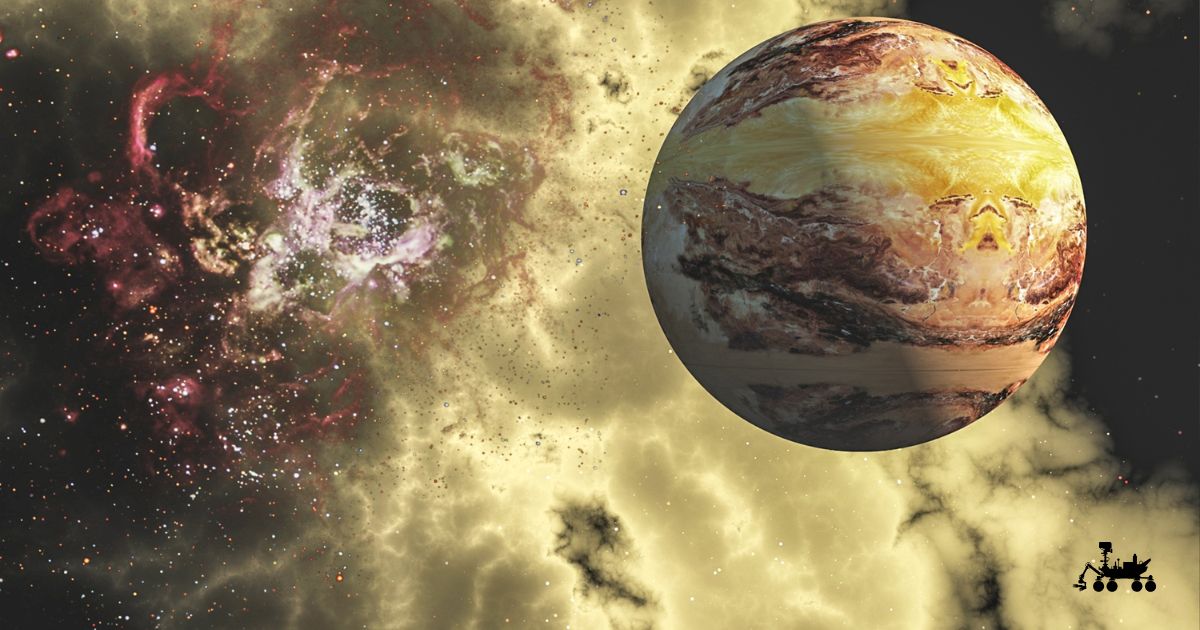
Our solar system is a familiar place. We learn about the eight planets in school, from rocky Mercury near the Sun to gassy Neptune far away. For a long time, astronomers felt they had a good map of our cosmic neighborhood. After Pluto was reclassified as a dwarf planet, the map seemed complete. We had eight major planets, a belt of asteroids, and a cold, distant region of icy objects.
But in the last decade, scientists have found clues that suggest our map is missing something. Not just a small rock, but something huge: a ninth major planet, hidden in the deep darkness far beyond Neptune. This undiscovered world is nicknamed “Planet 9,” and the search for it has become one of the most exciting hunts in modern astronomy.
This is not just a wild guess. The idea comes from hard evidence, from watching the strange behavior of other objects in the cold, dark edges of our solar system. The math suggests a large planet must be out there, pulling on these objects with its gravity. But if it is there, why can we not see it? And what would it mean if we finally found it?
What First Made Scientists Suspect a Ninth Planet?
The story of Planet 9 begins in a region called the Kuiper Belt. This is a vast, icy junkyard of comets, asteroids, and dwarf planets that orbits the Sun beyond Neptune. It is the cold, forgotten attic of our solar system. For years, astronomers have been finding small objects in this distant area. But in 2016, two astronomers from Caltech, Mike Brown and Konstantin Batygin, noticed something very strange.
They were studying the orbits of the most distant objects ever found, known as extreme trans-Neptunian objects (TNOs). They looked at a small group of about six of these TNOs and saw an amazing pattern. All of their orbits were clustered together. They were all tilted at the same angle compared to the rest of the solar system, and they all pointed in the same general direction.
This was extremely unlikely to be a coincidence. To understand why, imagine spinning six different tops on a large table. You would expect them to spin in random directions and end up in different places. If you came back and found all six tops leaning in the exact same corner of the table, you would not assume it was an accident. You would look for a cause. Maybe the table is tilted, or a fan in the corner is blowing them there. Brown and Batygin realized some invisible force, some massive object, must be “shepherding” these TNOs, pulling their orbits into this strange, aligned pattern.
They ran computer simulations to test their idea. What could cause this? The only thing that worked was a single, massive planet. When they added a ninth planet to their computer model, with a specific size and orbit, it naturally pushed all the little TNOs into the exact clustered orbits they were seeing in the real sky. The evidence was not a direct picture, but the gravitational echo of something big.
How Big and Far Away Would Planet 9 Be?
Based on the strength of its gravity, Brown and Batygin were able to create a profile of this hidden world. Their calculations suggest Planet 9 is not a small, rocky world like Earth or a gas giant like Jupiter. Instead, it is likely a “super-Earth” or a “mini-Neptune.” This means it would have a mass about five to ten times greater than the mass of our own planet.
This is especially interesting because super-Earths are one of the most common types of planets we find orbiting other stars, but our own solar system does not seem to have one. Finding Planet 9 would mean we have one after all, just hidden very far away. It would likely be a cold, gassy world with a rocky or icy core, similar to a smaller version of Uranus or Neptune.
The most mind-boggling part is its distance. Planet 9 is thought to be on a huge, stretched-out, oval-shaped orbit. At its closest point, it might be 200 times farther from the Sun than Earth is. For comparison, Neptune is only 30 times farther. At its farthest point, Planet 9 could be 600 to 1,200 times farther away than Earth. It is so far out that it would be in a realm of permanent, frozen twilight, getting almost no heat or light from our Sun.
Because it is so far away, it would move incredibly slowly. While Earth takes one year to go around the Sun, and Neptune takes 165 years, Planet 9 would take an astonishing 10,000 to 20,000 Earth years to complete a single orbit. This means that since the beginning of recorded human history, it has not even completed one full “year.”
Why Haven’t We Been Able to See It Yet?
If a planet five or ten times the size of Earth is really out there, it seems strange that we have not found it. The problem is a combination of three challenges: distance, brightness, and speed.
First, the distance is almost impossible to imagine. Because it is so far from the Sun, it receives very little sunlight. Planets do not make their own light; they only shine by reflecting light from their star. The sunlight that reaches Planet 9 would be thousands of times dimmer than the sunlight that reaches us. That faint light would then have to reflect off the planet and travel all the way back to our telescopes on Earth.
It is like trying to find a piece of charcoal in the middle of a dark forest, miles away, using only a tiny flashlight. The light is just too faint for our telescopes to easily pick up. It would be one of the dimmest objects ever found in our solar system.
Second, its slow speed makes it hard to spot. Telescopes find planets by taking pictures of the sky and looking for things that move. An asteroid or a comet moves noticeably against the background of fixed stars, sometimes even in a single night. But Planet 9 moves so slowly that it would look almost perfectly still. To see it move, astronomers would have to compare photos taken months or even years apart.
Finally, we do not know exactly where to look. While the astronomers have a “treasure map” that shows the path Planet 9 is likely on, that path is still a huge strip of the night sky. And we do not know where the planet is along that path. It is like knowing which road a car is on, but not knowing which city it is in. Searching this massive area for one extremely faint, slow-moving dot is a giant task that takes years and the most powerful telescopes on Earth.
How Are Scientists Trying to Find Planet 9 Right Now?
This is not just a theory people are talking about; there is an active, ongoing hunt. Astronomers are using some of the most powerful observatories in the world to scan the skies, hoping to be the first to capture a direct image.
One of the main telescopes used in the hunt so far has been the Subaru Telescope in Hawaii. This massive telescope can see very faint objects over a wide area of the sky. Teams of astronomers, including Batygin and Brown, have been using it to patiently scan the patches of sky where their calculations suggest Planet 9 is most likely to be. They take deep images and then return months later to the same spot, looking for anything that has moved.
But the biggest hope for the search, and the tool that has astronomers most excited, is the Vera C. Rubin Observatory. Located high in the mountains of Chile, this is a brand-new type of telescope that began its main science operations in 2025. Its mission is not to stare at one object, but to conduct a massive 10-year survey of the entire southern sky, over and over again.
The Rubin Observatory will create a giant “movie” of the night sky, cataloging billions of objects. It is designed specifically to find faint things that move or change. If Planet 9 exists and is in the southern sky, the Rubin Observatory is the perfect machine to find it. It will automatically compare new images with old ones, flagging any faint, slow-moving object that matches the description of a distant planet. Many scientists believe that if Planet 9 is out there, this observatory will either find it or prove it does not exist within the next few years.
What Are the Alternative Explanations?
Science is all about testing ideas and considering all possibilities. While the Planet 9 hypothesis is the leading explanation, it is not the only one. Some scientists are skeptical and have proposed other ideas to explain the strange clustering of the TNOs.
One possibility is called “observational bias.” This is the idea that the clustering is not real, but just an illusion caused by how we look for these objects. TNOs are incredibly faint and hard to find. Maybe we have only been able to find them when they are in one particular part of the sky, at one particular time of year. This would make it look like they are clustered, even if they are actually spread out randomly. It is like looking for ships at sea only through a small porthole; you might think all ships are in one tiny spot, but you are just not seeing the rest of the ocean.
As new telescopes find more of these objects, this idea is being tested. So far, as more TNOs have been found, the clustering pattern has mostly held up, which makes this bias argument weaker. New evidence found in 2024 and 2025 from simulations has strengthened the case that the clustering is real.
Another alternative is that there is not one big planet, but the combined gravity of many smaller objects in the Kuiper Belt that we have not discovered yet. Imagine instead of one large bowling ball tilting the table, it is thousands of small marbles, all working together. This is a complex idea, but it is possible that a “self-gravitating” disk of smaller bodies could create the pull needed. However, most models show this would require the Kuiper Belt to be much more massive than we think it is.
What Would Finding Planet 9 Mean for Us?
If an astronomer does spot that faint, slow-moving dot and confirms it is a new planet, it would be one of the biggest scientific discoveries of our lifetime. It would instantly change our most basic understanding of our own solar system.
First, it would mean we have to rewrite all the textbooks. Our solar system would officially have nine planets again. It would be a fundamental change to our map of home. It would also be the first time a new planet in our solar system was discovered not by just looking through a telescope, but by predicting its existence first using mathematics and gravity.
Second, it would help us solve major puzzles about how our solar system formed. Big planets like Planet 9 are not supposed to form that far away from their star, where there is not enough material. This leads to a fascinating theory: Planet 9 may have formed much closer to the Sun, near Jupiter and Saturn. In the chaotic early days of the solar system, a gravitational “kick” from Jupiter or Saturn could have flung this young planet out into the distant, dark orbit it has today.
Finding Planet 9 would be strong proof that this “planetary migration” happened. It would show that our solar system was once a much more violent and chaotic place, with planets being thrown around like billiard balls. It would also, finally, give us a “super-Earth” in our own backyard to study, helping us understand the thousands of similar planets we see around other stars.
What Is the Latest News on the Search in 2025?
As of 2025, Planet 9 has not been officially discovered, but the hunt is more intense than ever. The primary focus of the entire astronomical community is on the Vera C. Rubin Observatory. As it ramps up its 10-year Legacy Survey of Space and Time (LSST), every astronomer is waiting for its data. This survey is our best bet.
In the meantime, the original researchers, Batygin and Brown, have continued to refine their work. Using new data and more powerful computer simulations, they have updated their “treasure map.” They have been able to narrow down the search area and give a more precise estimate of the planet’s likely mass and brightness. This helps other telescopes, like Subaru, use their limited time more effectively, searching in the most promising locations.
There have been a few exciting “candidates” or “false alarms” over the past few years. In one case, astronomers found an object in old infrared data that seemed to be moving, but it was later shown to not be a match. These moments create excitement but also show how careful scientists must be. No one wants to announce a new planet unless they are 100 percent certain.
The general feeling in the science community is one of cautious optimism. The evidence for the clustering of the TNOs remains strong, and the Planet 9 hypothesis is still the simplest and best explanation for it. Now, it is a race against time for the telescopes to scan the sky and find the “smoking gun” — that one faint dot of light that finally confirms our solar system has a hidden member.
Conclusion
The solar system we thought we knew may be hiding a huge secret. Deep in the cold and dark, far beyond any world we have ever visited, the strange dance of icy comets points to the gravity of an unseen giant. This “Planet 9” is not a fantasy; it is a serious scientific prediction based on strong mathematical evidence.
The search for this planet is pushing our technology to its limits, forcing us to build new observatories and scan the sky with incredible patience. We do not yet know the answer. The hunt could lead us to a new planet, which would completely change our map of the cosmos. Or, it could fail, forcing us to find a new and perhaps even stranger explanation for the mysteries of the outer solar system.
For now, Planet 9 remains a ghost in the darkness, a scientific mystery waiting to be solved. It reminds us that even in our own backyard, there are still great discoveries to be made. If we do find it, it raises one simple but exciting question: What should we name it?
FAQs – People Also Ask
Is Planet 9 the same as Pluto?
No, they are very different. Pluto is a small dwarf planet with a mass much less than Earth’s moon. The “Planet 9” we are searching for is a huge, major planet, thought to be 5 to 10 times more massive than the entire Earth.
Is Planet 9 the same as Nibiru?
No. “Nibiru” is a mythical planet from conspiracy theories and has no basis in science. Planet 9 is a real scientific hypothesis based on mathematical evidence and the observed orbits of distant objects.
How did Planet 9 get its name?
The name “Planet 9” is just a simple, temporary nickname used by scientists. It was proposed by the astronomers who found the evidence for it, Mike Brown and Konstantin Batygin. If it is ever officially discovered, it will be given a formal name by the International Astronomical Union, likely from Greek or Roman mythology.
Have scientists found any new planets in our solar system recently?
No major planets have been found. We are constantly finding new dwarf planets, asteroids, and comets in the Kuiper Belt. The last major object discovered that was thought to be a planet was Pluto in 1930, but it was later reclassified as a dwarf planet.
What is a super-Earth?
A super-Earth is a type of planet that is larger and more massive than Earth, but smaller and less massive than a gas giant like Neptune. It is a very common type of planet found orbiting other stars, but we do not currently have one in our solar system.
What is the Kuiper Belt?
The Kuiper Belt is a giant, ring-shaped region of icy objects and dwarf planets (including Pluto) that orbits the Sun beyond Neptune. It is like a much larger, icier version of the asteroid belt that sits between Mars and Jupiter.
Who are Mike Brown and Konstantin Batygin?
They are both professors of planetary astronomy at Caltech (the California Institute of Technology). In 2016, they published the scientific paper that presented the mathematical evidence for Planet 9’s existence based on the clustering of objects in the Kuiper Belt.
What happens if Planet 9 is never found?
If extensive searches (like the one by the Vera C. Rubin Observatory) fail to find Planet 9, it would be a major scientific result. It would mean the Planet 9 hypothesis is wrong, and scientists would have to find a new explanation for the strange orbits of the TNOs, such as the “observational bias” or “massive disk” theories.
How long will it take the Rubin Observatory to find Planet 9?
The Vera C. Rubin Observatory began its 10-year survey in 2025. Many astronomers believe that if Planet 9 is where the calculations predict it is, the observatory could find it within the first few years of its operation, possibly by 2027 or 2028.
Could Planet 9 be dangerous to Earth?
No, not at all. Planet 9’s predicted orbit is hundreds of times farther away from us than Neptune. Its gravity is so distant that it has absolutely no effect on Earth or any of the inner planets. It is a completely safe and stable member of the distant outer solar system.