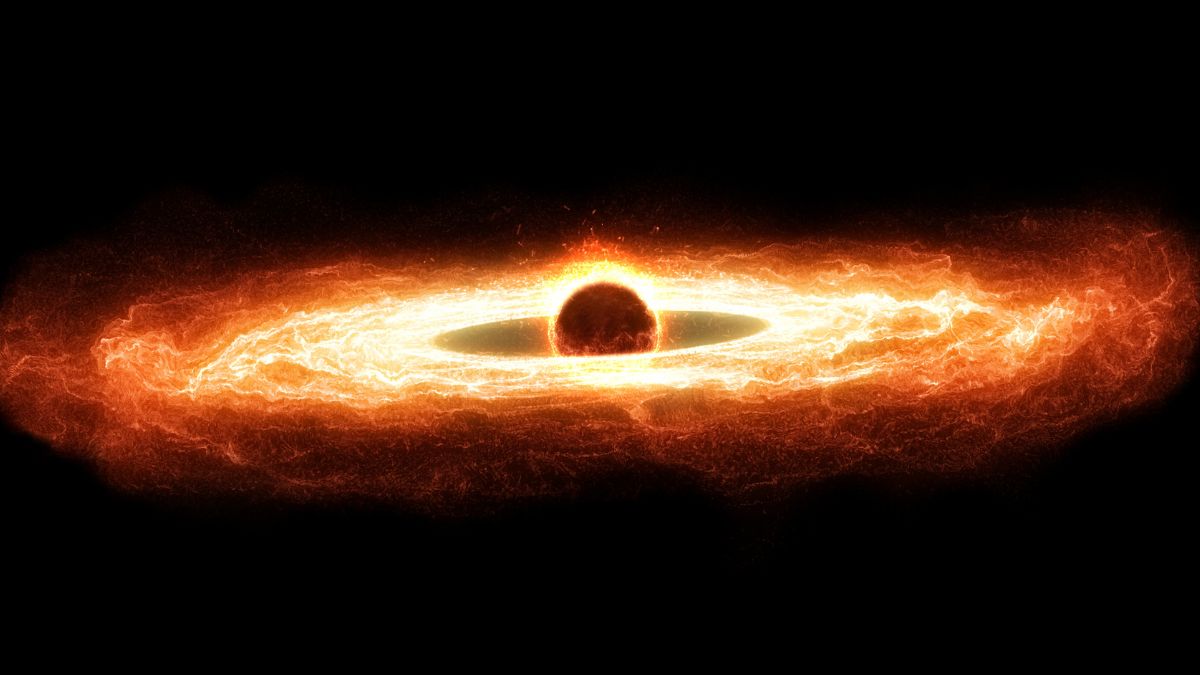
Our universe is a place of unbelievable size and filled with amazing, powerful objects. Among the strangest of all are black holes. These are not really “holes” at all, but huge amounts of matter crushed into a tiny space. Their gravity is so strong that nothing, not even light, can escape once it gets too close. Most big galaxies, including our own Milky Way, have a giant version at their center called a supermassive black hole. We thought we understood them: one giant black hole per galaxy, keeping things in order.
Then, astronomers found something that made everyone pause. It was not one, but a group of eleven supermassive black holes, all “active” and “feeding” at the same time. They were found packed together in a small patch of the early universe. This incredible discovery was given a fittingly grand nickname: the “Cosmic Himalayas.” It is one of the densest clusters of supermassive black holes ever found, and it’s challenging our ideas about how the universe grew up.
This discovery is like finding a busy city center in a place we thought was an empty desert. It raises a huge question that scientists are now scrambling to answer. These black holes are the engines of galaxies, and finding so many of them “on” at once, in one place, is not something theories had predicted. How did this massive cosmic mountain range form, and what is fueling this unbelievable gathering of giants?
What Exactly Is a Supermassive Black Hole?
Before we can understand why eleven of them are a big deal, let’s break down what one of them is. You have probably heard of black holes, and you might picture them as cosmic vacuum cleaners. The most “common” type is called a stellar-mass black hole. These are formed when a single, giant star, much bigger than our sun, runs out of fuel and collapses under its own weight. This type of black hole might be 5, 10, or 20 times the mass of our sun. They are tiny but incredibly dense.
A supermassive black hole, or SMBH, is in a completely different league. It is not 20 times the mass of our sun; it is millions or even billions of times more massive. If a stellar black hole is a bowling ball, a supermassive black hole is the size of a planet, but with the mass of an entire solar system, or more. We believe that nearly every large galaxy, including our own Milky Way, has one of these giants sitting right in its center. Our own SMBH is called Sagittarius A* (said “Sagittarius A-star”), and it has a mass of about 4 million suns.
These giants are not just sitting there. Their enormous gravity acts like an anchor for the entire galaxy. All the stars in the Milky Way, including our sun, are orbiting this central, massive object. The big mystery about SMBHs has always been: how did they get so big? Did they start small and eat a lot of gas? Did many smaller black holes merge together? Finding the “Cosmic Himalayas” gives us a powerful new clue to answering this very question. It’s like we just found a “nursery” for giant black holes.
What Did Scientists Find in the ‘Cosmic Himalayas’?
An international team of astronomers, using some of the most powerful telescopes on and off the planet, made this discovery. They were not just looking at a random patch of sky. They were peering deep into the distant, early universe. Because light takes time to travel, looking far away is like looking back in time. The “Cosmic Himalayas” structure is so far away that we are seeing it as it was 10.8 billion years ago. The universe was only about 3 billion years old at the time, still in its youth.
What they found was a structure containing eleven galaxies. This was already interesting, as it showed a place where galaxies were starting to clump together. But the real shock came when they looked closer at the center of each of these eleven galaxies. Each one was home to a supermassive black hole, and all eleven of them were “active.” This means they were not quiet or dormant. They were all in the middle of a massive feeding frenzy, swallowing huge amounts of gas and dust.
This feeding process is what allowed scientists to see them. As material falls toward a black hole, it speeds up, heats up to millions of degrees, and shines brighter than all the stars in the galaxy combined. This super-bright, feeding black hole is called a quasar, or an Active Galactic Nucleus (AGN). The team used Japan’s Subaru Telescope in Hawaii to find the galaxies and then used NASA’s Chandra X-ray Observatory, which orbits the Earth, to spot the high-energy X-rays pouring out from these 11 feeding black holes. Finding one quasar is common. Finding two near each other is rare. Finding eleven, all active at the same time in a small area, was a record-breaking discovery.
Why Is Finding 11 of These Together So Surprising?
Finding eleven supermassive black holes is not surprising on its own. We think almost all galaxies have one. The surprise is finding eleven active ones, all clustered together. Think of it this way: a supermassive black hole is like a giant volcano. Most of the time, it’s dormant, just sitting there, like the one in our own galaxy. But sometimes, it erupts. For a black hole, an “eruption” is when a large amount of gas or a star gets too close and falls in. This is the “active” or “quasar” phase. This phase is actually very short, maybe only a few million years, which is a blink of an eye in the life of a galaxy.
Because this active phase is so short and random, the chances of seeing two neighboring galaxies both have their black holes erupting at the exact same time are very low. The chances of seeing eleven of them doing it at once, all in the same cosmic neighborhood, is almost unbelievable. It’s like walking down a single street and seeing eleven different houses on fire at the exact same moment. You would know it was not a coincidence. Something must have caused all those fires to start at the same time.
This is the puzzle of the “Cosmic Himalayas.” This discovery breaks our old models that said black holes feed randomly. It tells us that in certain special places in the universe, the “on” switch for black holes can be flipped for an entire neighborhood at once. This suggests there is a much larger, invisible structure that is force-feeding all eleven of these black holes at the same time. It’s not a series of accidents; it’s a system.
How Does This Discovery Connect to the ‘Cosmic Web’?
The “something” that is feeding all these black holes is thought to be the “Cosmic Web.” This is one of the biggest and most amazing concepts in all of astronomy. On the largest possible scale, the universe is not just a random spray of galaxies. Instead, it is organized into a gigantic, sponge-like or web-like structure. This structure is made of long, invisible filaments of dark matter and hydrogen gas that stretch for billions of light-years across the entire cosmos. These filaments connect and crisscross, leaving huge, almost empty “voids” in between them.
You can picture it like a spider’s web. The long, sticky threads are the filaments. Where the threads intersect, you get a dense, heavy knot. Galaxies, like our Milky Way, tend to form along these long filaments, like beads of dew on a spider’s silk. But the truly massive structures, the giant clusters of thousands of galaxies, only form at the “nodes” or “intersections” where multiple filaments come together. These nodes are the cosmic crossroads, and they are the places where matter is most concentrated in the universe.
The “Cosmic Himalayas” is one of these super-dense nodes. It is a place where several massive filaments of the cosmic web are crashing into each other. This collision is funneling unbelievable amounts of gas—the food for black holes—down these filaments and into this one small region. This is the “common cause” that scientists were looking for. These eleven galaxies are not just randomly lighting up; they are all located inside this massive cosmic “gas station” that is force-feeding their central black holes all at once.
What Does This Tell Us About the Early Universe?
This discovery is like finding a photograph of the universe as a “teenager.” Because we are seeing it 10.8 billion years in the past, we are getting a snapshot of how the biggest structures in the universe first got started. We call a young, forming galaxy cluster like this a “protocluster.” It’s the “construction site” for what will later become a giant, mature galaxy cluster. And this construction site is far busier and more advanced than we expected.
For a long time, scientists had a puzzle. When we look at the universe today, we see gigantic, “finished” galaxy clusters that are incredibly massive. When we tried to model how they formed, it was hard to get them to grow that big in the 13.8 billion years the universe has been alive. It seemed like they must have had a “head start.” The “Cosmic Himalayas” is the first clear picture of that head start. It shows us that in these dense nodes of the cosmic web, the process of building galaxies and growing black holes was happening on fast-forward.
It proves that the environment where a galaxy is born matters. A galaxy forming in a quiet, “suburban” filament of the cosmic web (like our Milky Way) grows slowly and quietly. But a galaxy born in the “downtown” intersection of a protocluster (like these eleven) grows up in a chaotic, gas-rich, violent environment. This discovery confirms that the very first “cities” of the universe were built much faster and were much more extreme than we ever thought, powered by the cosmic web.
How Do So Many Black Holes Grow So Big, So Fast?
This discovery helps us answer the biggest question about supermassive black holes: how did they get so big, so quickly, in the early universe? The “Cosmic Himalayas” shows us two main processes working together in overdrive.
The first process is galaxy mergers. In a such a crowded protocluster, these eleven galaxies are not staying politely separate. They are moving rapidly and are constantly crashing into and merging with each other. When two galaxies merge, their two central supermassive black holes will eventually spiral in and merge too, forming one even more massive black hole. This chaotic “monster-mash” is a quick way to build up mass. The “Cosmic Himalayas” is a region where these mergers are happening over and over again.
The second, and perhaps more important, process is the one we already mentioned: the cosmic web. The sheer amount of cold gas being funneled into this node is staggering. This gas acts as a direct fuel line. It flows from the web, into the galaxies, and straight down to their central black holes. This is called “cold gas accretion,” and it’s like pumping high-octane fuel directly into an engine. So, these black holes are not just growing by eating each other; they are also growing by feasting on a nearly endless buffet of gas supplied by the cosmic web. The “Cosmic Himalayas” is a perfect storm where both giant mergers and massive gas flows are happening at the same time.
What Happened to the ‘Cosmic Himalayas’ Today?
It’s important to remember that we are seeing this structure as it was 10.8 billion years ago. So, what would we see if we could travel to that same spot in the universe today? It would look completely different. Those eleven galaxies, and probably hundreds more that were in the same protocluster, would have spent the last 10.8 billion years merging. All that chaos and activity we see in the “snapshot” was the process of construction.
Today, that structure would almost certainly be a single, gigantic, mature galaxy cluster. It would be one of the largest and most massive objects in the entire universe. Instead of eleven separate galaxies, we would likely see one “Brightest Cluster Galaxy,” or BCG. This is a super-galaxy, the largest in the universe, that forms at the center of a cluster after it has “eaten” all of its neighbors.
And at the heart of that one super-galaxy? We would find the “winner.” Those eleven supermassive black holes would have merged over billions of years. They would have combined to form one of the most terrifying objects imaginable: an ultramassive black hole. This single object could have the mass of 10, 20, or even 50 billion suns. The “Cosmic Himalayas” discovery is so important because it’s not just showing us something strange. It is showing us the “birth” of one of the universe’s greatest monsters, which is now fully grown in our modern universe.
Conclusion
The “Cosmic Himalayas” discovery is a perfect example of how exciting and mysterious space still is. By finding eleven supermassive black holes all “lit up” at once in the early universe, astronomers have opened a new window into our cosmic past. This isn’t just a random freak event; it’s a key piece of the puzzle. It shows us that the universe is built on a vast, invisible “cosmic web” that acts like a scaffolding.
This discovery confirms that at the busy intersections of this web, the “protoclusters,” the growth of galaxies and their black holes happened at a furious, super-fast pace. These regions were force-fed enormous amounts of gas, causing their central black holes to light up as quasars and grow to giant sizes much earlier than we thought possible. We are, in effect, watching the “construction phase” of what is today one of the largest structures in the universe.
This new understanding changes how we see our own place in the cosmos. Our Milky Way grew up in a quiet neighborhood, but other galaxies were born in the heart of a cosmic metropolis. As we build even more powerful telescopes, what other ‘cosmic mountain ranges’ are waiting to be discovered in the dawn of time?
FAQs – People Also Ask
What is the official name of the ‘Cosmic Himalayas’ discovery?
The “Cosmic Himalayas” is a descriptive nickname given by the researchers. The structure itself is a protocluster, or a forming galaxy cluster, located in a field of the sky that astronomers have studied, but the nickname is used to describe the “peak” of activity with 11 quasars.
How far away is the ‘Cosmic Himalayas’ black hole cluster?
The structure is about 10.8 billion light-years away from Earth. This means the light from these 11 black holes traveled for 10.8 billion years to reach us. We are seeing this structure as it existed when the universe was only about 3 billion years old.
How can scientists see black holes if they are black?
Scientists cannot see the black hole itself, as its gravity traps all light. Instead, they see the effects of the black hole on the material around it. As gas and dust are pulled toward the black hole, they form a spinning “accretion disk” that heats up to millions of degrees and shines intensely, releasing huge amounts of light, especially X-rays. This is what we see as a quasar or active galactic nucleus.
Are these 11 black holes dangerous to Earth?
No, they are not dangerous to us at all. They are incredibly far away, at 10.8 billion light-years. The distance is so vast that their gravity or radiation has no effect on our solar system or galaxy. They are simply objects for us to study to learn about the early universe.
What is the difference between a black hole and a quasar?
A supermassive black hole is the object itself: a huge mass in a small space. A quasar is the event that happens when that black hole is actively “feeding.” When a black hole is not eating, we call it “dormant.” When a large amount of gas falls into it, the material heats up and shines brightly, and we call this bright, active object a quasar.
What is dark matter and how does it relate to the cosmic web?
Dark matter is a mysterious, invisible substance that makes up about 85% of all matter in the universe. We cannot see it, but we know it exists because we can detect its gravity. The cosmic web is like the “scaffolding” of the universe, and it is made almost entirely of this dark matter. The gravity of the dark matter is what pulls in the regular gas and forms the filaments and nodes where galaxies are born.
Will our Milky Way galaxy’s black hole ever become a quasar?
Yes, it is possible. Our black hole, Sagittarius A*, is mostly dormant or quiet right now. However, if a large gas cloud or a star were to drift too close, it would be torn apart and begin to fall in. This would cause our black hole to “turn on” and light up as an active galactic nucleus. This has likely happened many times in the Milky Way’s past.
How many supermassive black holes are in the universe?
Scientists believe that nearly every large galaxy in the observable universe has a supermassive black hole at its center. Since there are estimates of hundreds of billions, or even trillions, of galaxies, there are likely at least hundreds of billions of supermassive black holes.
What telescopes were used to find the ‘Cosmic Himalayas’?
This discovery was made by combining data from several telescopes. The Subaru Telescope, an 8.2-meter optical-infrared telescope in Hawaii, was used to observe the area and find the distant galaxies. Then, NASA’s Chandra X-ray Observatory, a space telescope orbiting Earth, was used to detect the high-energy X-rays coming from the actively feeding black holes, confirming they were quasars.
Could there be more than 11 black holes in this cluster?
It is very likely. The 11 black holes that were found are the ones that were “active” and shining as quasars at that specific moment. There were probably many other galaxies in the same protocluster that also had supermassive black holes, but those black holes just happened to be “dormant” or “sleeping” when we took the picture.