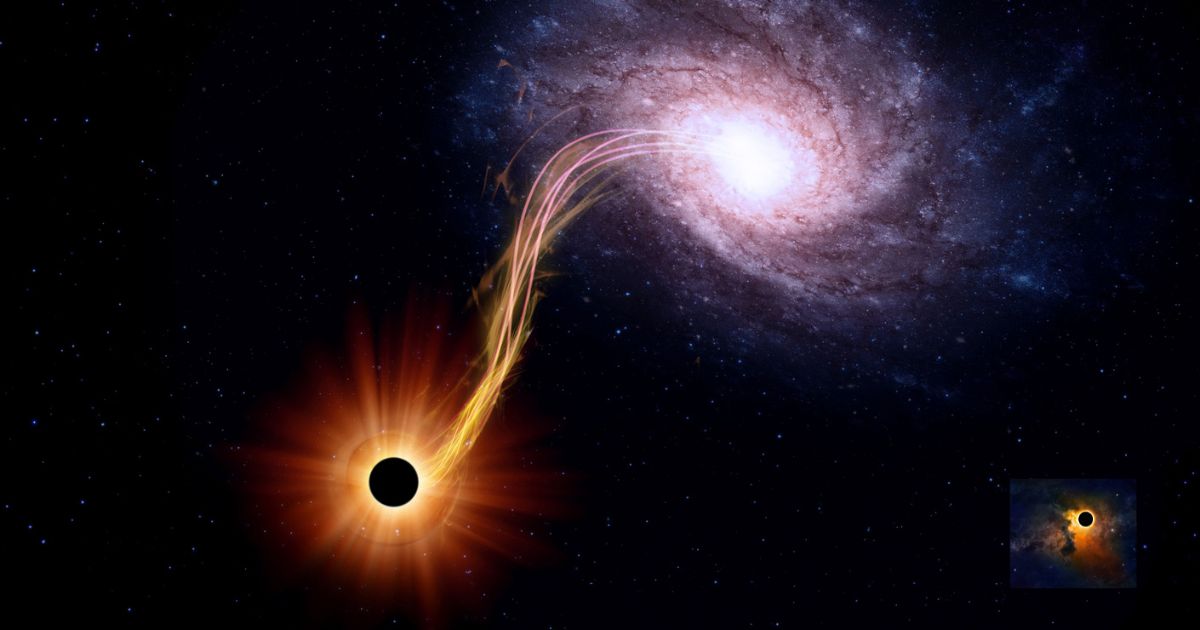
Space is full of incredible, powerful objects that challenge what we think we know about physics and reality. Among these wonders are black holes, which are regions of spacetime where gravity is so strong that nothing, not even light, can escape. We know our own Milky Way galaxy has a supermassive black hole, Sagittarius A* (pronounced “Sagittarius A-star”), right at its heart. This giant is millions of times the mass of our Sun, yet it mostly sits quietly, like a sleeping giant.
But for decades, scientists have also been tracking a different kind of powerful signal coming from the general direction of our galaxy’s center. This signal isn’t just X-rays or radio waves; it’s a very specific kind of gamma-ray energy. These gamma rays are the telltale sign of annihilation, a process where matter and antimatter meet and destroy each other, turning into pure energy. Because this source is so intense and creates so much of this antimatter-matter collision energy, astronomers gave it a truly dramatic nickname: The Great Annihilator. This name hints at an object with incredible, destructive power, maybe even one that is a massive black hole close to the core of our galaxy. It raises a huge question for us: is this “Annihilator” the same as the supermassive black hole we already know, or is it a completely different, mysterious celestial body lurking nearby?
Understanding what this Great Annihilator is helps us figure out where all the antimatter in our galaxy comes from and what kind of extreme objects are truly out there. Since we know Sagittarius A* is the only supermassive black hole at the center, the existence of another nearby, incredibly active source suggests a distinct and fascinating object. So, what exactly is this intense gamma-ray emitter, and is it truly a second, major black hole situated right on the doorstep of our galaxy’s core?
What Exactly Is the Great Annihilator and Where Does It Come From?
The Great Annihilator is an astronomical object officially known by the catalog name 1E 1740.7-2942. This is a much less exciting name, of course, but it helps scientists pinpoint its exact location. It was discovered because it is an extremely strong and variable source of 511 keV gamma-rays. The “keV” stands for kilo-electron volt, which is a unit of energy, and $511$ keV is the precise energy signature released when an electron meets its antimatter twin, a positron, and they annihilate. The Great Annihilator produces a massive, time-variable stream of these photons, meaning it’s creating and ejecting enormous amounts of positrons, which then crash into nearby electrons in space, creating the signature energy blast. The object itself is not the annihilation event; rather, it is the powerful engine that creates the antimatter in the first place. Astronomers realized that this object could produce about $10^{43}$ positrons every second, which is why it earned its fearsome nickname for being the strongest compact annihilation source known in our entire galaxy at the time of its discovery.
Is the Great Annihilator the Same as Sagittarius A*?
No, the Great Annihilator is not the same as the supermassive black hole Sagittarius A* (Sgr A*) at the very center of the Milky Way. Scientists have been able to pinpoint the location of the Great Annihilator, 1E 1740.7-2942, and found that it is actually located a few hundred light-years away from Sgr A* in the general direction of the Galactic Center. While it is certainly nearby in cosmic terms, it is a completely separate object. This distinction is crucial because Sgr A* is a supermassive black hole, with a mass millions of times that of the sun. The Great Annihilator, on the other hand, is believed to be a much smaller, stellar-mass black hole. This means it was formed from the collapse of a single, massive star. Stellar-mass black holes are the most common type, typically weighing in at anywhere from five to a few tens of times the mass of our Sun. The Annihilator is also an active system, constantly flaring and changing its output, while Sgr A* is generally very quiet, only occasionally flaring up.
What Type of Cosmic Object Is 1E 1740.7-2942?
Current evidence strongly suggests that the Great Annihilator, 1E 1740.7-2942, is a type of system called an X-ray binary, specifically a microquasar. A binary system means it’s made up of two objects orbiting each other. In this case, one object is a stellar-mass black hole—the Annihilator itself—and the other is a companion star. The black hole’s immense gravity is actively pulling material, such as gas and dust, away from its nearby companion star. This stolen material doesn’t fall straight into the black hole; instead, it swirls around it, forming a superheated, bright, flat structure called an accretion disk. This disk is the source of the incredibly bright X-ray emissions that first allowed the object to be discovered.
The “microquasar” part of the description refers to the fact that this X-ray binary is so powerful it acts like a miniature version of a quasar, which are the extremely bright cores of distant, young galaxies. The Great Annihilator produces powerful, narrow beams of superheated plasma that shoot out from the poles of the black hole’s accretion disk at incredible speeds, close to the speed of light. These beams are called relativistic jets, and they are the likely mechanism responsible for creating and launching the massive quantities of positrons that lead to the “annihilation” gamma-ray signature.
How Does a Stellar-Mass Black Hole Create Antimatter Positrons?
The creation of the vast amounts of antimatter in the form of positrons is directly linked to the black hole’s relativistic jets. The environment right around the stellar-mass black hole and its accretion disk is unimaginably extreme. The gas and plasma in the accretion disk are heated to millions of degrees as they spiral inward, and the black hole’s magnetic field lines become highly twisted. This intense energy, combined with strong magnetic fields, accelerates particles to nearly the speed of light, and they are channeled into the narrow, focused jets shooting away from the black hole.
Within these jets, the energy is so high that photons (light particles) can collide with each other or with magnetic fields to spontaneously create pairs of particles: a regular electron and its antimatter counterpart, a positron. This is known as pair production. The powerful jets then launch these newly created positrons out into the surrounding interstellar medium. As these high-speed positrons slow down and eventually encounter normal electrons that are floating in the gas and dust of the galaxy, the particles annihilate, releasing the distinctive $511$ keV gamma-ray light that we can detect with our space telescopes. This constant, high-speed ejection of antimatter is what makes the Great Annihilator so unique and fascinating.
What Is the Significance of the Annihilation Line Energy?
The significance of the annihilation line energy being exactly $511$ keV is profound because it’s a pure, fundamental signal of physics in action, confirming the presence of antimatter in space. In the famous equation $E=mc^2$, mass can be converted into energy. The $511$ keV value is precisely the energy equivalent of the rest mass of an electron (or a positron). When a positron and an electron meet, their entire mass is converted into energy, and this energy leaves as two gamma-ray photons, each carrying exactly half of the total mass-energy, or $511$ keV.
This narrow, precise line in the gamma-ray spectrum acts as a fingerprint for the annihilation process. If the gamma rays had a slightly different energy, they would point to a different physical process, like a supernova explosion or the decay of a radioactive element. Because the line is so sharp, scientists know they are observing the clean, direct conversion of mass to energy from the collision of subatomic particle and antiparticle pairs. It is one of the few ways we can be sure we are observing antimatter in the distant cosmos. The fact that the Great Annihilator shows a broad and sometimes redshifted $511$ keV line suggests the annihilation is happening very close to the black hole, in a violently turbulent and energetic region.
How Does the Great Annihilator Compare to Other Black Holes in the Milky Way?
The Great Annihilator stands out from most other black holes in the Milky Way, mainly because of its incredibly powerful, antimatter-generating jets. Our galaxy is thought to contain millions of stellar-mass black holes, but most of them are “silent”; they are not actively pulling in matter and therefore aren’t emitting much light. Even the biggest black hole, Sagittarius A*, is currently considered a relatively quiet, sleeping supermassive giant.
The Great Annihilator, being a microquasar, belongs to a rare class of active black holes. Compared to other X-ray binaries, the Great Annihilator is one of the most luminous and powerful X-ray sources in the entire region of the Galactic Center. It is also particularly notable because its jets are thought to be pointed almost directly toward Earth, meaning we get an intense, straight-on view of the particle acceleration and positron creation. This unique alignment and extreme activity make it a prime, one-of-a-kind laboratory for studying how black holes create and launch matter and antimatter across cosmic distances.
Why Is This Discovery Important for Understanding Our Galaxy’s History?
The discovery and study of the Great Annihilator are immensely important because they help us solve the long-standing mystery of the origin of the Galactic Center’s positron excess. For many years, telescopes have detected a large, diffuse cloud of $511$ keV annihilation radiation that spreads across the central bulge of the Milky Way. It was clear that a constant supply of positrons was needed to sustain this cloud, but the source remained unknown.
Potential sources included radioactive decay from supernovae, cosmic ray interactions, or even the annihilation of dark matter particles. However, the Great Annihilator, with its immense and variable positron output, provides a concrete, powerful source that can at least partially explain the origin of this positron cloud. It shows us that stellar-mass black holes, particularly active ones like this microquasar, are crucial engines for creating and distributing antimatter throughout the galaxy’s central region. By figuring out how much of the total positron cloud comes from this single black hole system, scientists can narrow down the search for other sources, giving us a clearer, more complete picture of the extreme physics and chemical history that has shaped our galactic core over billions of years.
Conclusion
The object nicknamed the Great Annihilator is a spectacular example of extreme physics in our own galactic backyard. Far from being the supermassive black hole at the core, it is a separate, intensely active stellar-mass black hole system known as a microquasar. Its official name is 1E 1740.7-2942, and it earns its fearsome title by being an extraordinary engine for antimatter. By siphoning material from a nearby star and channeling it into powerful, focused jets, this black hole creates and launches a massive stream of positrons, which then annihilate with normal matter to produce the signature $511$ keV gamma-rays that we detect. The Great Annihilator is not just a fascinating object; it is a key piece in the puzzle of understanding where antimatter comes from and how active stellar-mass black holes influence the extreme environment of the Milky Way’s central region. What other equally powerful, un-nicknamed cosmic engines might still be hidden in the dense, dusty heart of our galaxy, waiting to be discovered?
FAQs – People Also Ask
Is the Great Annihilator a real black hole?
Yes, the Great Annihilator is considered a real black hole, specifically a stellar-mass black hole. This means it is the collapsed remnant of a star that was once much more massive than our sun. Its classification as a black hole is based on its extreme gravity and the way it actively pulls matter from its companion star to form a swirling accretion disk, which then powers its powerful X-ray and gamma-ray emissions. The energy output and spectral characteristics of the system strongly align with the known behavior of other stellar-mass black hole candidates in binary systems, which is the final stage in the life of a giant star.
How big is the Great Annihilator black hole?
The Great Annihilator is believed to be a stellar-mass black hole, which means its size is relatively small compared to the supermassive one at the galactic center. Stellar-mass black holes typically have a mass between about five and twenty times the mass of the Sun. This means that its event horizon—the point of no return—would only be a few tens of kilometers across. While its mass is large, its physical size is tiny, making it one of the most compact and dense objects in the universe. This small size is what allows it to pull in matter so efficiently and create such a violently energetic environment.
What is the difference between a black hole and a microquasar?
A black hole is the dense, collapsed object itself, defined by its extreme gravity. A microquasar is an entire system that contains a stellar-mass black hole (or sometimes a neutron star) actively feeding on a companion star. The “quasar” part of the name refers to the system’s ability to create powerful, high-speed jets of plasma. Therefore, the Great Annihilator is an object (a stellar-mass black hole) that is part of a system (a microquasar) and the nickname refers to the system’s active annihilation process. The microquasar description focuses on the intense energy and jet activity of the entire binary system, not just the black hole.
What is the $511$ keV gamma-ray line?
The $511$ keV gamma-ray line is a specific, precise energy of light that is a fingerprint of electron-positron annihilation. When a matter particle (an electron) and an antimatter particle (a positron) meet and destroy each other, their entire mass is converted into energy, and this energy is released as two gamma-ray photons, each carrying exactly $511$ kilo-electron volts of energy. Detecting this line in space is one of the clearest pieces of evidence that antimatter is being created somewhere in that region. Scientists use this line to map out the distribution and source of positrons in our Milky Way galaxy.
How far away is the Great Annihilator from Earth?
The Great Annihilator, 1E 1740.7-2942, is estimated to be approximately $16,000$ light-years away from Earth. This places it in the direction of the center of our Milky Way galaxy, which is about $26,000$ light-years away from us. Because it is closer than the true Galactic Center, it is not actually at the core, but rather is positioned along our line of sight toward the core, in one of the inner spiral arms of the galaxy. Its location near the dense, crowded inner region of the Milky Way is what gives it access to the gas and dust needed to feed its energetic, antimatter-creating activity.
Do black hole jets create antimatter often?
Yes, the jets produced by actively feeding black holes and neutron stars are thought to be common sources of antimatter production, especially positrons. The extreme energy and magnetic fields within the relativistic jets of microquasars, like the Great Annihilator, provide the perfect conditions for the spontaneous creation of electron-positron pairs from high-energy light. While the Great Annihilator is particularly famous for this, it is an important mechanism in high-energy astrophysics, suggesting that many other active black holes throughout the universe may be contributing to the general background of antimatter in space.
Is the Great Annihilator an active galactic nucleus?
No, the Great Annihilator is not an Active Galactic Nucleus (AGN). An AGN is the term used for the incredibly bright, highly active core of a galaxy powered by its supermassive black hole, like the core of the Andromeda galaxy or a distant quasar. The Great Annihilator, however, is a relatively small microquasar system located within our own galaxy, the Milky Way, and it is powered by a much smaller stellar-mass black hole. Although both AGNs and microquasars have accretion disks and powerful jets, the scale of an AGN is billions of times larger and their total energy output is vastly greater than a microquasar.
Does the Great Annihilator pose a danger to Earth?
No, the Great Annihilator poses no danger to Earth. While the name sounds threatening and it is an incredibly powerful system, it is simply too far away for its radiation or jets to have any negative effect on us. The distance of $16,000$ light-years ensures that any radiation we detect has been drastically weakened by the time it reaches our solar system. We are completely safe from its effects, and it serves only as a spectacular, distant natural laboratory for studying the extremes of particle physics and gravity in space.
Why is a black hole called an ‘annihilator’?
A black hole is called the ‘Annihilator’ not because the black hole itself is destroying matter in the way we might think, but because it is the power source for the creation of antimatter. When scientists discovered the object, they realized it was responsible for an incredibly powerful, variable stream of $511$ keV gamma rays, which is the direct energy signature of matter-antimatter annihilation. The black hole’s energy output, channeled through its jets, is what generates the positrons that then annihilate with regular matter, thus earning the entire active system the dramatic and memorable nickname.
Is the Great Annihilator still active in 2025?
Yes, the Great Annihilator is considered an active system in 2025, although like many black hole binary systems, its brightness and activity are variable. It goes through periods of increased luminosity and jet activity, and times where it is much quieter, as the black hole’s feeding rate from its companion star changes. Astronomers continue to monitor 1E 1740.7-2942 using powerful space-based telescopes, as its changing behavior provides important clues about the physics of accretion disks and relativistic jets around stellar-mass black holes.