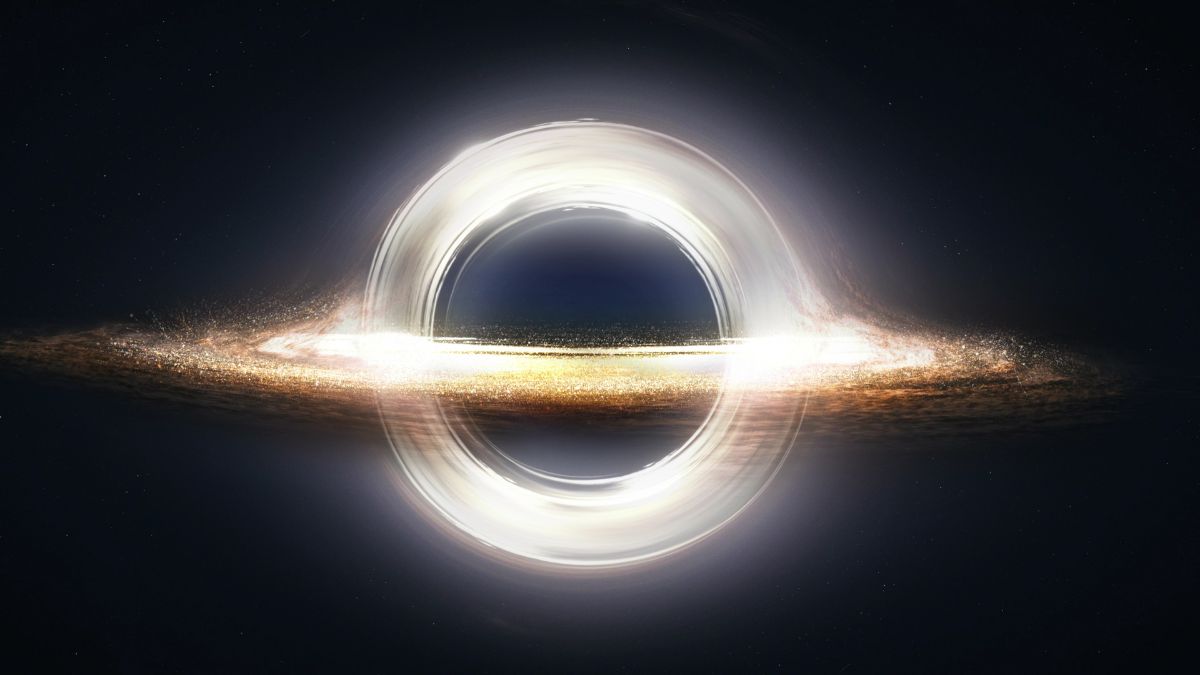
Black holes are some of the most fascinating objects in the entire universe. In simple terms, a black hole is a place in space where gravity is so strong that nothing, not even light, can escape once it gets too close. This intense gravity comes from a huge amount of matter being squeezed into an incredibly tiny space. They are a natural part of the universe, and we are learning more about them all the time.
When we say a black hole is “dangerous,” it’s important to know what that means. They are not cosmic vacuum cleaners that go around sucking up everything in space. You have to get very, very close to one to be in trouble. For astronomers, “dangerous” can mean a few different things. It might be dangerous because it’s very close to us (in cosmic terms). It could be dangerous because it is extremely active, shooting out powerful jets of energy or ripping apart nearby stars. Or, it could be “dangerous” simply because it is so mind bogglingly huge that it challenges our understanding of the cosmos.
Scientists have found many black holes, and each one teaches us something new. Some are small and quiet, while others are giants that dominate their galaxies. We are going to explore five of the most extreme and “dangerous” black holes that humanity has discovered so far. So, what are the most extreme examples we’ve found in the cosmic neighborhood and beyond?
What exactly is a black hole?
Before we look at the top five, let’s quickly understand what a black hole is. Think of it like a valley that is infinitely deep. The edge of this valley is called the event horizon. This is the “point of no return.” As long as you stay outside the event horizon, you could orbit a black hole safely, just like we orbit the sun. But if you cross that line, you can never get back out. The gravity is just too strong. At the very center of the black hole is a point called the singularity. This is where all the matter that fell into the black hole is crushed into a point of zero size and infinite density.
There are two main types of black holes that we know about. The first type is a stellar-mass black hole. These are very common. They form when a very massive star, much bigger than our sun, runs out of fuel. The star’s core collapses under its own gravity, and this collapse is so violent it causes a huge explosion called a supernova. The outer parts of the star are blasted into space, but the core keeps crushing down until it becomes a black hole. These “smaller” black holes are typically 5 to 100 times the mass of our sun.
The second type is the supermassive black hole. These are the true giants of the universe. They are millions or even billions of times more massive than our sun. Scientists have found that almost every large galaxy, including our own Milky Way, has one of these giants sitting right at its very center. We are still learning exactly how they get so big. They may have formed from the collapse of giant gas clouds in the early universe and have been growing ever since by swallowing gas, dust, and even stars that get too close.
How do scientists even find these ‘dangerous’ black holes?
This is a great question because black holes are, by definition, black. They are invisible because they trap all light. So, scientists have to be clever and look for them in other ways. They find black holes by observing their effect on the things around them. There are a few main methods that astronomers use to hunt them down.
One of the most common methods is to watch the stars. If a star is orbiting something that we cannot see, and that invisible “something” has a very strong gravitational pull, it is a very good clue that there is a black hole. By measuring the star’s speed and the shape of its orbit, astronomers can calculate the mass of the invisible object. If the mass is more than three times the mass of our sun and it is not shining, it has to be a black hole. This is how we found the black hole at the center of our own galaxy and the one closest to Earth.
Another way is to look for X-rays. While a black hole itself is dark, the area around it can be one of the brightest places in the universe. This happens when a black hole is in a binary system (paired with a normal star). The black hole’s powerful gravity can pull gas and matter off its companion star. This material does not fall straight in. Instead, it forms a flat disk around the black hole, called an accretion disk. The material in this disk spins around the black hole at incredible speeds, getting hotter and hotter from friction. It can reach millions of degrees, causing it to glow brightly in X-ray light, which our space telescopes can see.
Sometimes, a black hole does more than just glow. When a supermassive black hole is feeding very quickly, it can get messy. The intense magnetic fields around the spinning black hole can grab some of the infalling matter and shoot it back out into space. These are called relativistic jets. They are giant streams of particles and energy traveling at nearly the speed of light, and they can be thousands or even millions of light years long. When we see these giant jets, we know a supermassive black hole is at their base.
A fourth method is called gravitational lensing. Albert Einstein showed that gravity can bend space itself. This means a massive object, like a black hole, can bend the path of light, acting like a magnifying glass. If an invisible black hole passes in front of a distant star, its gravity will bend the star’s light, making the star appear to brighten and then fade in a very specific way. This “microlensing” effect is how astronomers are starting to find “rogue” black holes that wander through space all by themselves.
Finally, we can now “hear” black holes. When two black holes spiral into each other and merge, they send out powerful ripples in the fabric of space and time. These are called gravitational waves. In 2015, the LIGO and Virgo observatories detected these waves for the first time, opening up a brand new way to study the universe and confirm the existence of these amazing objects.
How ‘dangerous’ is the closest black hole, Gaia BH1?
Our first “dangerous” black hole gets its title not from its size, but from its location. This is Gaia BH1, the closest-known black hole to Earth. Discovered in 2022 by the Gaia space telescope, this black hole is located about 1,560 light years away in the constellation Ophiuchus. In cosmic terms, that is in our backyard. It is so close that we can consider it part of our local neighborhood in the Milky Way galaxy.
So, how dangerous is it to us? The good news is: it is not a threat at all. At 1,560 light years away, we are far too distant to ever feel its gravity. Remember, black holes are not vacuum cleaners. If our sun was magically replaced by a black hole of the same mass, Earth would not get sucked in; it would just keep orbiting the black hole in the dark. Gaia BH1 is “dangerous” in the sense that it is the closest confirmed black hole to our planet. Its discovery proves that these objects are scattered all over thegalaxy, and we are only just beginning to find them.
Gaia BH1 is a stellar-mass black hole, weighing in at about 10 times the mass of our sun. It is part of a binary system, meaning it is not alone. It has a companion star, similar in size to our sun, that orbits it. This black hole is also “dormant,” which means it is not actively pulling material from its companion star. It is not glowing in X-rays. Scientists found it using the first method we discussed: they watched its companion star “wobble” in a way that could only be explained by a 10-solar-mass invisible partner.
The discovery of Gaia BH1 was a big deal. For a long time, scientists were not sure how a system like this—a normal star and a black hole—could even form. Its existence has sent theorists back to the drawing board. And it is not alone. In 2024, astronomers using the same Gaia data found Gaia BH3, which is the second-closest black hole (about 2,000 light years away) but holds the record for the most massive stellar black hole found in our galaxy, at 33 times the mass of the sun. These “Gaia” black holes show us that our galaxy is filled with sleeping giants, and we are just now learning how to find them.
What makes Cygnus X-1 a ‘vampire’ black hole?
Our next black hole is famous for being one of the first ones ever confirmed. It is called Cygnus X-1, and it is a perfect example of an active black hole. This is our “vampire” black hole, and its danger comes from its violent behavior. Located about 7,300 light years away, it is also relatively close to us within the Milky Way.
Cygnus X-1 was discovered back in the 1960s, not with a regular telescope, but with X-ray detectors flown on rockets. Astronomers found a spot in the Cygnus constellation that was blasting out an incredible amount of X-rays. When they pointed optical telescopes there, they found a massive, blue supergiant star. But the star alone could not produce those X-rays. They realized the star was orbiting an invisible companion, and that companion was the source of the X-rays.
This is where the “vampire” nickname comes from. Cygnus X-1 is a stellar-mass black hole with a mass of about 21 times our sun. Its companion is a giant star about 30 times the mass of our sun. The black hole is so close to this giant star that its powerful gravity is literally sucking the outer layers of gas off the star. This stolen material forms a swirling, superheated accretion disk around the black hole. As the gas spirals inward at unbelievable speeds, it heats up to millions of degrees and shines intensely in X-rays. Cygnus X-1 is one of the brightest and most persistent X-ray sources in our entire sky.
The discovery of Cygnus X-1 was so strange at the time that it led to a famous scientific bet between physicists Stephen Hawking and Kip Thorne in 1974. Hawking bet that the object was not a black hole, while Thorne bet that it was. Hawking was playing it safe, as he noted that if it was not a black hole, our understanding of physics would be even more confused. By the 1990s, the evidence was so overwhelming that Hawking conceded the bet, admitting that Cygnus X-1 was indeed a black hole. Its danger is very real, but only to its poor companion star, which is being slowly eaten alive.
What is special about Sagittarius A*, our galaxy’s giant?
Now we move up in scale from the stellar “vampires” to the supermassive giants. Our third “dangerous” black hole is Sagittarius A* (pronounced “Sagittarius A-star,” or “Sgr A*” for short). This black hole is special because it is ours. It is the supermassive black hole located at the exact center of our very own Milky Way galaxy.
Sgr A* is located about 26,000 light years away from Earth. For decades, astronomers watched a group of stars at the galactic center (including one named S2) whipping around an invisible point at incredible speeds. The stars were moving so fast that the only thing that could be holding them in orbit was an object with a mass of about 4.3 million times our sun, all packed into a space smaller than our solar system. For this discovery, astronomers Reinhard Genzel and Andrea Ghez were awarded the 2020 Nobel Prize in Physics. They had proven that the dark heart of our galaxy was a supermassive black hole.
In 2022, the Event Horizon Telescope (EHT) collaboration, the same team that took the first-ever black hole picture, released an image of Sgr A*. It was much harder to photograph than their first target because Sgr A* is smaller, and the gas swirling around it moves much faster. But they did it, and the image confirmed all our theories. We saw the dark shadow of the black hole, surrounded by a ring of glowing-hot gas.
So, what is its “danger”? Sgr A* is currently a “sleeping” giant. It is not feeding very much. Unlike an active black hole (a quasar), our black hole is relatively calm. It only nibbles on small amounts of gas and dust that drift by, which causes it to “flicker” with occasional flares. However, its danger lies in its potential. If a large gas cloud or an unlucky star were to wander too close, Sgr A* would wake up. It would begin to feed violently, becoming a brilliant quasar and flooding the center of our galaxy with deadly radiation. We are perfectly safe from this out in the spiral arms, but it is a reminder of the immense power sleeping at the heart of our galactic home.
Why is the M87* black hole so famous and powerful?
Our fourth black hole is a true celebrity. This is M87*, the supermassive black hole at the center of the giant galaxy Messier 87. This black hole is famous for one simple reason: it was the subject of the first-ever photograph of a black hole, a stunning image released to the world in 2019. This single picture changed black holes from a scientific theory into a visual reality for the public.
M87 is a giant elliptical galaxy about 55 million light years away from us. Its central black hole is a true monster, far larger than our own. While Sgr A* is 4.3 million solar masses, M87* weighs in at a staggering 6.5 billion times the mass of our sun. It is one of the most massive black holes known. The shadow we see in the famous picture is larger than our entire solar system. To capture this image, the Event Horizon Telescope team had to link radio telescopes all across the globe, effectively creating a virtual telescope as large as the Earth itself.
The “danger” and power of M87* are clear to see. This black hole is not sleeping. It is an active and messy eater, and it is famous for shooting one of the most powerful relativistic jets ever observed. This jet is a colossal beam of energy and particles being blasted away from the black hole’s poles at nearly the speed of light. This single jet stretches for 5,000 light years, far beyond the black hole itself. If you could see it in the night sky, it would look like a giant cosmic searchlight.
This jet is incredibly destructive. It plows through the M87 galaxy, heating up gas and preventing new stars from being born. Recent observations in 2025, using new telescopes like the James Webb Space Telescope (JWST), have given us an even clearer view of this jet. Astronomers are also studying the magnetic fields around M87*, which seem to be flipping and changing, helping us understand how these powerful jets are launched. M87* is a perfect example of a “dangerous” black hole, not because it is close, but because it is one of the most powerful and active engines in our local universe.
Is Ton 618 the biggest and hungriest black hole we know?
We have saved the biggest for last. Our final black hole is Ton 618, and its “danger” is its sheer, mind-bending scale. This object is so massive that it falls into a new class called “ultramassive black holes.” Located over 10 billion light years away, we are seeing it as it was in the early universe. And what we are seeing is an object of almost unimaginable size and power.
Ton 618 is not just a black hole; it is a quasar. A quasar is the name we give to a supermassive black hole that is at its peak feeding time. It is swallowing enormous amounts of gas, dust, and stars, and its accretion disk shines with more light than entire galaxies. Ton 618 is a hyperluminous quasar, meaning it is one of the brightest objects in the entire known universe. It shines with the light of 140 trillion suns. It is so bright that it completely outshines its own host galaxy, which we cannot even see.
The source of this incredible light is the black hole itself. Astronomers have measured the mass of Ton 618, and the number is difficult to comprehend: it is estimated to be 66 billion times the mass of our sun. This is not just a “supermassive” black hole; it is one of the most massive objects we have ever found. Its event horizon, the “point of no return,” would stretch far beyond the orbit of Neptune, swallowing our entire solar system many times over.
Ton 618 is the ultimate “dangerous” black hole. It is a cosmic monster from the early universe, growing at a furious rate. While it is too far away to ever harm us, it shows us the absolute limit of what is possible. It is important to note that the title of “most massive” is always being challenged. In 2025, astronomers announced the discovery of another giant, a 36-billion-solar-mass black hole found hiding in the Cosmic Horseshoe galaxy. These ultramassive objects are the true heavyweights of the cosmos, and they show us just how extreme the universe can be.
Conclusion
Black holes are far from being simple, scary voids. They are active, dynamic, and essential parts of the universe. They range from the “nearby” and quiet neighbor Gaia BH1, to the messy “vampire” Cygnus X-1, to our own sleeping giant, Sgr A*. On the grandest scales, we see the awesome power of the jet-shooting M87* and the unbelievable size of the ultramassive quasar Ton 618.
Each new discovery gives us a new piece of the puzzle, showing us how stars die and how galaxies themselves grow and evolve. We have learned to see the invisible, first by its pull, then by its X-ray scream, and now by its very shadow and the ripples it makes in spacetime. As our telescopes get better and we find more of these amazing objects, what new kinds of black holes do you think we will discover?
FAQs – People Also Ask
What is spaghettification?
Spaghettification is the real term for what happens if you get too close to a smaller, stellar-mass black hole. The gravity at your feet would be so much stronger than the gravity at your head that you would be stretched out like a long piece of spaghetti.
Could a black hole ever destroy Earth?
No, there is no danger of a black hole destroying Earth. The closest black hole, Gaia BH1, is 1,560 light years away, which is far too distant to have any effect on us. A black hole would have to come very close to our solar system to be a threat, and the chances of that are almost zero.
What is the difference between a black hole and a quasar?
A quasar is a black hole, but a specific type. A quasar is a supermassive black hole that is actively and rapidly feeding on huge amounts of gas and dust. This material forms an incredibly hot and bright accretion disk, making the quasar one of the brightest objects in the universe. Most black holes, like Sagittarius A*, are “dormant” or “sleeping” and are not quasars.
Did the first black hole picture in 2019 show the black hole itself?
No, you cannot take a picture of a black hole itself because it traps all light. The famous 2019 image from the Event Horizon Telescope shows the black hole’s “shadow.” This shadow is the dark central region where light cannot escape, and it is silhouetted against the bright, glowing ring of superheated gas that is orbiting the black hole’s event horizon.
What is inside a black hole?
We do not know for sure. Our current laws of physics, including Einstein’s theory of general relativity, predict that all the matter that falls into a black hole is crushed down into a single point of infinite density called a singularity. However, our theories break down at this point, and we would likely need a new theory of “quantum gravity” to truly understand what happens at the center.
What is a stellar-mass black hole?
A stellar-mass black hole is the most common type. It forms when a single star, one that is much more massive than our sun (perhaps 20 times more massive or more), runs out of fuel. The star’s core collapses under its own gravity, creating a black hole that is typically between 5 and 100 times the mass of the sun.
How big is a supermassive black hole?
Supermassive black holes are the largest type and are found at the centers of most large galaxies. They are enormous, ranging from millions to billions of times the mass of our sun. Our galaxy’s black hole, Sagittarius A*, is about 4.3 million solar masses, while M87* is 6.5 billion solar masses.
What is a rogue black hole?
A rogue, or wandering, black hole is one that does not orbit the center of a galaxy. Scientists believe these are stellar-mass black holes that were “kicked out” of their original star systems, perhaps during a supernova. They now wander through the galaxy on their own and are very difficult to find, as they are completely dark and invisible unless they pass in front of a background star.
Can black holes die or evaporate?
Yes, but it takes an impossibly long time. The physicist Stephen Hawking proposed that black holes can slowly “evaporate” over time by releasing tiny amounts of energy known as Hawking radiation. For a black hole the mass of our sun, this process would take longer than the current age of the universe. The supermassive black holes will be the very last things to evaporate, long after all the stars have died.
What happens when two black holes merge?
When two black holes spiral into each other and merge, they create one larger black hole. This event is one of the most violent in the universe. It releases an enormous amount of energy, not as light, but as powerful ripples in the fabric of space and time called gravitational waves. We can now detect these waves on Earth using observatories like LIGO and Virgo.