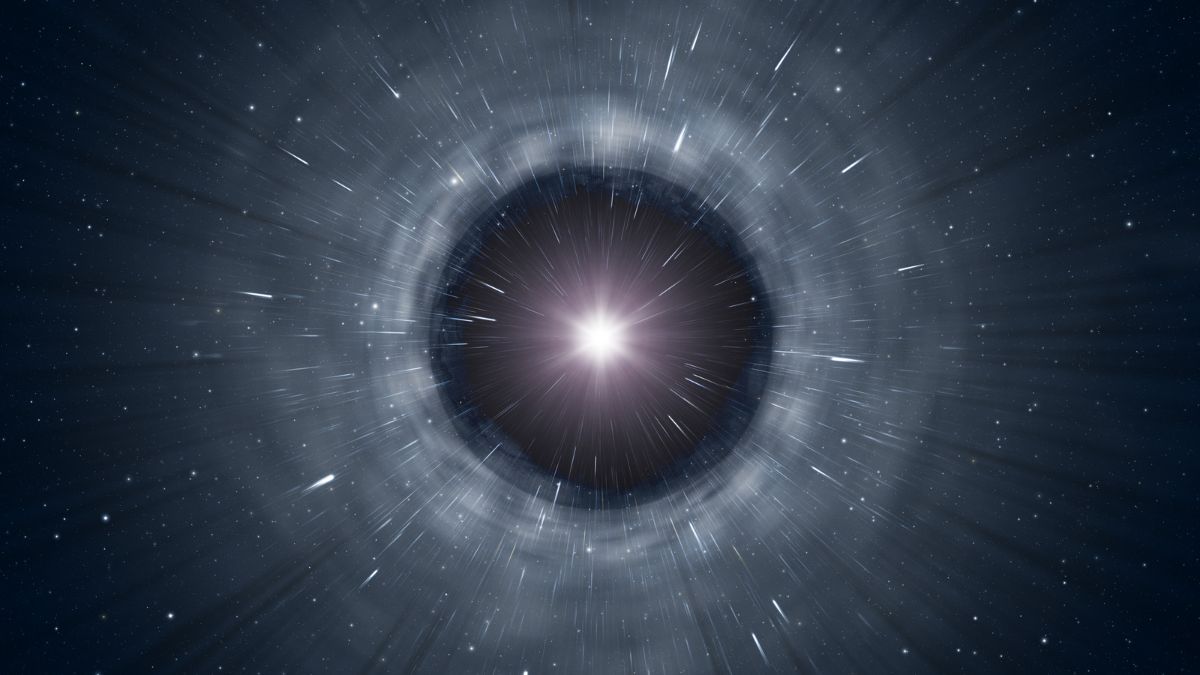
We have all heard about black holes. They are one of the most famous and scary objects in space. A black hole is a place in space where gravity is so strong that it pulls everything in. Nothing, not even light, can escape once it gets too close. They are like a one-way street in the universe, where all traffic only goes in. We know they are real. We have even taken a picture of the shadow of one.
But in science, especially in physics, there is often a need for balance. If there is an “in,” could there also be an “out”? This is where a very strange and fascinating idea comes from: the “white hole.” A white hole is the exact, theoretical opposite of a black hole. Instead of pulling everything in, a white hole would be a place that constantly spits everything out. It would be a one-way street where all traffic only goes out. Nothing from the outside could ever get in.
For decades, white holes were just a cool idea on a chalkboard, something scientists talked about but never expected to find. They seemed like pure fantasy. But now, the James Webb Space Telescope (JWST), our powerful new eye in the sky, is seeing some very strange things in the deep, early universe. These new discoveries are so puzzling that a few scientists are starting to ask a wild question: Could we be seeing the first hints of a white hole?
What Is a White Hole Anyway?
A white hole is a “hypothetical” object, which is a science-word for something that our theories say could exist, but we have never found any proof of. The idea comes directly from Albert Einstein’s most important work, the theory of general relativity. This is the same theory that first predicted black holes, long before we ever found one. In Einstein’s math, the description of a black hole has a “reverse” solution, just like a movie that can be played forward or backward. The black hole is the movie played forward, and the white hole is the movie played in reverse.
Think about the “event horizon,” the famous “point of no return” for a black hole. When you cross it, you can never get back out. A white hole also has an event horizon. But its horizon is a “point of no entry.” You can never get in. Matter and light are always gushing out of it. If a black hole is a cosmic drain, a white hole is a cosmic fountain, a gusher that never stops. This fountain would be incredibly bright, blasting out light and energy. This is why it is called a “white” hole, as opposed to a “black” one.
But there is a big problem. AccordingS to our understanding of the universe, white holes should not be able to exist. They seem to break a very important rule of physics called the second law of thermodynamics. This law is a fancy way of saying that things in the universe tend to get messier and more random over time (this is called “entropy”). A white hole, by spitting out organized matter and energy, would be like a broken egg putting itself back together. It just does not seem natural. Because of this, most scientists have long believed that white holes are just a mathematical ghost, a quirk in the equations that does not happen in the real world.
How Are White Holes Different from Black Holes?
It is easy to get black holes and white holes mixed up, but they are complete opposites. The simplest way to remember it is by what they do to the things around them. A black hole consumes, and a white hole expels.
A black hole is formed when a huge amount of matter gets squeezed into a tiny space, like when a giant star dies and collapses. This creates an object with gravity so powerful it bends space itself. It acts like a trap. Anything that gets too close—a star, a planet, a beam of light—is pulled in and can never leave. We cannot see the black hole itself, but we can see the effects of its gravity on nearby stars and gas, which often forms a glowing, spinning disk as it gets pulled in. We have found many black holes, and we are very confident they are real.
A white hole, on the other hand, is not something that “forms.” It would have to just be there, or be the other end of something else. It would be a source of matter and energy. Instead of a spinning disk of material falling in, a white hole would be a blazing spot of material rushing out. It would not be dark; it would be the brightest thing imaginable. But it would also be very unstable. Physics suggests that if even one single particle of light tried to enter a white hole, the entire thing would collapse instantly. This instability is a major reason why we have never expected to find one.
Here is a simple breakdown:
| Feature | Black Hole (Real) | White Hole (Theoretical) |
| What it does: | Pulls things in | Pushes things out |
| Event Horizon: | A “point of no return” (one-way in) | A “point of no entry” (one-way out) |
| Appearance: | Dark (black) | Incredibly bright (white) |
| How it forms: | From a collapsing massive star | We do not know; maybe from the Big Bang? |
| Stability: | Very stable (lasts for billions of years) | Extremely unstable (should collapse instantly) |
| Evidence: | Lots of evidence! We have seen them. | Zero direct evidence. Just math. |
Why Did Scientists Even Think of White Holes?
If they seem so impossible, why talk about them at all? The idea of a white hole comes from the beautiful, perfect symmetry in the mathematics of general relativity. When scientists first solved Einstein’s equations, they found a solution that described not just a black hole, but a complete “map” of spacetime. This map included the black hole we know, but it also included its mirror image: the white hole.
This mathematical map also showed a possible connection between them. This connection is the famous “wormhole,” also known as an Einstein-Rosen bridge. The theory suggested that if you fell into a black hole, you might not just be crushed at the center. Instead, you might travel through a tunnel (the wormhole) and come shooting out of a white hole somewhere else in the
universe, or even in another universe entirely. This became a favorite idea for science fiction movies, but in reality, physicists quickly showed this would not work. The wormhole would collapse on itself faster than even light could travel through it.
So, for a long time, the white hole was just a “mathematical curiosity.” It was a part of the equations that most scientists agreed you had to ignore, like a weird glitch in the code. They assumed that in the real universe, something must prevent white holes from ever forming. The Big Bang itself is sometimes described as being like a white hole—a single event from which all matter and energy in our universe erupted—but that was a one-time, unique event. The idea of small, individual white holes dotting the cosmos seemed impossible.
What Did the James Webb Space Telescope (JWST) Observe?
This is where the story gets really interesting. The James Webb Space Telescope (JWST) is the most powerful telescope ever built. Its main mission is to look deep into space, which is the same as looking far back in time. Because light takes time to travel, when we look at a galaxy that is 13 billion light-years away, we are seeing it as it was 13 billion years ago, not long after the universe began.
JWST is designed to find the very first galaxies that formed after the Big Bang. And it is working perfectly. In fact, it is working too well. It is finding things that our old theories cannot explain.
The telescope is spotting galaxies in the “cosmic dawn” (just a few hundred million years after the BigBang) that are shockingly large, bright, and well-formed. According to our old models, galaxies should start small, as little messy clouds of stars, and then slowly merge and grow over billions of years. But JWST is finding galaxies that are already “teenagers” when they should be “babies.” They are too big, too bright, and have signs of complex elements that should not have had time to form yet. One famous example is an object called GN-z11, which is incredibly bright and distant. These “impossible early galaxies” are a huge puzzle. Astronomers are scratching their heads, trying to figure out how these galaxies grew so big, so fast.
How Does This JWST Data Connect to White Holes?
This is the big, exciting, and very speculative leap. Because our old theories are struggling to explain these “impossible” galaxies, a few bold scientists are proposing a completely new idea.
The mainstream (or most common) explanations for these bright, early objects are:
- They contain the very first generation of stars (called Population III stars), which were monsters, hundreds of times bigger than our sun and burned incredibly bright.
- They have supermassive black holes at their center (quasars) that grew much faster than we thought possible, spitting out huge amounts of energy.
But what if it is neither? A new, fringe theory proposes a third option. What if these bright objects are not “galaxies” at all? What if they are the “eruptions” of white holes?
This idea, proposed by some theoretical physicists, links back to the Big Bang and dark matter. The theory goes like this: What if the Big Bang created a huge numberof “primordial black holes”—black holes that formed in the first second of the universe? And what if these tiny, ancient black holes are, over billions of years, “evaporating” or “bouncing”? In this theory, a primordial black hole could reach the end of its life and, instead of just disappearing, it “tunnels” through spacetime and erupts as a white hole.
If this were true, these “small bangs” happening all over the early universe would look like incredibly bright, compact explosions. They would release a burst of energy and matter, which could then start forming stars and a galaxy around them. This would perfectly explain what JWST is seeing: extremely bright points of light in the early universe that seem to come from nowhere and are too powerful to be easily explained. In this model, an object like GN-z11 might not be a galaxy with a big black hole, but instead a “white hole” event that is creating a new galaxy.
Is This Real Evidence for a White Hole?
It is extremely important to be clear: No, this is not proof. The James Webb Space Telescope has not “found” a white hole.
What JWST has found is an anomaly. It found a puzzle. It found data that does not fit our current, accepted models of the universe. This is a normal and very exciting part of science. When we find something we cannot explain, it means we are about to learn something new.
The “white hole” idea is just one possible hypothesis to explain this new, strange data. It is an “exotic” or “fringe” theory, which means most scientists in the field are very skeptical. They believe it is much more likely that our current models are just incomplete. We probably just need to update our theories about how fast stars can form or how quickly black holes can grow in the early universe. That is the “boring” but most probable answer.
However, the white hole hypothesis is exciting because it shows how scientists think. They see something new and ask, “What if?” It stretches our imagination and pushes us to test new ideas. To prove this theory, we would need much more evidence. We would need to look at these strange objects and see if they behave like an erupting white hole or just a very active, normal (but surprising) galaxy. Right now, the white hole idea is just a fascinating “maybe.”
What Other Explanations Are There for JWST’s Findings?
Since most scientists do not think these are white holes, what are the more likely explanations for these “impossible” early galaxies?
The most popular idea is that our understanding of the first stars is wrong. We have theories about the first generation of stars, called “Population III” stars. These stars would have been made of only hydrogen and helium (the only elements made in the Big Bang). Because of this, they could grow to be absolutely enormous, hundreds or even thousands of times the mass of our sun. A star that big would burn unbelievably hot and bright before exploding in a way that creates the heavier elements we see. It is very possible that JWST is simply seeing the light from these giant, first-generation stars or the galaxies they are rapidly building.
Another strong possibility involves “direct collapse black holes.” Our old models assumed that a black hole had to start from a star, and then slowly “eat” gas and other stars to grow big. But a newer theory suggests that in the dense, chaotic early universe, a gigantic cloud of gas could have skipped the “star” phase entirely and collapsed directly into a massive black hole. This would create a “supermassive” black hole in just a few million years, rather than billions. This “direct collapse” black hole would immediately become a quasar, a blazing-bright object that would look exactly like the “impossible” galaxies JWST is finding.
Ultimately, the most likely answer is that our knowledge is simply incomplete. The universe is more creative and efficient than our models predicted. JWST is not finding white holes; it is finding the flaws in our textbooks. And now, scientists have the exciting job of figuring out how to rewrite them with this new, amazing data.
Conclusion
White holes remain one of the most exciting “what ifs” in physics. They are the perfect opposite of black holes: a cosmic fountain instead of a cosmic drain. For all of modern science, they have been just a ghost in Albert Einstein’s equations, something that was mathematically possible but physically forbidden.
The James Webb Space Telescope has not found a white hole. What it has found are new and deep mysteries in the earliest pages of the universe’s history. It is seeing galaxies that are too big, too bright, and too early, challenging everything we thought we knew about how the cosmos got started.
While a few scientists have bravely suggested that these strange objects could be the first sign of white holes, this remains a very speculative and unlikely idea. The most probable answer is that the universe is simply more efficient at building galaxies and giant black holes than we ever imagined. But this is the beauty of science. A new mystery opens the door for new ideas, and even the wildest theories can help us find the truth.
Even if this “white hole” idea turns out to be wrong, what other amazing secrets about our universe’s birth is JWST on the verge of uncovering?
FAQs – People Also Ask
What is the main difference between a black hole and a white hole?
A black hole is a real object in space with gravity so strong it pulls everything in, and nothing can escape. A white hole is a theoretical object that does the exact opposite: it constantly pushes matter and energy out, and nothing can enter.
Did JWST prove white holes exist?
No, absolutely not. JWST found some very bright, distant objects that our current theories cannot easily explain. A “white hole” is just one very speculative, fringe hypothesis that a few scientists have proposed to explain this new mystery.
What is a wormhole?
A wormhole, also called an Einstein-Rosen bridge, is a theoretical “tunnel” through spacetime that connects two different points. In old theories, a black hole would be the “entrance” and a white hole would be the “exit,” but modern physics shows these kindsof wormholes would be too unstable to cross.
Why are white holes only theoretical?
White holes are only theoretical because we have never seen one, and they appear to violate a key law of physics (the second law of thermodynamics). This law states that systems should become more random over time, but a white hole would do the opposite. They also seem to be extremely unstable.
What is GN-z11?
GN-z11 is one of the oldest and most distant galaxies ever observed. It is one of the “impossible” objects that JWST is studying because it is extremely bright for its age, challenging our models of how quickly galaxies could form after the Big Bang.
What are Population III stars?
Population III stars are the name for the very first generation of stars that formed after the Big Bang. Scientists believe they were made only of hydrogen and helium, which allowed them to grow to enormous sizes (hundreds of times bigger than our sun) and burn incredibly bright.
What is the most likely explanation for JWST’s strange findings?
Most scientists believe the objects JWST is seeing are not white holes. They are more likely either very early galaxies powered by the first generation of “Population III” stars, or they are “direct collapse black holes” that grew to supermassive size much faster than we thought possible.
If white holes are real, could we travel to one?
No, even if they existed, you could not travel to a white hole. Its event horizon is a “point of no entry.” Anything that tried to approach it would be pushed away or destroyed by the incredible outward blast of energy and matter.
Where does the idea of a white hole come from?
The idea comes from the mathematics of Albert Einstein’s theory of general relativity. The equations that describe black holes also have a “reverse” solution that describes an object that behaves in the exact opposite way, which scientists named a white hole.
What is the “second law of thermodynamics”?
In simple terms, this is a rule in physics that says “entropy,” or randomness and disorder, always tends to increase in the universe. A broken glass does not put itself back together. A white hole, by “spitting out” organized matter, would seem to break this fundamental rule.