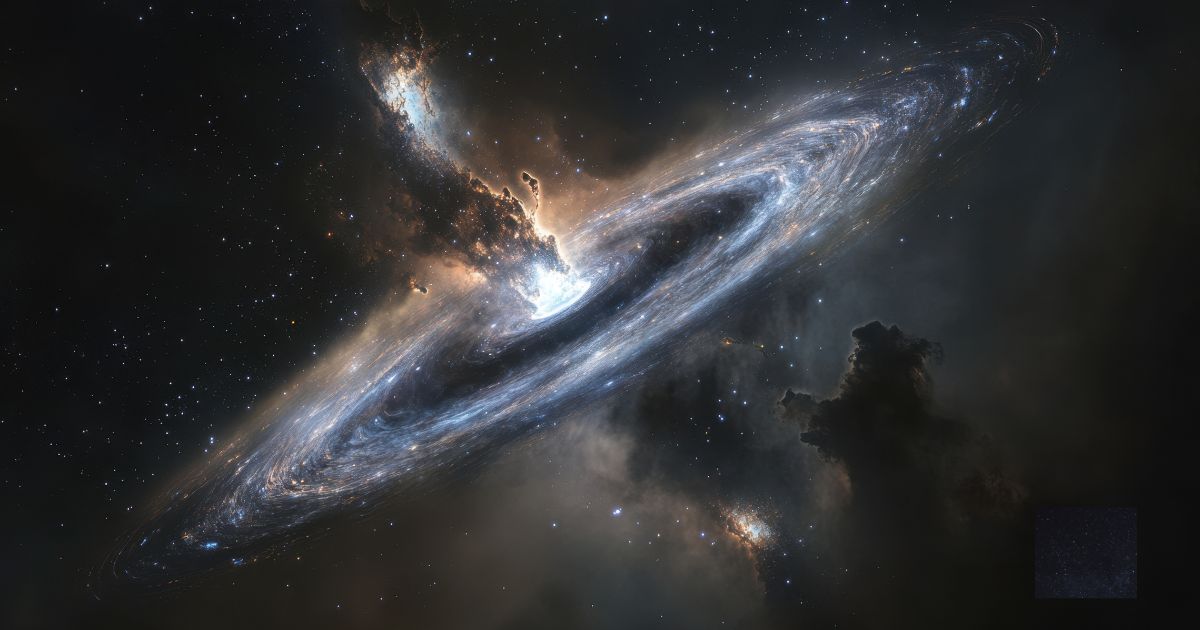
Quasars are much more than just bright dots; they are essentially the most energetic and active galactic nuclei—the hearts of young galaxies. The intense light we observe is created by matter spiraling into the galaxy’s central supermassive black hole. As this material is pulled in, it heats up to millions of degrees, creating a massive, glowing disk called an accretion disk. The energy output is so high that a single quasar can outshine all the stars in its host galaxy. Because they are so bright, they can be seen from immense distances, making them perfect markers for tracing the early structure of the universe.
Studying quasars is like using a cosmic flashlight to illuminate the distant past. When we observe one that is 10 billion light-years away, we are seeing light that started its journey 10 billion years ago, showing us the universe when it was much younger. The clustering of quasars tells us about the structure of the “cosmic web”—the vast network of matter, dark matter, and cosmic voids that forms the scaffolding of the universe. Generally, quasars are expected to form in the most massive clumps of matter, where a high density of galaxies leads to more collisions, which in turn feeds the central black holes. Their distribution helps astronomers test the models of how matter grew into the large structures we see today, like galaxy clusters and superclusters.
Why Is the Quasar’s Location in the ‘Cosmic Himalayas’ So Strange?
The discovery of the Cosmic Himalayas is puzzling because this massive cluster of eleven quasars does not sit squarely in the middle of an expected super-dense group of galaxies. According to our standard understanding of the cosmos, the greatest number of quasars should be found in the most massive clusters of galaxies—the “downtown” areas of the universe—because that is where the most galaxy collisions and mergers occur, providing the necessary fuel for the black holes to become active. Instead, the Cosmic Himalayas appear to be located on the boundary between two different, dense regions of galaxies, almost like a frontier territory between two cities.
This unusual placement is a problem for current theories about quasar formation. The standard model suggests that a quasar turns on when a galaxy merger or collision sends a huge supply of gas and dust rushing toward the central black hole. If this were the main trigger, we’d see the highest concentration of quasars exactly where the galaxy density is highest. Finding this huge cluster between two dense galactic regions suggests that a different, or at least an additional, mechanism might be responsible for feeding these hungry black holes. It’s as if a huge fire started in a place that didn’t have much kindling, forcing scientists to look for a hidden source of fuel.
What Does Quasar Clustering Tell Us About the Early Universe?
The way objects cluster together in space provides powerful clues about the nature of the early universe and the role of dark matter. Scientists believe that all visible matter, like galaxies and quasars, follows the framework laid out by invisible dark matter. Dark matter forms huge, invisible halos, and normal matter collects inside these halos due to gravity, eventually forming stars and galaxies. The clustering of quasars acts as a tracer for these underlying dark matter structures.
When quasars are tightly clustered, it means they are sitting inside an extremely massive dark matter halo—a cosmic skyscraper that formed very early on. This clustering allows astronomers to estimate the mass of the host dark matter halo for these early, active galaxies. The sheer size and density of the Cosmic Himalayas cluster imply that the dark matter structure it formed within is far more massive than what was expected to exist at that early cosmic time. Essentially, this discovery challenges models of hierarchical structure formation, which suggest that small structures form first and then slowly merge to create large ones. The Cosmic Himalayas look like a massive structure that grew “too big, too fast.”
How Does This Discovery Challenge Our Standard Cosmic Models?
The standard cosmological model, known as Lambda-CDM (Lambda-Cold Dark Matter), is the framework that best describes the structure and evolution of the universe. This model is very successful at explaining most observations, but extremely large or unusual structures, like the Cosmic Himalayas, begin to strain its limits. The finding suggests that the process of structure formation in the early universe might be more complex or efficient than our current simulations predict.
The main challenge comes from the speed of growth required. For such a massive dark matter halo to form early enough to host eleven highly-active quasars simultaneously, it would have needed to assemble matter at an incredibly rapid rate. If structures this large existed so early, it might mean that the early universe was “lumpier” than the Lambda-CDM model assumes, or that the properties of dark matter itself might be slightly different. Astronomers are now exploring possibilities such as very rapid black hole growth driven by large-scale gas flows, rather than just galaxy collisions, or perhaps even a subtle adjustment to the initial conditions of the universe.
What Is the Role of the Intergalactic Medium in the ‘Cosmic Himalayas’?
Another intriguing clue about the Cosmic Himalayas comes from the Intergalactic Medium (IGM), which is the sparse, diffuse gas that exists in the vast space between galaxies. The IGM isn’t totally empty; it’s mostly hydrogen gas. When light from a distant quasar passes through the IGM, the hydrogen atoms absorb some of that light, leaving dark lines in the quasar’s spectrum, which acts like a cosmic fingerprint.
In the case of the Cosmic Himalayas, scientists found a sharp difference in the IGM properties on either side of the quasar cluster. On one side, the IGM was relatively transparent, suggesting the hydrogen gas was largely ionized (stripped of its electrons). On the other side, the IGM was more opaque, meaning the gas was still mostly neutral. This distinct boundary, which reminded the researchers of the way the Himalayas on Earth separate different climate systems, is what inspired the name. This suggests that the powerful energy and radiation coming from the clustered quasars may be actively “zapping” the gas in their surroundings, creating a sharp difference in the cosmic environment around them and possibly fueling their ongoing activity.
What New Ideas Are Scientists Proposing to Explain the Quasar Cluster?
The “shocking” clustering of the Cosmic Himalayas has led astronomers to propose new and exciting ideas beyond the simple galaxy-merger model. One leading idea is that the cluster represents a massive cosmic collision interface. Instead of the quasars being within one dense region, they might be forming at the boundary where two colossal, early cosmic filaments—the largest parts of the cosmic web—are crashing into each other. This immense, large-scale shockwave of matter flowing between the two galactic nodes could be forcing gas to pour into the central black holes, lighting up the quasars along the collision front.
Another possibility involves large-scale gas infall. The Cosmic Himalayas could be a point in the cosmic web where a massive stream of cold gas is flowing in from the intergalactic medium directly onto the dark matter structure. This steady, large supply of fuel, channeled by the vast cosmic web structure, could sustain the activity of multiple quasars without needing as many direct galaxy-on-galaxy mergers. This scenario highlights how the overall structure of the universe, not just local collisions, plays a vital role in fueling the most powerful black holes in the early cosmos.
In the end, the discovery of the Cosmic Himalayas has thrown a delightful wrench into our understanding of the young universe. It has provided us with a new, massive, and extremely puzzling object that does not fit neatly into the existing cosmic story. This cluster of eleven super-bright quasars, sitting unexpectedly on a cosmic boundary, forces us to re-examine how the very first giant structures formed and how supermassive black holes found enough food to grow so quickly. It’s a clear signal that the universe still has incredible secrets to reveal. What other unexpected, colossal structures might be hiding in the far reaches of the cosmos, waiting to completely rewrite our current understanding of the universe?
FAQs – People Also Ask
What is a quasar in simple terms?
A quasar is the extremely bright, active center of a young galaxy. It is powered by a supermassive black hole that is rapidly pulling in matter like gas and dust. This material heats up enormously before falling in, creating a brilliant light show that can be seen across billions of light-years of space, making quasars some of the brightest objects in the entire universe.
How far away are the Cosmic Himalayas?
The Cosmic Himalayas quasar cluster is incredibly distant, with the light we see having traveled for about 10.8 billion years to reach Earth. This means we are viewing the structure as it existed when the universe was less than three billion years old. Its great distance makes it a powerful probe for studying the conditions and structure of the cosmos in its infancy.
Why are quasars more common in the early universe?
Quasars were much more common in the early universe because the galaxies were closer together and had much more raw gas and dust available. This greater density led to more frequent galaxy collisions and mergers, which effectively funneled a large amount of fuel to the central supermassive black holes, causing them to turn on as bright quasars.
What is the “cosmic web”?
The cosmic web is the largest known structure in the universe, describing how matter is organized in space. It is a vast network made up of huge filaments (strands) of galaxies and dark matter, which are connected by massive clusters and separated by enormous, mostly empty regions called voids. The entire observable universe is structured by this web-like framework.
What is the significance of quasars being clustered?
The clustering of quasars is significant because it shows that these brilliant objects are not randomly scattered but are located in regions where the underlying dark matter is extremely dense. Measuring their clustering allows scientists to estimate the mass of the dark matter halos that host them, providing crucial information about how the largest cosmic structures formed.
What is the difference between a quasar and a black hole?
A black hole is the collapsed core of a massive star or the super-dense object at a galaxy’s center. A quasar, however, is not the black hole itself but the immense light and energy created by the matter swirling around a feeding black hole. A black hole is the engine, and the quasar is the powerful light beam it projects while running at full speed.
Do quasars exist in the universe today?
Yes, quasars still exist today, but they are much rarer and generally less luminous than the ones seen in the early universe. Most modern black holes have consumed much of the readily available fuel in their immediate surroundings. A black hole can still become an active quasar if it gains a fresh, large supply of gas and dust, often through a new galaxy merger.
What is a dark matter halo?
A dark matter halo is an invisible, roughly spherical cloud of dark matter that surrounds a galaxy or a group of galaxies. Since dark matter does not interact with light, we cannot see the halo, but its gravity provides the necessary scaffolding. Visible matter, like stars and gas, collects inside these halos to form galaxies.
How do scientists name objects like the Cosmic Himalayas?
Astronomers often give new, massive cosmic structures evocative nicknames to make them easier to remember and discuss, especially when their properties are surprising or challenge current theories. The structure was named the “Cosmic Himalayas” because the quasar cluster sits on a very distinct boundary between two regions, similar to how the towering Himalayas on Earth separate two different geographical regions.
What is the Lambda-CDM model of the universe?
The Lambda-CDM model is the current standard model of cosmology. “Lambda” ($\Lambda$) refers to dark energy, which is thought to be causing the universe to expand at an accelerating rate. “CDM” stands for Cold Dark Matter, the invisible substance that provides the gravitational force to form the structure of the universe. This model is the best fit for most of the data collected by astronomers.