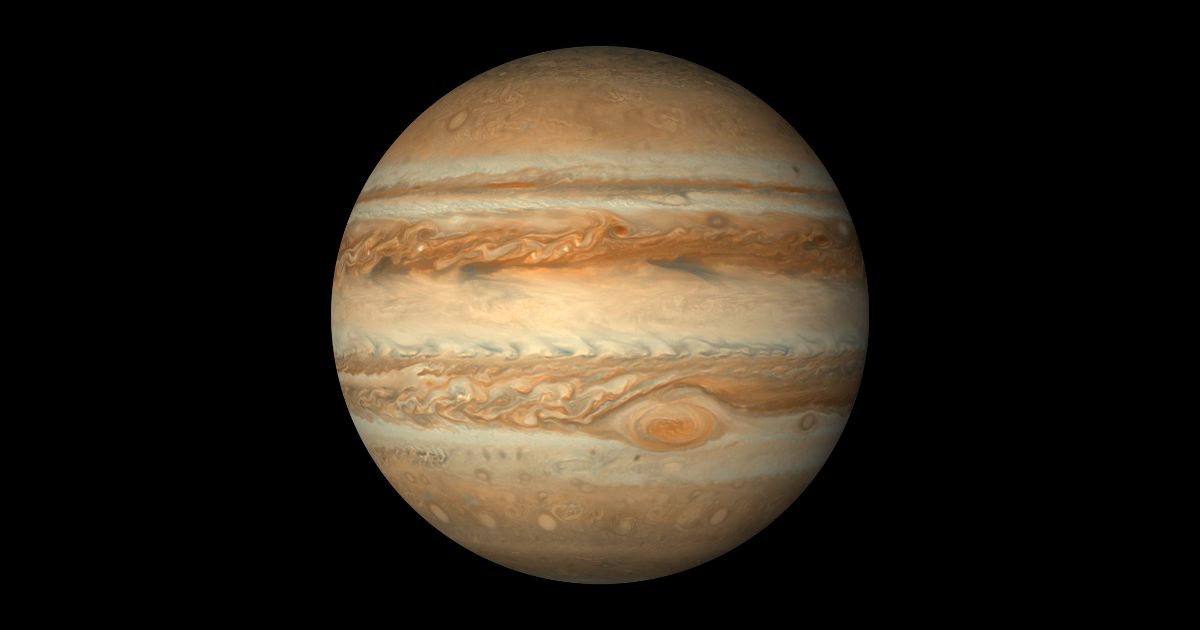
Jupiter is the giant of our solar system. It is a massive planet made of swirling gas, and it is famous for one feature above all others: the Great Red Spot. This spot is a huge, spinning storm that has been raging for hundreds of years. It is like a hurricane on Earth, but it is so big that our entire planet could fit inside it. For as long as we have had telescopes, this storm has been the most recognizable landmark on any planet besides our own.
For centuries, the Great Red Spot seemed like a permanent part of Jupiter. But in recent decades, scientists have noticed something dramatic. This ancient, giant storm is getting smaller. Year after year, observations from powerful telescopes show the storm is shrinking. It is not as long as it used to be, and it is losing its famous oval shape.
This discovery has created a brand new mystery. We are watching a solar system icon change right before our eyes. This has led scientists to ask many new questions. They want to know why this is happening and what it means for the giant planet. Is the storm dying? Is it just changing its shape? Or is something new happening in Jupiter’s stormy atmosphere? So, what is really happening to this giant storm, and why are scientists so fascinated by its downsizing?
What Exactly Is the Great Red Spot?
The Great Red Spot is not just any storm; it is the largest and longest lasting storm in our entire solar system. To understand why it is shrinking, we first need to know what it is. On Earth, hurricanes are storms that spin around a center of low pressure. Jupiter’s Great Red Spot is the opposite. It is an anticyclone, which means it is a massive area of very high pressure. You can think of it as a giant, spinning mountain of gas in Jupiter’s atmosphere. The clouds at its center are much higher and colder than the clouds around it.
This storm is located in Jupiter’s southern hemisphere, and it is truly enormous. In the late 1800s, astronomers measured it to be over 40,000 kilometers (about 25,000 miles) wide. At that size, you could have lined up three Earths next to each other and they would have fit inside the storm. The winds at the edge of the storm are unbelievably fast, whipping around at speeds over 430 kilometers per hour (about 270 miles per hour). These winds are much faster and more powerful than the strongest hurricanes ever recorded on Earth.
One of the biggest mysteries is the storm’s age. We have continuous, reliable records of it from astronomers since 1831. But some scientists believe it might be the same “Permanent Spot” observed by the astronomer Giovanni Cassini back in 1665. If that is true, the storm could be over 350 years old. No storm on Earth can last for more than a few weeks. The Great Red Spot lasts for centuries because Jupiter is very different from Earth. As a gas giant, it has no solid land surface. On Earth, hurricanes lose their power when they move over land. On Jupiter, this storm just keeps spinning in the gas, with nothing to slow it down. It is also “stuck” between two powerful bands of wind, called jet streams, which flow in opposite directions and help keep the storm spinning.
How Long Have We Known the Great Red Spot Is Changing?
We have known that the Great Red Spot is not static for a very long time, but the fact that it is steadily shrinking is a more recent discovery. Astronomers in the 1800s drew the storm as a long, enormous oval. Their measurements gave us a starting point, showing just how big it was. For the next hundred years, people knew it was big, but they did not have the tools to track small changes. The first big update came in 1979 when NASA’s Voyager 1 and 2 spacecraft flew past Jupiter. They sent back the first-ever close-up photos, and they were stunning.
The Voyager photos gave us a precise measurement. By 1979, the storm was only 23,000 kilometers (about 14,500 miles) wide. This was a huge realization. In just one hundred years, the storm had shrunk by almost half. It was still big enough to fit two Earths inside, but it was clear that it was not the same giant it had been in the 1800s. After Voyager, however, we did not have another spacecraft visit Jupiter for many years, so it was hard to know if this shrinking was a steady trend or just a temporary change.
The real proof came from the Hubble Space Telescope. After its launch in 1990, Hubble gave us a “weather eye” on the outer planets. A special program called the Outer Planet Atmospheres Legacy (OPAL) uses Hubble to take a detailed “family portrait” of Jupiter every single year. This consistent, year-after-year record has been priceless. The Hubble images confirmed, without a doubt, that the storm is shrinking. Every year, its “waistline” gets a little smaller. Then, in 2016, NASA’s Juno spacecraft arrived and went into orbit around Jupiter. Juno flies much closer to the planet than any other probe and has given us the most detailed look at the storm in history, confirming the shrinking and providing new clues about its structure.
How Fast Is the Storm Actually Shrinking?
The rate of shrinking is what has scientists so interested. It is not just getting a little smaller; the change is happening fast enough to measure clearly from one year to the next. The Hubble telescope’s long-term data shows that since the 1990s, the storm’s diameter has been shrinking by an average of about 930 kilometers (about 580 miles) per year. To put that in perspective, the storm is losing a patch of territory as wide as a large state or small country every single year.
As of 2017, when the Juno spacecraft flew directly over it, the storm was measured at about 16,350 kilometers (10,160 miles) wide. This means it is now only about 1.3 times the width of our planet Earth. A storm that could once easily swallow three Earths can now barely hold one. This is a very dramatic change in just 150 years, which is a blink of an eye in the life of a planet.
But something else is changing, too: its shape. In the 1800s, the Great Red Spot was a long, stretched-out oval. As it shrinks, it is becoming more and more circular. It is changing from the shape of a piece of bread to the shape of a coin. This is a very important clue. It tells scientists that the physics of the storm, the way the winds spin and the energy flows, is changing. A round storm behaves differently than a long storm. This change in shape might be a clue as to why it is shrinking, or it might be a result of it shrinking. Scientists are working to figure this out, but the “Great Red Oval” is quickly becoming the “Great Red Circle.”
What Is Causing the Great Red Spot to Lose Its Size?
This is the billion dollar question, and the truth is, scientists do not have one single, simple answer. It is likely a combination of several factors. Imagine the storm is like a giant, spinning top. It has been spinning for centuries, but now it is starting to wobble. Here are the main theories scientists are studying right now.
The first and most popular theory is that the storm is running out of food. The Great Red Spot stays alive by “eating” smaller storms. Jupiter’s atmosphere is full of smaller, swirling vortices. When these smaller storms get too close to the Great Red Spot, they are captured by its gravity and spin, and then they merge with it. This process is like adding fuel to a fire; it transfers energy and momentum to the giant storm, keeping it spinning. A recent study in 2024 suggests that this “diet” might be changing. The jet streams that flow around Jupiter might be steering these smaller storms away from the Great Red Spot. If the storm is not getting as many of these “meals” as it used to, it is slowly starving. It is running out of the energy it needs to maintain its massive size, so it begins to shrink.
Another theory is that the storm is being “shredded” at the edges. Astronomers have observed events they call “flaking”. Using the Hubble telescope, they have seen long, blade-like “flakes” of red cloud material peeling off the main body of the storm. These red flakes get caught in the jet stream next to the storm and are carried away, like a streamer flying off in the wind. These flaking events, especially some big ones seen around 2019, look very dramatic, as if the storm is unraveling. Some scientists think this is a sign the storm is becoming unstable and falling apart. However, other studies suggest this might just be a surface-level event, like the storm “shedding its skin,” and that the deep, powerful vortex underneath is still intact.
A third idea is that the jet streams are changing. The Great Red Spot is trapped between two very powerful jet streams that move in opposite directions. These streams act like a conveyor belt, helping to keep the storm spinning. Some computer models show that if these jet streams were to change their speed or their path, even slightly, it could have a huge effect on the storm. The jet streams might be moving closer together, “pinching” the storm and squeezing it into a smaller, rounder shape. Or, the winds might be changing in a way that is “draining” energy from the storm instead of feeding it.
Finally, it might just be a natural life cycle. Nothing lasts forever, not even a 350-year-old storm. We have only been watching Jupiter closely for a very short part of its history. It is entirely possible that giant storms like this have a natural life. They are born, they live for centuries, and then they slowly run out of energy and fade away. We might just be lucky enough to be watching as this legendary storm enters its “retirement” phase.
How Do Scientists Study the Great Red Spot from So Far Away?
Studying a storm that is hundreds of millions of miles away is one of the greatest challenges in science. We cannot send a probe into it, as the immense pressure and speed would crush any machine we build. Instead, scientists use amazing tools to study it from a distance.
Our main tool for more than a century has been telescopes on Earth. From the first drawings in the 1800s to the giant, modern telescopes on mountaintops, astronomers have tracked its size and color. Today’s advanced telescopes can even use special techniques to reduce the blur from Earth’s own atmosphere, giving very clear views.
The most important tool for consistent monitoring has been the Hubble Space Telescope. Floating in space high above Earth’s blurry atmosphere, Hubble can take incredibly sharp pictures. The OPAL program, which uses Hubble to check on Jupiter every year, has given us the data that proves the shrinking is a steady trend. It is like having a yearly checkup for the storm, and Hubble’s “medical chart” shows it is clearly losing weight.
The most exciting tools, however, are the space probes that have visited Jupiter. The Voyager probes in 1979 gave us our first stunning close-ups. The Galileo orbiter in the 1990s studied the storm for years. But the current superstar is the Juno mission. Since 2016, Juno has been orbiting Jupiter from pole to pole. On some of its orbits, it flies directly over the Great Red Spot. Juno has a camera called JunoCam that takes the breathtaking, high-resolution photos you see online. But its real superpower is an instrument called a Microwave Radiometer. This instrument can “see” through the top layers of clouds. This is how Juno made a shocking discovery: the Great Red Spot is not just a wide storm, it is incredibly deep. Its “roots” go down at least 500 kilometers (over 300 miles) into Jupiter’s atmosphere. This is far deeper than Earth’s oceans. This tells us the storm is a massive, powerful weather system, not just a thin feature on the surface.
Does the Shrinking Change the Storm’s Other Behaviors?
Yes. The storm is not just getting smaller and rounder; its whole personality is changing. These other changes are important clues for scientists. One of the most surprising changes is that as the storm shrinks, its winds are speeding up. You might think a shrinking storm would get weaker, but data from Hubble shows that the winds at the storm’s outer edge are accelerating.
Scientists compare this to an ice skater. When an ice skater is spinning with their arms out, they spin slowly. When they pull their arms in, their spin gets much faster. This is a rule in physics called the conservation of angular momentum. The Great Red Spot seems to be doing the same thing. As its diameter shrinks (pulling its “arms” in), its outer winds have to spin faster to conserve its energy. So, while the storm is shrinking, it is also becoming more concentrated and, in some ways, more intense.
Another change is its height. A study in 2018 suggested that as the storm’s area is shrinking, it may be growing taller. Think of what happens if you squeeze a ball of clay. As you squeeze it from the sides, it gets thinner, but it also squishes upwards and becomes taller. The Great Red Spot might be doing the same thing. As the surrounding jet streams “pinch” it, the storm is forced to stretch vertically.
This vertical stretch might even explain another change: its color. The “Great Red Spot” is not always the same color. Sometimes it is a pale, salmon pink, and other times it is a deep, brick red. Since 2014, scientists have noticed the color becoming a more intense orange. If the storm is getting taller, its top clouds are being pushed higher into Jupiter’s atmosphere. Up there, they are exposed to more intense ultraviolet (UV) radiation from the Sun. This UV light could be causing chemical reactions in the clouds that create the deep red color, almost like the storm is getting a “sunburn.” A taller storm would get a stronger sunburn, making its color deeper.
Why Is the Great Red Spot Red Anyway?
This seems like a simple question, but it is one of the longest-running mysteries about Jupiter. Scientists are still not one hundred percent sure why the storm is red, while so many other clouds on Jupiter are white, tan, or brown. We know the clouds are mostly made of frozen ammonia, which is white. So, some other chemical, a “trace” ingredient, must be acting as a dye.
The most popular theory is the “sunburn” theory. As we just mentioned, the Great Red Spot is extremely tall. Its cloud tops are higher than almost any other clouds on the planet. This theory says that chemicals in Jupiter’s upper atmosphere (like ammonia or acetylene) are lifted to this great height by the storm’s powerful updrafts. Once at the top, they are zapped by the Sun’s powerful ultraviolet light. This sunlight breaks the simple chemicals apart and causes them to reform into new, more complex molecules. These new molecules, called chromophores, happen to be red. The storm is constantly churning, pulling up new “ingredients” to be “cooked” by the Sun, which keeps the storm’s top layer red.
The other main theory is the “deep chemicals” theory. This idea suggests the red-making chemicals are not from the top, but from the bottom. Deep inside Jupiter, where it is very hot, there are other chemicals (perhaps compounds of sulfur or phosphorus). The theory is that the Great Red Spot is so powerful that its “roots” dredge up these chemicals from deep within the planet. When these chemicals rise to the cold cloud tops, they freeze or react and then turn red. Scientists in 2024 are still using data from the Juno probe to study the storm in different kinds of light, trying to find the chemical “fingerprint” that will finally solve the color mystery.
What Happens If the Great Red Spot Disappears Completely?
This is a very real possibility. Based on the current rate of shrinking, some scientists predict the storm could be gone within our lifetime, perhaps in just a few decades. It likely will not “pop” or explode. Instead, it will just continue to shrink, getting smaller and weaker. One scientist predicted it will first become the “Great Red Circle,” and then, as it fades, it will become the “Great Red Memory.”
If the storm does disappear, will it change Jupiter’s weather? The answer is: probably not very much. Jupiter is an enormous planet. The Great Red Spot is its most famous feature, but it does not run the planet’s weather. The planet’s weather is driven by its incredibly fast 10-hour rotation and the powerful heat rising from its core. The jet streams, bands, and zones would all continue to exist without the storm. When the storm finally breaks apart, its energy will scatter. It will likely break into many smaller, weaker storms that will get caught in the jet streams and fade away.
However, this might not be the end of the story. It is very possible that a new “great spot” could form. We have seen it happen on a smaller scale. In the year 2000, three smaller white oval storms were seen drifting on Jupiter. They eventually merged, and this new, combined storm turned red, just like the Great Red Spot. Astronomers nicknamed it “Red Spot Junior.” This proves that the conditions on Jupiter for making large, long-lived red storms still exist. The Great Red Spot we have known for centuries might just be one in a long line of giant storms that have formed, reigned for a while, and then faded away, only to be replaced by a new one. For us on Earth, the biggest impact would be the end of an icon. It would be a powerful reminder that the solar system is not a static, unchanging place, but a living, dynamic system where even the giants can change.
Conclusion
Jupiter’s Great Red Spot, the most famous storm in the solar system, is definitely shrinking. We have watched it go from a giant oval that could swallow three Earths to a smaller, rounder circle that can barely hold one. This change is being driven by a complex set of factors. The most likely reason is that the storm is on a “starvation diet,” getting less energy from the smaller storms it used to “eat.”
At the same time, the storm is changing. It is likely growing taller, and its outer winds are spinning faster, even as its footprint gets smaller. Thanks to amazing tools like the Hubble Space Telescope and NASA’s Juno mission, we are watching this amazing event happen in real time. We are learning that even a storm that has lasted for centuries cannot last forever. We still do not know if it will disappear completely in 20 years or if it will just settle into a new, smaller, stable size. But either way, we are witnesses to a major change on our giant neighbor.
As we watch this giant storm wind down, it makes us wonder: what other massive changes are happening right now on other planets, waiting for us to discover them?
FAQs – People Also Ask
How big is the Great Red Spot right now in 2025?
As of the 2024 to 2025 period, the Great Red Spot is approximately 16,000 kilometers (about 10,000 miles) wide. This is just a little larger than the diameter of planet Earth.
Could the Great Red Spot disappear completely?
Yes, it is possible. Based on its current rate of shrinking, some scientists predict it could break apart and fade away within the next 10 to 20 years. Others believe it might just shrink to a smaller, more stable circular size.
Why does the Great Red Spot last so long?
Unlike Earth, Jupiter is a gas giant with no solid land surface. On Earth, hurricanes die when they hit land, which cuts off their energy. The Great Red Spot just keeps spinning in the gas, and it is “fed” by merging with smaller storms.
What is the storm made of?
The storm is made of clouds of gas, primarily ammonia ice. The white parts are ammonia, but the famous red color comes from other trace chemicals. Scientists believe these chemicals get their red color when they are hit by sunlight high in the atmosphere.
How fast are the winds in the Great Red Spot?
The winds at the outer edge of the storm are incredibly fast, reaching speeds of over 430 kilometers per hour (about 270 miles per hour). Interestingly, as the storm shrinks, these outer winds appear to be speeding up.
How deep is the Great Red Spot?
NASA’s Juno spacecraft used a special instrument to look “through” the clouds. It discovered that the storm is incredibly deep, with its “roots” extending at least 500 kilometers (over 300 miles) down into Jupiter’s atmosphere.
What is “Red Spot Junior”?
“Red Spot Junior,” officially named Oval BA, is another storm on Jupiter. It formed in 2000 when three smaller white storms merged into one. A few years later, it turned red, just like the Great Red Spot, proving that new red storms can still form on Jupiter.
Why is the storm’s shape changing?
The Great Red Spot used to be a long oval. As it shrinks, it is becoming much more circular. This is likely because the forces that are “squeezing” it, like the surrounding jet streams, are causing it to pull into a more compact, round shape.
What is “flaking” on the Great Red Spot?
“Flaking” is a term for events where long, red “blades” of cloud material are seen peeling off the edge of the storm. These flakes get caught in the nearby jet stream and carried away, making it look like the storm is unraveling.
Is the Great Red Spot hot or cold?
The top of the Great Red Spot’s clouds are very high up, making them extremely cold, much colder than the surrounding clouds. However, scientists were shocked to find that the atmosphere above the storm is hundreds of degrees hotter than anywhere else on the planet, a mystery they are still trying to solve.