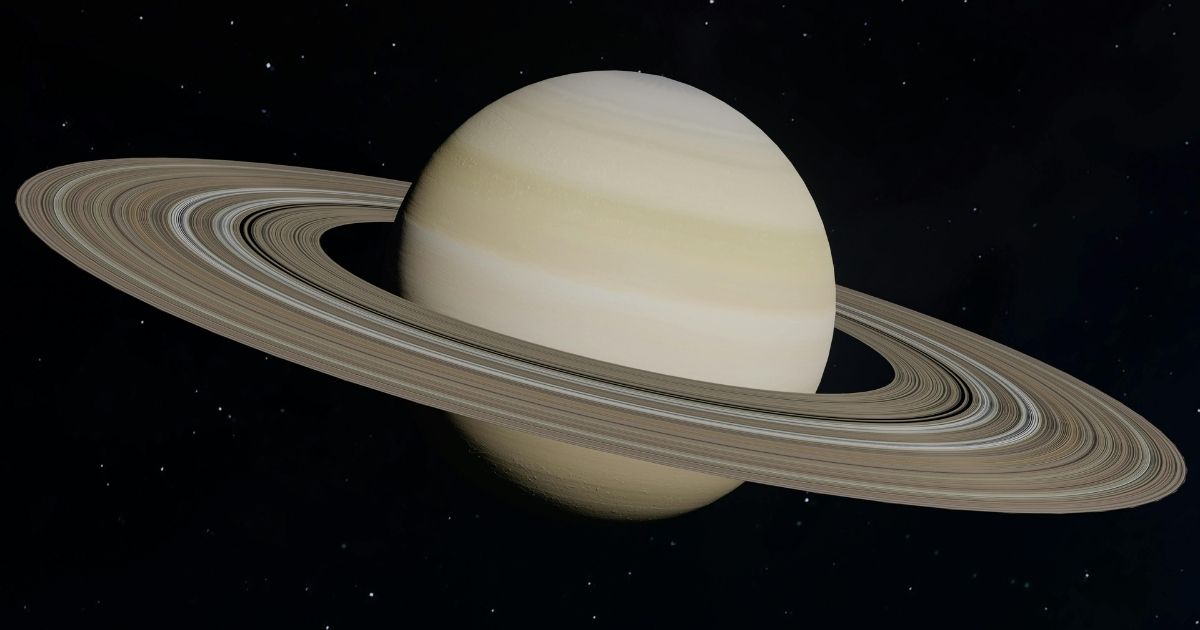
Saturn is one of the most beautiful sights in our solar system. Most people know it for its stunning, icy rings. But the planet itself is a wild and stormy place. It is a gas giant, meaning it is a massive ball of gas and liquid with no solid ground to stand on. And just like on Earth, this giant planet has weather. Sometimes, it has very, very big weather. In 2025, astronomers are thrilled because one of the solar system’s most exciting events has returned: the Great White Spot.
This is not just any storm. It is a “megastorm” so enormous that it can grow to be larger than the entire planet Earth. It appears as a brilliant, white patch in Saturn’s normally hazy, yellowish atmosphere. Unlike Jupiter’s famous Great Red Spot, which seems to last for centuries, Saturn’s storm is temporary. It shows up, puts on a huge show that can last for months or even years, and then it fades away.
For over a hundred years, these giant storms seemed to follow a schedule, appearing roughly once every 30 Earth years, which is about one year on Saturn. But the last major storm in 2010 broke that pattern by arriving early. Now, its appearance in 2025, only 15 years later, confirms that Saturn’s weather is far more complex and exciting than we ever thought. So, what is causing this monster storm to re-emerge, and why is it happening now?
What Exactly Is This Great White Spot?
The Great White Spot is the name we give to a massive, erupting storm on Saturn. You can think of it as the biggest, most powerful thunderstorm you can possibly imagine. It is not a permanent feature like a mountain or a crater. It is a weather event, like a hurricane or a blizzard, but on a planetary scale. These storms start deep inside Saturn’s atmosphere, thousands of miles below the clouds we can see. They are a sign of incredible power being unleashed from the planet’s hidden interior.
The “white” part of the name comes from the clouds it creates. Saturn’s upper atmosphere is usually a bit hazy and has a pale yellow or beige color. This storm is a powerful updraft, like a giant chimney, that punches up from the planet’s warm depths. As this hot gas rises, it carries moisture with it. When it reaches the cold upper atmosphere, this moisture freezes, forming bright white crystals of ammonia ice. These fresh, white clouds are what we see from Earth. They are so bright and plentiful that they create a “spot” that stands out against the rest of the planet. The 2025 storm started as a distinct spot but is already growing, and scientists are watching to see if it will spread out to form a “tail” that wraps around the entire planet, just as the 2010 storm did.
How Often Does This Giant Storm Appear on Saturn?
For a long time, astronomers believed these storms were very predictable. The first well-observed Great White Spot was seen in 1876. Another appeared in 1903, then 1933, 1960, and 1990. If you look at those dates, you will notice a pattern. They are all spaced about 27 to 30 years apart. This timing is very special because it matches the length of Saturn’s year. It takes Saturn about 29.5 Earth years to make one full orbit around the sun.
This led to a popular theory: the storms were seasonal. The idea was that these storms only happened during the summer in Saturn’s northern hemisphere. Just like on Earth, Saturn has seasons because it is tilted on its axis. During its northern summer, that part of the planet receives more sunlight and warmth. Scientists thought this extra energy from the sun was the final “push” needed to trigger one of these giant storms. It seemed like a perfect, simple clock. The planet would store up energy for decades, and then the summer sun would pop the cork, unleashing the storm. This pattern held for over a century, and astronomers were all expecting the next storm to arrive around 2020.
Why Did the Storm Schedule Suddenly Change?
The reliable 30-year “summer storm” pattern was completely broken in 2010. To everyone’s surprise, a new Great White Spot erupted a full ten years earlier than expected. It did not appear in the northern summer, but in the northern spring. This was a huge discovery. It proved that the sun’s warmth, while perhaps a small factor, was not the main trigger. The 2010 storm showed that the true “clock” for these events was not tied to the seasons, but to something happening deep inside the planet.
This 2010 storm was also the most powerful ever recorded. It was studied in amazing detail by NASA’s Cassini spacecraft, which was orbiting Saturn at the time. The storm grew so large that its cloudy tail completely encircled the planet. Now, with the arrival of the 2025 storm, the old seasonal theory is officially retired. The 2010 event was not a one-time fluke. It was the beginning of a new, more active, and less predictable pattern. The appearance of a new megastorm just 15 years after the last one tells us that the planet’s internal engine is running on its own schedule.
What Is Happening Inside Saturn to Create This Storm?
To understand what is happening in 2025, we have to forget about the sun and think about Saturn’s internal heat. Saturn is a gas giant, and like Jupiter, it actually creates more heat deep in its core than it receives from the distant sun. This heat is left over from when the planet first formed, billions of years ago. This internal heat is the true engine for the Great White Spot.
Scientists believe the process works like this: Saturn’s atmosphere is made of layers. The main gases are hydrogen and helium, but there are also other materials, including water. Deep down, where it is very hot and pressure is high, there are likely clouds of liquid water. Over many years, this “wet” air in the lower atmosphere gets heated by the planet’s core. At the same time, the very top layers of the atmosphere, which we see, are very cold. This top layer radiates its heat out into space, cooling down and becoming denser, or “heavier.”
This creates an unstable situation. You have a warm, light, moist layer of gas at the bottom and a cold, heavy, dry layer on top. Eventually, after a period of 15, 20, or 30 years, the top layer becomes so cold and heavy that it starts to “sink.” This is a process called convection. As this heavy gas sinks, it pushes the warm, moist gas from deep below. This hot, wet gas has nowhere to go but up. It rises incredibly fast, like a cannonball shot toward the sky. As it bursts through the upper atmosphere, the water and ammonia freeze into the bright white ice crystals that we see from Earth as the Great White Spot. It is a massive, planet-sized thunderstorm erupting from the inside out.
How Big Is the 2025 Great White Spot?
When a Great White Spot is born, it starts as a single point of light. But it grows with terrifying speed. We are seeing this happen right now in 2025. Based on past storms, we have a good idea of what to expect. The 2010 storm, for example, started as a spot but grew to be over 10,000 miles across in just a few weeks. That is already wider than the entire planet Earth.
But the storm does not just stay in one place. Saturn has incredibly fast winds, or jet streams, that blow at over 1,000 miles per hour. These winds catch the storm’s clouds and stretch them out. The “head” of the storm, the bright white part, remains the active center where the eruption is happening. But the winds pull a “tail” of clouds and turbulence away from it. This tail can get so long that it eventually wraps all the way around Saturn, catching up to the head of the storm from the other side. The 2010 storm created a band of clouds that was 190,000 miles long. We are watching the 2025 storm to see if it will become this large. Right now, its head is already several times the size of Earth, and it is churning with incredible energy and lightning.
Is This Storm Just Like Jupiter’s Great Red Spot?
This is a very common question, and it is a great one! Both are giant storms on giant gas planets, but they are almost complete opposites. The main difference is their lifespan. Jupiter’s Great Red Spot is like a permanent hurricane. It has been observed for at least 150 years, and possibly for over 300. It is a very old, stable storm. Saturn’s Great White Spot is temporary. It is an “eruption.” It appears, rages for many months, and then fades away as the planet’s atmosphere calms down.
Another big difference is their structure. The Great Red Spot is a high-pressure system. Think of it as a huge, rotating “mountain” of clouds. The winds are strongest at its edges, but the center is actually quite calm. Saturn’s Great White Spot is the opposite. It is a low-pressure system, a convective storm. All the energy is rising from the center. It is an incredibly violent and active place, full of massive lightning bolts. This lightning is thousands of times more powerful than any lightning on Earth.
Finally, there is the color. Jupiter’s spot is red, while Saturn’s is white. The whiteness of Saturn’s storm comes from the fresh, clean ammonia ice crystals that are dredged up from below. They are white for the same reason snow on Earth is white. The reason for Jupiter’s red color is still a bit of a mystery, but scientists think it is a chemical “sunburn.” Chemicals from deep inside Jupiter rise to the top of the spot and are then hit by ultraviolet light from the sun, which slowly cooks them and turns them a reddish-orange color. Saturn’s storm is too young and fresh to get this “sunburn.”
How Do Scientists Even See and Study This Spot?
Studying a storm that is nearly a billion miles away is a major challenge, but we have some amazing tools. The 2025 storm is being watched by a combination of telescopes on Earth and in space. Because this storm is so big and bright, it can actually be seen by skilled amateur astronomers right here on Earth using high-quality backyard telescopes. This is how many of the historical spots were first discovered.
Professionally, the Hubble Space Telescope is one of our most important tools. Orbiting above Earth’s blurry atmosphere, Hubble can take incredibly sharp pictures of Saturn. It can track the storm’s growth, watch its color, and see how it interacts with Saturn’s jet streams. On the ground, giant telescopes can also study the storm, but they use different kinds of light. By looking at infrared light, for example, scientists can measure the storm’s temperature. These measurements show that the Great White Spot is much warmer than the surrounding clouds, which is a key piece of evidence proving it is powered by heat from deep inside.
Our best-ever look at one of these storms came from the Cassini spacecraft, which orbited Saturn from 2004 to 2017. Cassini was in the perfect place to watch the 2010 storm unfold. It flew right over the storm and measured its temperature, finding a spike of over 150 degrees Fahrenheit above normal. It detected the chemical “fingerprints” of water ice being brought up from the depths. It even had a radio antenna that could “hear” the static from the millions of lightning bolts flashing inside the storm. All the data Cassini gathered is now being used to understand the 2025 storm we are seeing today.
What Does the 2025 Storm Tell Us About Saturn?
The return of the Great White Spot is more than just a beautiful light show. It is a fantastic scientific opportunity. This storm acts like a natural probe. It is a window into Saturn’s hidden interior. Normally, all we can see is the planet’s calm, hazy top layer. We have no way of knowing what is happening thousands of miles down. But when this storm erupts, it is like a volcano. It dredges up material from the deep atmosphere and brings it to the surface for us to study.
By looking at the chemicals inside these white clouds, scientists can learn what Saturn is really made of in its mysterious lower layers. This helps them test their models about how gas giants form and how they work. The storm also helps us understand Saturn’s powerful internal heat engine. How does the planet store and release this energy? Why did the 30-year cycle break? The 2025 storm provides new clues. It suggests the planet’s atmosphere might have different layers that can trigger storms on different timelines. Perhaps the 30-year cycle was for one layer, and the 2010/2025 cycle is for another.
Ultimately, studying Saturn’s weather helps us understand weather on all planets, including our own. It shows us how energy moves inside a planet and what can happen when massive amounts of heat and moisture are unleashed. This storm is a powerful reminder that the planets in our solar system are not static, unchanging balls of rock and gas. They are active, dynamic, and living worlds, full of surprises.
Conclusion
The 2025 Great White Spot is a thrilling event that has astronomers around the world scrambling to their telescopes. It is a powerful, planet-sized thunderstorm that has erupted from Saturn’s deep, warm interior. Its arrival confirms that the planet’s old, 30-year storm cycle is broken, replaced by a new, more unpredictable and exciting weather pattern.
This storm is a beautiful, bright beacon in our solar system. But it is also a vital scientific laboratory. It gives us a rare glimpse into the hidden heart of a gas giant, showing us the incredible power moving beneath its calm, hazy clouds. As we watch this magnificent storm grow and spread, it makes us realize how much more we have to learn about the ringed planet.
What other amazing secrets do you think are still hidden deep inside Saturn’s atmosphere?
FAQs – People Also Ask
Can I see Saturn’s Great White Spot with my telescope?
It is possible, but you need a very good, high-quality telescope. A small beginner’s telescope will not be able to show it. You would need a larger instrument (at least 6-8 inches in diameter) and very clear, steady skies, but skilled amateur astronomers are able to spot it as a bright patch on the planet’s surface.
How long will the 2025 Great White Spot last?
Based on past storms, the Great White Spot will likely be visible for many months, and its effects on Saturn’s atmosphere could last for several years. The main “head” of the storm may fade after six or seven months, but the band of clouds it creates can circle the planet for two or three years before fully mixing in.
Does the Great White Spot make Saturn brighter?
Yes, it does, but only by a very tiny amount that you would not be able to notice with your eyes. The storm itself is incredibly bright, but Saturn is already so large and reflective that the storm only adds a very small percentage to the planet’s total brightness as seen from Earth.
What is Saturn’s storm made of?
The bright white clouds we see are made of ammonia ice crystals. The storm itself is a massive plume of hot gas (mostly hydrogen and helium) that also contains moisture, like water and ammonia. As this plume rises from Saturn’s hot interior, the cold temperatures of the upper atmosphere cause the ammonia to freeze into white, snowy particles.
Is the Great White Spot dangerous?
It is extremely dangerous if you were anywhere near it, as it is a super-violent storm with 1,000-mile-per-hour winds and lightning thousands of times stronger than Earth’s. However, it poses absolutely no danger to us here on Earth. It is a natural weather event that stays on Saturn, almost a billion miles away.
Why is Saturn’s storm white?
The storm is white because it is made of fresh, bright ammonia ice. Think of it like fresh, white snow on Earth. This ice is dredged up from deep inside the planet and has not been “weathered” or changed by sunlight. It reflects sunlight very well, making it appear brilliant white against Saturn’s duller, yellowish clouds.
How fast are the winds in Saturn’s Great White Spot?
Saturn’s normal jet streams already blow at over 1,000 miles per hour. The storm itself is a massive updraft, with hot gas rising at hundreds of miles per hour from the planet’s interior. This combination creates an incredibly turbulent and fast-moving weather system, far more powerful than any hurricane on Earth.
Did the Cassini spacecraft see a Great White Spot?
Yes, it did. The Cassini orbiter was at Saturn for the 2010 Great White Spot. It had a front-row seat and gathered amazing data. It measured the storm’s temperature, “listened” to its lightning, and even detected the chemical signature of water ice, which helped scientists create the theories we are using to understand the 2025 storm.
Why does Jupiter have a Red Spot but Saturn has a White Spot?
The main difference is age and composition. Saturn’s White Spot is a temporary, “fresh” storm made of bright ammonia ice. Jupiter’s Red Spot is an ancient, permanent storm that has been raging for centuries. Scientists believe the red color comes from chemicals (perhaps sulfur or phosphorus compounds) that have been lifted to the top of the storm and slowly “cooked” by the sun’s ultraviolet light over hundreds of years, turning them red.
What happens to the Great White Spot after it fades?
The storm fades when the “eruption” of hot gas from below stops. The main “head” of the storm, the bright white spot, breaks apart and disappears. However, the massive band of clouds and the turbulence it created continue to circle the planet for years, slowly spreading out and mixing into the rest of the atmosphere until Saturn looks calm once again.