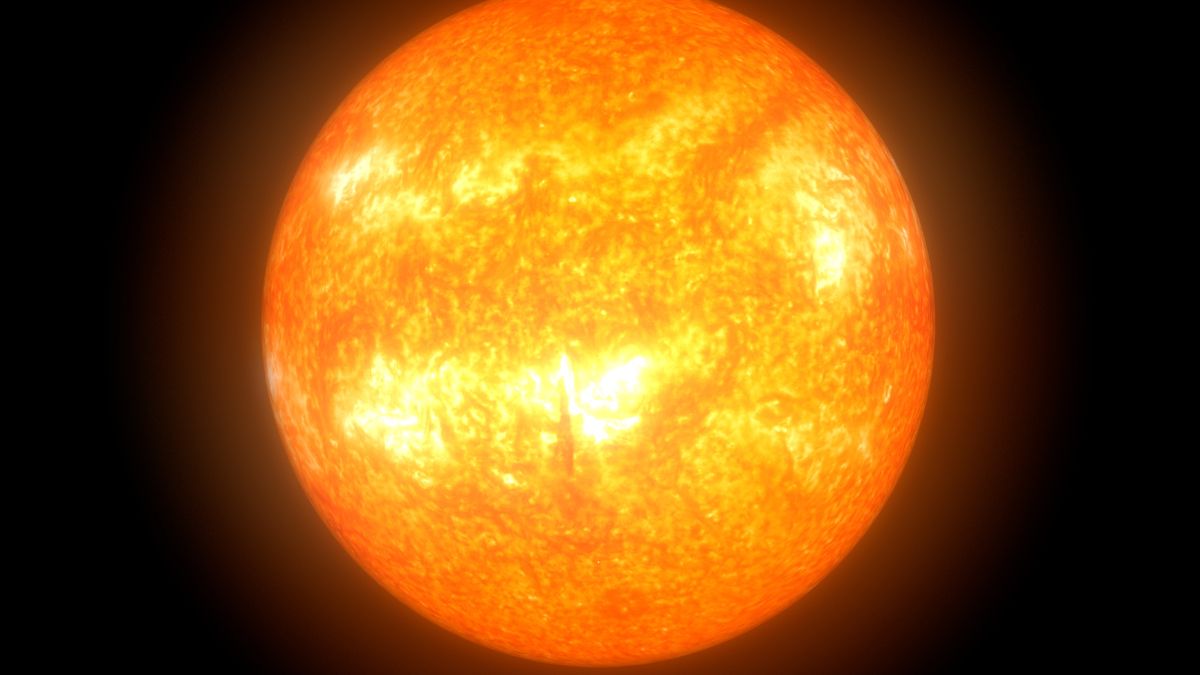
Our Sun is the center of our solar system. It gives us the light, heat, and energy that makes all life on Earth possible. It feels permanent, like it has always been there and will always be there. The Sun is incredibly stable, which is why life has had billions of years to grow and change. But just like anything else that burns fuel, the Sun has a limited supply. It is a star, and like all stars, it has a life cycle. It was born, it is living in its long middle age, and one day, it will die.
This process is not something we need to worry about in our lifetimes, or even in the lifetime of our entire civilization. The Sun’s death is a slow, gradual process that will take place over billions of years. Scientists have studied other stars in our galaxy to understand what this process looks like. By looking at stars in all different stages of their lives, from young to old, we can piece together a very accurate timeline for what will happen to our own Sun.
The Sun is about 4.6 billion years old, and it is only about halfway through its stable, main life. It has billions of years of fuel left. But eventually, that fuel will start to run low, and when it does, the Sun will begin a long, slow transformation. This change will one day end our solar system as we know it. So, what exactly happens when that fuel finally starts to run low?
How Long Will Our Sun Last in Its Current State?
Our Sun is currently in a phase called the “main sequence.” This is the long, stable, adult life of a star. Right now, deep inside the Sun’s core, an amazing process is happening called nuclear fusion. The Sun’s immense gravity squeezes the center so tightly that it creates unbelievable heat and pressure. In this environment, the Sun’s main fuel, which is hydrogen, gets smashed together. Four hydrogen atoms fuse to become one new, heavier atom: helium. This fusion process releases a massive amount of energy in the form of light and heat.
This energy, pushing outward from the core, is what keeps the Sun from collapsing in on itself. It creates a perfect balance. Gravity is always trying to crush the Sun, while the fusion energy is always trying to push it apart. This balance is called “hydrostatic equilibrium,” and it is what makes our Sun so steady and reliable. It has been burning hydrogen like this for about 4.6 billion years.
Scientists calculate that the Sun has enough hydrogen fuel in its core to keep this process going for about another 5 billion years. For all of human history, and for billions of years to come, the Sun will stay almost exactly as it is today. It gets just a tiny bit brighter over very long periods, but for the most part, it is the stable star we depend on. The “death” of the Sun only begins when this main fuel source, the hydrogen in its core, finally starts to run out.
What Is the First Sign the Sun Is Starting to Die?
The very first step in the Sun’s death happens deep inside the core, where we cannot see it. After about 5 billion more years, the Sun will have used up all the hydrogen in its super hot, dense center. The core will be full of the “ash” from this fusion: helium. At this point, the fusion engine in the very middle of the Sun stops. Without the outward push from fusion, gravity wins. The core, now made of helium, will start to shrink and collapse in on itself.
This shrinking is a big problem. As the helium core gets squeezed, it gets even hotter. This new heat radiates outward to the layer of hydrogen that surrounds the core. This shell of fresh, unburned hydrogen suddenly becomes hot enough to start its own nuclear fusion. This is called “hydrogen shell burning.” In a way, the Sun’s engine moves from the center to a ring around the center.
This new shell-burning is actually hotter and more intense than the old core-burning was. This extra energy pushes the Sun’s outer layers outward, causing the Sun to start expanding. It will slowly grow larger, and as it expands, it will also become significantly brighter. This stage, where the Sun begins to swell up and get more luminous, is known as the “subgiant” phase. It is the first major change and the first clear sign that the Sun has left its stable main sequence life behind.
What Will Happen When the Sun Becomes a Red Giant?
After the subgiant phase, the hydrogen shell burning continues to rage. This process creates more helium “ash,” which falls onto the core, making the core heavier and causing it to shrink even more. This, in turn, makes the core hotter, which makes the hydrogen shell burn even faster. It is a runaway cycle that rapidly pushes the Sun’s outer layers farther and farther into space. This is when the Sun enters the “red giant” phase.
During this phase, our Sun will become enormous. It will swell up so large that its expanding outer atmosphere will swallow the inner planets. Mercury will be the first to go, followed by Venus. The Sun will grow to be about 200 times its current size, meaning its surface will reach, or even pass, the current orbit of Earth. Our planet will either be consumed by the Sun’s fiery atmosphere or be so close that its surface becomes a scorched, molten wasteland. All water will boil away, the atmosphere will be stripped, and life on Earth will be impossible long before this happens.
You might wonder why it is called a “red” giant if it is producing so much energy. As the Sun’s surface expands, the same amount of heat is spread over a much, much larger area. This means the surface temperature will actually drop, causing it to glow a dull red-orange color instead of the bright yellow-white we see today. Even though its surface is “cooler,” it will be so huge that it will radiate far more total heat than it does now, baking the outer planets.
What Is the ‘Helium Flash’ Inside the Sun?
While the Sun’s outer layers are puffed up in the red giant phase, the helium core is still shrinking and getting hotter. For hundreds of millions of years, this helium ash has been building up, squeezed by gravity into an incredibly strange state. The core becomes so dense that a single teaspoon of it would weigh tons. This is called “electron-degenerate matter.” In this state, the core does not act like normal gas. Its pressure does not change with temperature.
The core keeps heating up, and when it finally reaches about 100 million degrees Celsius, something dramatic happens. The helium atoms suddenly become hot enough to fuse. Helium begins to fuse into a heavier element: carbon. Because the core is in that strange, degenerate state, this ignition is not slow and steady. Instead, the entire core ignites in a matter of minutes or hours. This sudden, runaway explosion of helium fusion is called the “helium flash.”
We would not see this flash from the outside. It happens deep within the red giant, and the Sun’s massive outer layers would absorb all the energy. The main effect of the helium flash is that it finally creates a new outward pressure in the core. The core stops shrinking. This new energy source “fixes” the core, and the Sun’s internal structure changes completely. The runaway hydrogen shell burning calms down, and the Sun actually shrinks, becoming smaller and hotter than it was as a red giant.
Will the Sun Become Stable Again After the Red Giant Phase?
Yes, for a little while. The helium flash gives the Sun a second chance at a stable life. After the flash, the Sun is now burning helium into carbon and oxygen in its core. It also still has the hydrogen-burning shell surrounding this new helium-burning core. The Sun settles into a new, stable balance. This phase is often called the “horizontal branch.”
During this time, the Sun is much smaller, hotter, and bluer than it was as a red giant. It is still much larger and brighter than it is today, but it is stable once again. It has found a new way to fight gravity. However, this second life is very short. While the Sun’s main sequence (hydrogen burning) lasts for about 10 billion years, this new helium-burning phase will only last for about 100 million years.
This is because helium is a much less efficient fuel than hydrogen. It burns hotter and faster, and it does not produce as much energy per fusion reaction. The Sun will quickly burn through all the available helium in its core. Once this helium fuel runs out, the Sun will find itself in the exact same situation as before: the engine in its core will die, and gravity will take over once again. This will trigger the Sun’s next, and final, giant phase.
Why Does the Sun Become a Red Giant a Second Time?
When the helium in the core is all used up, the core is left as a ball of carbon and oxygen “ash.” This new core has no fuel to burn. It is not hot or dense enough to fuse carbon. So, just like before, the core begins to shrink under its own gravity. As it shrinks, it gets incredibly hot. This new heat ignits the layers around the core.
This time, the Sun develops two burning shells. There is a shell of helium (just outside the carbon core) that starts to fuse, and a shell of hydrogen (outside the helium shell) that also continues to burn. This setup is called the “asymptotic giant branch” (AGB), and it is like having two powerful engines roaring at the same time. This double-shell burning is extremely unstable and generates a tremendous amount of energy.
This energy pushes the Sun’s outer layers outward again, causing the Sun to become a red giant for a second time. This time, it becomes even larger and more luminous than the first. It will easily swell past the orbit of Earth and perhaps even reach the orbit of Mars. This AGB phase is the Sun’s final act as a true star. It is very unstable, and it does not last long. The Sun is now in the process of truly dying.
What Is a Planetary Nebula and How Does the Sun Make One?
During the second red giant (AGB) phase, the double-shell burning is not steady. It is prone to “thermal pulses,” which are like giant, periodic hiccups or burps of energy. With each pulse, the Sun’s outer layers are pushed violently outward. The Sun’s gravity is now very weak at its enormous surface, and it can no longer hold on to its own atmosphere.
These thermal pulses, combined with a strong stellar wind, begin to puff away the Sun’s outer layers. Giant, expanding clouds of gas—mostly hydrogen and helium, enriched with the carbon and oxygen made inside the Sun—are blown off into deep space. Over a few thousand years, the Sun will shed its entire outer half, leaving its tiny, hot core behind.
This expanding cloud of gas is called a “planetary nebula.” The name is a bit confusing. It has absolutely nothing to do with planets. Early astronomers, looking through small telescopes, thought these colorful, glowing rings and bubbles looked like fuzzy planets, so the name stuck. The gas in the nebula glows because the hot, naked core left behind (the white dwarf) shines with intense ultraviolet light. This light energizes the gas, causing it to light up like a giant, beautiful neon sign in space. This nebula will continue to expand and fade for about 10,000 to 20,000 years until it mixes with the gas of the galaxy.
What Is a White Dwarf and Is It the Sun’s Final Form?
After the Sun has puffed its outer layers away to create a planetary nebula, the only thing left behind is the original core. This leftover core is called a “white dwarf.” This object is the final, collapsed remnant of a star like our Sun. It is no longer a star because it is not doing any nuclear fusion. It is not making any new heat. A white dwarf is more like a hot, cosmic ember left over from a giant fire.
This ember is made of the carbon and oxygen “ash” that the Sun created during its helium-burning phase. It is incredibly dense. The white dwarf that the Sun leaves behind will have about 60% of the Sun’s original mass, but it will be compressed into a ball only about the size of planet Earth. A single teaspoon of white dwarf material would weigh several tons.
A new white dwarf is one of the hottest objects in the universe, with a surface temperature of over 100,000 degrees Celsius. It shines with a brilliant, blue-white light, which is what illuminates the surrounding planetary nebula. This is the Sun’s final form. It will spend the rest of its existence, for billions and billions of years, doing nothing but slowly radiating its leftover heat into space and cooling down.
What Is a Black Dwarf?
The white dwarf is the Sun’s final, hot corpse. But the timeline does not technically end there. It just enters a very, very long and slow final stage. The white dwarf shines only because it is hot. It has no internal engine. Over an almost unimaginable amount of time, it will slowly lose its heat to the coldness of empty space.
After billions of years, it will cool from blue-white to yellow, then to orange, and then to a dull red. Eventually, after trillions of years, it will have radiated away all its remaining heat. It will become a “black dwarf”—a cold, dark, invisible chunk of super-dense carbon and oxygen, drifting through the dark. It will be the final, dead remnant of our once-bright Sun.
Scientists are very confident that black dwarfs are the final stage, but we have never seen one. The universe is “only” about 13.8 billion years old. This is not nearly enough time for even the very first white dwarfs to have cooled down enough to become black dwarfs. The process takes so long that no black dwarfs exist anywhere in the universe yet. Our Sun, and all the other stars like it, will one day be among the first.
Conclusion
The life and death of our Sun is a long and amazing story. It will spend about 10 billion years as a stable, hydrogen-burning star, giving life to its planets. When its fuel runs low, it will swell into a massive red giant, becoming a very different kind of star. It will get a brief second life burning helium, only to swell up again and finally puff its outer layers away into a beautiful planetary nebula.
All that will be left is a tiny, super-dense white dwarf. This hot ember will be the Sun’s tombstone, slowly cooling for trillions of years until it becomes a cold, dark black dwarf. This entire story is written in the laws of physics. We are lucky to live in the Sun’s long, stable springtime. We have billions of years before these changes even begin, giving us plenty of time to appreciate the calm, steady star that makes our world possible.
Knowing that even our Sun has a beginning, a middle, and an end, doesn’t it make you value the stable, warm sunshine we have right now even more?
FAQs – People Also Ask
What will happen to Earth when the Sun dies?
Long before the Sun completely dies, its expansion into a red giant will make Earth uninhabitable. In about 1 billion years, the Sun will be bright enough to boil Earth’s oceans. In about 5 billion years, when it becomes a red giant, it will swell up and likely swallow the Earth completely.
Will the Sun explode in a supernova?
No, the Sun will not explode. A supernova is a massive explosion that only happens to stars that are much, much bigger than our Sun (at least eight to ten times more massive). Our Sun is too small, so it will die by puffing its outer layers away to form a planetary nebula, leaving a white dwarf behind.
How do scientists know all this about the Sun’s future?
Scientists know this by studying the millions of other stars in our galaxy. We can see stars at every stage of their life cycle: young stars being born, main sequence stars like our Sun, red giants, planetary nebulas, and white dwarfs. By putting all these “snapshots” in order, we can build a very accurate model of how a star like our Sun lives and dies.
What color is a white dwarf?
A brand new white dwarf is extremely hot, so it shines with an intense blue-white color. As it cools over billions of years, its color will slowly change to yellow, then orange, and finally to a dim red, just before it fades to black.
Can humans survive the Sun’s red giant phase?
Humans will not be able to survive on Earth. The planet will become far too hot to support life long before the red giant phase even begins. To survive, humanity would have to find a way to travel to another star system or perhaps to a moon in the outer solar system, like around Jupiter or Saturn, which would temporarily warm up.
How much longer will the Sun live?
The Sun is about 4.6 billion years old and is in its “main sequence” or adult life. It has enough hydrogen fuel in its core to continue burning stably, just as it is now, for about another 5 billion years.
What is the Sun made of right now?
Right now, the Sun is made mostly of hydrogen (about 74% of its mass) and helium (about 24% of its mass). The remaining 2% is a mix of other, heavier elements like oxygen, carbon, neon, and iron, which were created in older, long-dead stars.
Will the Sun become a black hole?
No, the Sun will never become a black hole. Like supernovas, black holes are only formed from the deaths of extremely massive stars. The Sun is not nearly heavy enough. The final, leftover core of the Sun will become a white dwarf, not a black hole.
What is the hottest part of the Sun’s life cycle?
The Sun’s core will be at its hottest during the red giant phases, as the helium and carbon cores are shrinking. However, the hottest surface temperature will be when it becomes a new white dwarf. The Sun’s current surface is about 5,500°C, but a new white dwarf can have a surface temperature of over 100,000°C.
How big will the Sun get as a red giant?
During its first red giant phase, the Sun will swell to be about 200 times its current size, which is large enough to reach Earth’s orbit. During its second red giant phase (the AGB phase), it will get even bigger, possibly expanding out as far as the orbit of Mars.