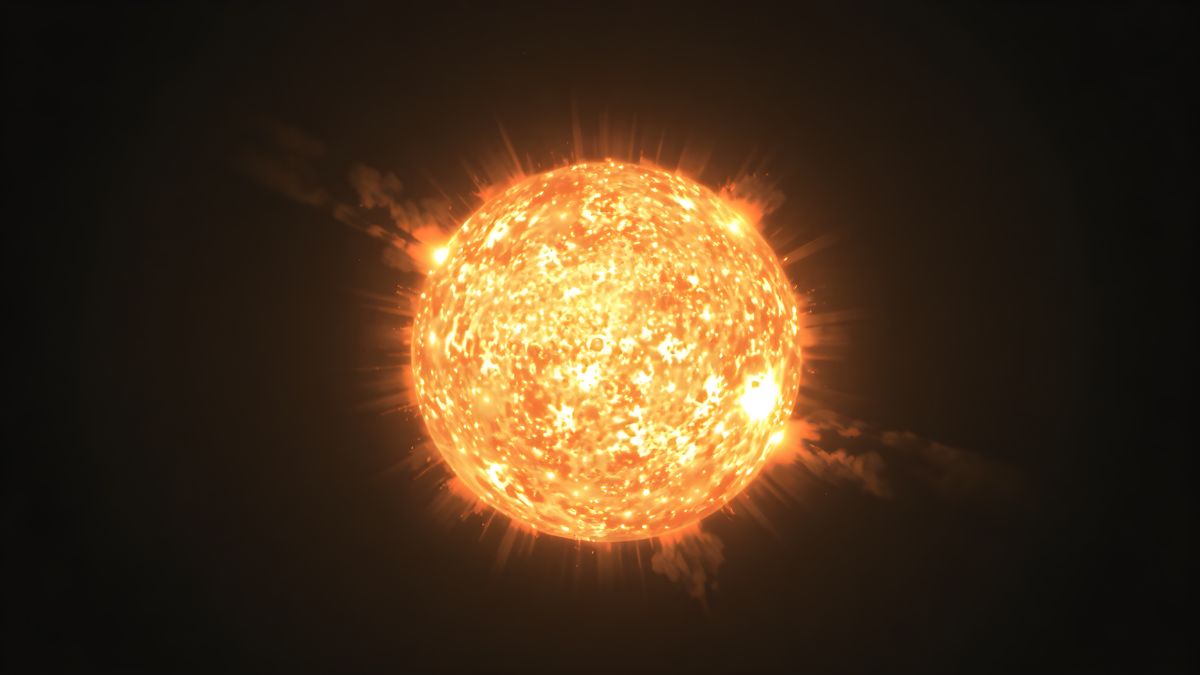
When we look up at the sky, the Sun is the most important object we see. It is a giant, bright ball of fire that gives us light, warmth, and energy. All life on Earth depends on it. To us, the Sun feels incredibly special. It is the center of our family of planets, our solar system. It is our star, and it is the only one we can see in such amazing detail.
But our galaxy, the Milky Way, is a huge place. It is a giant spinning city of stars, and scientists estimate it contains hundreds of billions of them. Our Sun is just one of those billions. This leads to a very big question: Is our Sun truly special, or is it just a common, average star? When we compare it to all the other stars out there, how does it measure up?
Understanding this helps us understand our own home in the universe. It also guides us in the search for other planets that might be like Earth. To find the answer, we need to look at our Sun like an astronomer would. We will compare its size, its type, its age, and even its location to its galactic neighbors. So, what do the facts tell us?
What Kind of Star Is Our Sun?
First, let’s give our Sun its proper name. In astronomy, stars are sorted into different types based on their temperature and the kind of light they give off. Our Sun is officially classified as a G-type main-sequence star. This name sounds technical, but it is easy to break down and tells us a lot about our star.
The “main-sequence” part is the most important. It means our Sun is in the long, stable, adult part of its life. It is not a “baby” star (a protostar) just forming, and it is not an “elderly” star (a red giant or white dwarf) that is running out of fuel. A main-sequence star spends its time doing one main job: turning hydrogen gas into helium gas in its core. This process, called nuclear fusion, is what releases the massive amounts of energy that we feel as light and heat. Most stars in the galaxy, including our Sun, are in this stable main-sequence phase.
The “G-type” part tells us about its temperature and color. Astronomers use letters to rank stars by heat, from the hottest (O-type) to the coolest (M-type). The order is O, B, A, F, G, K, M. O-type stars are incredibly hot and blue. M-type stars are much cooler and red. Our Sun, a G-type, is right in the middle. G-type stars have a surface temperature of about 9,941 degrees Fahrenheit (or 5,505 degrees Celsius). This “medium” temperature gives them a yellowish-white color. This is why our Sun is often called a “yellow dwarf.” While it is technically a dwarf star, the name is a bit misleading. It is not tiny, it just is not one of the giant stars in the universe.
How Common Are Stars Like Our Sun?
Now that we know our Sun is a G-type star, we can ask how many others like it are out there. If you were to count all the stars in the Milky Way, what would you find? You might be surprised to learn that stars like our Sun are not the most common type.
The vast majority of stars in our galaxy are actually red dwarfs (M-type stars). These are the smallest, coolest, and dimmest stars. They make up about 70% to 80% of all stars. For every G-type star like our Sun, there are about ten or twelve red dwarfs. These stars are the “economy cars” of the galaxy; they are everywhere, but they are so dim that we cannot see a single one from Earth with just our eyes, even though our closest stellar neighbor, Proxima Centauri, is a red dwarf.
So, where does that leave our Sun? G-type stars like ours make up only about 7.5% of the stars in the Milky Way. This means our Sun is in a minority group. It is not as common as a red dwarf, but it is not super rare either. The rarest stars are the giant, hot, blue O-type stars. These “superstars” are so massive and bright that they make up less than 1% of the galaxy’s population. You can think of it this way: if the galaxy’s stars were people, the red dwarfs would be the general population, and our Sun would be part of a smaller, but still very large, group. With hundreds of billions of stars in total, that 7.5% still means there are billions of other stars very similar to our Sun.
Is the Sun an Average Size for a Star?
This question can be tricky because the answer depends on how you define “average.” If “average” means the most common size, then the average star is a small, lightweight red dwarf. By that standard, our Sun is much larger, more massive, and brighter than the average star. In fact, our Sun is more massive and brighter than about 90% of all the stars in the Milky Way.
However, if “average” means “in the middle of the full range of sizes,” then our Sun is a perfect example. Astronomers have found stars that are truly extreme in size. On the small end, you have the red dwarfs, which can be as small as 10% the size and mass of our Sun. Even smaller are white dwarfs, which are the dead, leftover cores of stars like our Sun. A white dwarf is incredibly dense, packing the mass of a sun into a ball only the size of Earth.
On the other end, you have the giants and supergiants. These stars are so big they are hard to even imagine. A well-known red supergiant is Betelgeuse, in the constellation Orion. Betelgeuse is hundreds of times wider than our Sun. If you were to swap our Sun with Betelgeuse, it would swallow the orbits of Mercury, Venus, Earth, and Mars. And Betelgeuse is not even the biggest. One of the largest known stars, VY Canis Majoris, is a red hypergiant. It is so enormous that it would stretch out past the orbit of Jupiter, and possibly even Saturn. Next to these monsters, our Sun is just a tiny speck of dust. So, while our Sun is a “big fish” compared to the tiny red dwarfs, it is a “guppy” compared to the true giants. This places it comfortably in the “medium” or “mid-sized” category.
What About the Sun’s Brightness and Temperature?
Just like with its size, our Sun’s temperature and brightness are in a stable, middle range. Its surface temperature of around 10,000°F (5,500°C) is what makes it a G-type star. This is a very comfortable medium heat. Red dwarfs are much cooler, with surfaces around 4,000°F (2,200°C). Giant blue O-type stars are like blast furnaces, with temperatures soaring over 50,000°F (28,000°C).
Its brightness, or luminosity, is directly related to its size and temperature. Because it is much hotter and larger than the common red dwarfs, it is much, much brighter. If we replaced our Sun with our neighbor Proxima Centauri, Earth would be a dark, frozen world. The light we would get would be as dim as twilight, and the planet would be too cold for liquid water.
But on a galactic scale, our Sun is not a spectacular beacon. The brightest O-type stars can be millions of times more luminous than our Sun, shining with a brilliant blue-white light that outshines everything in their neighborhood. Our Sun is more like a steady, reliable 100-watt bulb in a city full of dim nightlights (red dwarfs) and giant stadium floodlights (blue giants).
The most special thing about our Sun’s brightness is not its power, but its stability. Our Sun has a very regular 11-year cycle of activity, but it does not have wild, unpredictable changes. Some stars, especially young red dwarfs, are very violent. They can unleash “superflares” that are thousands of times more powerful than any our Sun produces. A flare like that would be strong enough to strip the atmosphere off a nearby planet. Our Sun’s steady, calm, and reliable light has been a key factor in allowing complex life to develop and thrive on Earth.
Is It Special That Our Sun Is a Single Star?
When we look at our solar system, we see one star: the Sun. We might assume this is the normal setup for a star system. But in reality, it is very common for stars to have partners. Many stars are in binary systems, where two stars orbit each other. Some are even in trinary (three-star) or other multiple-star systems. Imagine looking up and seeing two or three suns in the sky!
For the most massive stars, being in a pair is the rule, not the exception. For stars in the same G-type family as our Sun, the numbers are more balanced. Studies show that for Sun-like stars, it is about a 50/50 or 60/40 split. This means that just over half of them are single “singletons” like our Sun, while just under half are in binary or multiple systems. So, being a single star is not rare, but it is not a guaranteed thing either. It is like flipping a coin and having it land on heads.
This “singleton” status is incredibly important for us. A single star provides a stable, predictable center of gravity. This allows planets to have stable, nearly circular orbits. This stability is what gives Earth its predictable seasons and a consistent amount of heat and light year after year. In many binary systems, a planet’s orbit would be much more chaotic. The gravity from the second star could pull on the planet, causing wild swings in its orbit. A planet might get too close to one star and get fried, then swing far away and freeze, or it could even be thrown out of the system entirely. Our Sun’s single status is a huge checkmark in the “good for life” category.
How Does the Sun’s Age and Lifespan Compare?
Our Sun is about 4.6 billion years old. Based on its mass and how fast it is burning its fuel, scientists calculate it has a total main-sequence lifespan of about 10 billion years. This means our Sun is “middle-aged.” It is in the prime of its life and will remain stable for another 4 or 5 billion years.
This 10-billion-year lifespan is a direct result of its mass. It might seem strange, but the bigger and more massive a star is, the shorter its life is. A massive O-type star has more fuel, but its immense gravity crushes its core, making its nuclear furnace burn at an insane rate. These stars “live fast and die young.” They burn through all their fuel in just a few million years, ending their lives in a massive explosion called a supernova. This is likely not enough time for complex life to evolve on any planets they might have.
At the other extreme, low-mass red dwarfs are the champions of long life. They have very little fuel, but they are “fuel-sippers.” They burn their hydrogen so slowly and efficiently that they can last for trillions of years. The universe itself is only 13.8 billion years old, so not a single red dwarf has ever died of old age yet.
Our Sun’s 10-billion-year lifespan is a fantastic “in-between.” It is long enough to provide the billions of years of stability needed for planets to form, for Earth to cool down, and for life to evolve from simple cells into complex beings like us. Our good luck is that we exist during this long, stable, middle-aged period of our star’s life.
What About the Sun’s Chemical Makeup?
When astronomers talk about the “recipe” for a star, they keep it simple. Stars are made almost entirely of the two lightest elements: hydrogen and helium. Everything else on the periodic table—like the oxygen we breathe, the carbon in our bodies, and the iron in our blood—is called “metals” by astronomers.
The very first stars in the universe were made of only hydrogen and helium. They had no “metals.” This means they could not have formed rocky planets like Earth, because the ingredients did not exist. Those first stars exploded as supernovae, and in that process, they forged all the heavier elements. They “seeded” the next generation of stars with these new ingredients.
Our Sun is one of these later-generation stars. Its composition is about 73.5% hydrogen and 24.8% helium. The last 1.7% is “metals.” That small percentage might not sound like much, but it is everything to us. That tiny slice of “metals” is the raw material that formed Mercury, Venus, Earth, and Mars. It is the stuff we are made of. A star with this much metal is called “metal-rich.” This “metal-rich” status is a key feature of our Sun. It means our Sun was born in a part of the galaxy that was already rich with the recycled materials of long-dead stars, giving it the building blocks to create a solar system with rocky planets.
Does Our Sun’s Location in the Galaxy Matter?
Yes, location is everything. Just like in a big city, the galaxy has dangerous neighborhoods and quiet, safe suburbs. The center of the Milky Way is like a chaotic, dangerous “downtown.” It is densely packed with stars, and it has a supermassive black hole (called Sagittarius A*) at its very heart. The region is flooded with intense radiation and a high rate of supernovae. Any life in this region would likely be sterilized.
The outer edges of the galaxy, the “galactic halo,” are like the empty countryside. It is very sparse, and the stars there are very old and “metal-poor.” They do not have enough of the heavy elements needed to build rocky planets.
Our Sun and solar system are located in what is called the Galactic Habitable Zone. This is a “Goldilocks” ring in the galaxy—not too close to the center, not too far out. We are in a quiet “suburb” called the Orion Arm, about 26,000 light-years from the dangerous center. This location is perfect. It is “metal-rich” enough to have all the ingredients for planets and life. But it is also quiet and safe, far from the intense radiation of the galactic core. Furthermore, our Sun has a very stable, nearly circular orbit around the galactic center, which keeps us from drifting into the more dangerous inner or outer regions of the galaxy.
Conclusion
So, is our Sun “special” or “average”? The most accurate answer is that our Sun is a special kind of average.
On paper, it is very average. It is a medium-sized, medium-temperature, middle-aged star. It is a G-type star, which is not the most common type, but there are billions of others just like it.
But it is the combination of its average traits with a few “special” or “less common” ones that makes it perfect for us. It is an average G-type star, but it is also a single star, which gives us stable orbits. It is an average-sized star, but it is also metal-rich, which gave us the ingredients for Earth. It is an average star, but it lives in a safe, quiet location in the galaxy.
Our Sun is not a rare cosmic superstar. Instead, it is a stable, reliable, and well-located star that has all the right ingredients to host a solar system with a planet like Earth. It is this “just right” set of qualities that makes it the most special star in the universe to us. It makes you wonder: with billions of other G-type stars in our galaxy, how many of them also have this perfect, life-giving combination of “average” and “special” traits?
FAQs – People Also Ask
What is the Sun mostly made of?
The Sun is almost entirely made of two gases. By mass, it is about 73.5% hydrogen and 24.8% helium. All the other heavier elements, like oxygen, carbon, and iron, make up less than 2% of its total mass.
Will our Sun ever explode?
No, our Sun will not explode in a giant supernova. Stars only do that if they are extremely massive. Our Sun is too small for that. Instead, in about 5 billion years, it will run out of hydrogen, swell up into a red giant, and then shed its outer layers. It will leave behind a small, hot, dense core called a white dwarf, which will slowly cool off over trillions of years.
What is the most common type of star in the galaxy?
The most common type of star by far is the red dwarf, also known as an M-type star. These stars are small, cool, and dim. They make up about 75% of all the stars in the Milky Way galaxy.
Is our Sun the biggest star?
No, our Sun is not even close to being the biggest star. While it is larger than 90% of stars (which are mostly small red dwarfs), it is tiny compared to giant and supergiant stars. Stars like UY Scuti or VY Canis Majoris are so enormous they would stretch past the orbit of Jupiter if they were in our solar system.
How old is our Sun?
Our Sun is about 4.6 billion years old. Scientists have determined this by studying the age of the oldest meteorites and rocks in our solar system, which all formed at the same time. The Sun is about halfway through its total 10-billion-year lifespan.
Why does the Sun look yellow to us?
The Sun’s light is technically white, containing all the colors of the rainbow. When its light enters Earth’s atmosphere, the shorter wavelengths (blue and violet) get scattered by gas molecules. This is why the sky looks blue. The light that is left over, which reaches our eyes directly, looks more yellowish or reddish, especially at sunrise and sunset.
What is a “yellow dwarf” star?
A “yellow dwarf” is the common nickname for a star like our Sun. The official classification is a G-type main-sequence star. This means it is a medium-sized, medium-temperature star that is in the stable, adult phase of its life, fusing hydrogen into helium.
Do all stars have planets like our Sun does?
We do not know if all stars have planets, but we know that planets are extremely common. Using powerful telescopes, astronomers have discovered thousands of planets orbiting other stars, which are called exoplanets. This suggests that billions of stars in our galaxy, and perhaps most of them, have their own solar systems.
How hot is the Sun’s surface?
The part of the Sun that we can see, called the photosphere, has a temperature of about 9,941 degrees Fahrenheit (or 5,505 degrees Celsius). The Sun is much hotter on the inside. Its core, where nuclear fusion happens, reaches an incredible 27 million degrees Fahrenheit (15 million degrees Celsius).
What will happen to the Sun when it dies?
When the Sun runs out of hydrogen fuel in its core in about 5 billion years, it will begin to die. It will expand dramatically into a red giant, becoming large enough to swallow the orbits of Mercury, Venus, and possibly Earth. After this phase, it will cast off its outer layers, creating a beautiful cloud called a planetary nebula, and its core will collapse into a very small, dense object called a white dwarf.