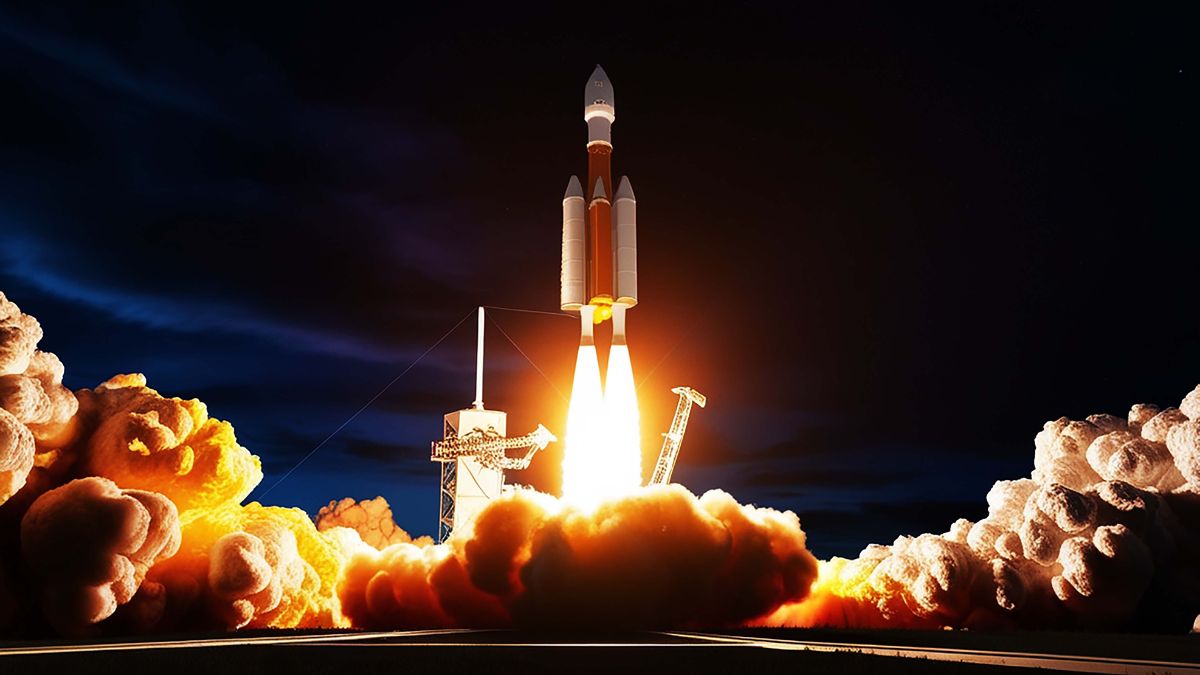
NASA, America’s space agency, has a big goal: to send astronauts back to the Moon. This exciting new chapter in space exploration is called the Artemis program. It is named after the twin sister of Apollo, who was the Greek goddess of the Moon. This name is fitting, as the program plans to land the first woman and the first person of color on the lunar surface. These missions are not just about repeating what the Apollo astronauts did in the 1960s and 1970s. The Artemis program has a much bigger goal. It is about building a long-term human presence on the Moon.
The plan is to learn how to live and work on another world. This includes building a small space station that orbits the Moon, called the Gateway, and setting up a base camp on the lunar surface. Everything NASA learns from Artemis will be used for the next giant leap in human history: sending the first astronauts to Mars. This is a huge and very difficult task. Sending humans into deep space is one of the most challenging things humanity can do, and safety is the number one priority.
Because safety comes first, the timeline for these missions can, and often does, change. As of late 2025, NASA has provided an important update to the Artemis schedule. Engineers have been studying data from the first test flight and need more time to make sure every system is perfect for the crews. So, what is the new plan for returning humans to the Moon?
What Is the New Official Timeline for Artemis Missions?
The most important takeaway from the new timeline is that the first two crewed missions, Artemis II and Artemis III, have been delayed. This decision was made to give engineering teams the time they need to solve complex technical problems. NASA’s leaders have been clear that they will launch when they are ready, not just to meet an old date on a calendar. The new schedule is built around mission safety and readiness.
The first mission with astronauts, Artemis II, is now scheduled to launch in early 2026, with NASA targeting a window between February and April. This mission was previously planned for 2025. Artemis II will be a historic flight, carrying four astronauts on a journey around the Moon and back. The crew includes three NASA astronauts—Reid Wiseman, Victor Glover, and Christina Koch—and one Canadian Space Agency astronaut, Jeremy Hansen. They will be the first humans to travel to the Moon in more than fifty years.
The crew of Artemis II will not land on the Moon. Their mission is a 10-day “test drive” of the Orion spacecraft with people on board. They will fly farther from Earth than any human has ever gone before. Their main job is to test all of an Orion capsule’s critical life support, navigation, and communication systems in the deep space environment. This ensures the spacecraft is ready for the landing mission that follows. As of late 2025, the team has just passed a major milestone by “stacking” the crew’s Orion capsule, which they named “Integrity,” onto the giant Space Launch System rocket.
Following the Artemis II flyby, the actual Moon landing mission, Artemis III, is now scheduled for mid-2027. This mission was originally planned for 2026. During Artemis III, two astronauts will make history by landing near the lunar South Pole. They will spend about a week on the surface, living out of their lander and conducting science experiments. This will be the first human landing on another world since the Apollo 17 mission in 1972.
Looking further into the future, the rest of the plan is still taking shape. Artemis IV is scheduled for late 2028. This mission is a major step in building the program’s long-term home in space. It will deliver the first major international habitat module to the Lunar Gateway. After docking, two astronauts will once again travel down to the Moon’s surface for another landing. Later missions, like Artemis V, will continue to build the Gateway and the surface base camp, with the goal of having a permanent, rotating human presence on the Moon.
Why Did NASA Change the Artemis Schedule?
When NASA makes the difficult decision to delay a major mission, the reason is almost always for astronaut safety. Space is an unforgiving environment, and the hardware used to keep humans alive is incredibly complex. The Artemis program is no different. The recent delays for Artemis II and III were caused by specific issues that engineers discovered during testing and after reviewing data from the uncrewed Artemis I test flight.
The Artemis I mission, which flew without a crew in late 2022, was a huge success. It proved that the giant Space Launch System rocket works and that the Orion capsule could fly to the Moon, orbit it, and come home. However, during its return, the capsule’s heat shield, which protects it from the 5,000-degree Fahrenheit (2,760-degree Celsius) heat of re-entry, did not perform exactly as expected. Engineers saw that the shield’s material wore away, or charred, in a new and unexpected pattern. While the capsule returned safely, NASA must understand exactly why this happened and be 100 percent sure it will not be a problem for a crewed flight.
Another major challenge was discovered in the Orion capsule’s life support system. This is the hardware that provides the crew with breathable air, filters carbon dioxide, and controls the temperature and pressure inside the capsule. It is the system the four astronauts will depend on to stay alive for their entire mission. During testing on the ground, engineers found problems with some of the valves and other electronic components in this system. NASA is taking extra time to replace and re-test these parts to ensure they are perfectly reliable.
There were also smaller issues that added to the delay, such as troubleshooting a battery system on the Orion capsule. When all these small and large challenges are added together, the agency decided the responsible choice was to give the teams more time to get everything right. The data, not the date, is what leads the decision. Pushing the timeline to early 2026 for Artemis II gives engineers the time they need to fix the heat shield, certify the life support system, and ensure the crew has the safest ride possible.
What Is the New Challenge with the Moon Lander?
The delay to the Artemis III landing mission in 2027 is not just because of the Orion capsule. It is also linked to the most critical piece of hardware for that mission: the lunar lander. This is the vehicle that will actually ferry two astronauts from lunar orbit down to the Moon’s surface. In a major change from the Apollo program, NASA is not building this lander itself. Instead, it is paying private American companies to design, build, and fly it as a service.
Originally, NASA awarded an exclusive contract to SpaceX to provide the lander for the first landing. SpaceX’s lander is a special, lunar-optimized version of its giant, futuristic Starship. This vehicle is revolutionary, but it is also incredibly complex and has never flown a mission like this before. To get to the Moon, the Starship lander must first be launched into Earth orbit. Then, SpaceX must launch multiple “tanker” Starships to meet it in orbit and refuel it. This process, known as orbital refueling, has never been done on this scale and is still in the testing phase.
As of late 2025, NASA officials have stated that the development of the Starship lander is “behind schedule.” Because this landing system is so vital to the mission and is facing technical delays, NASA has announced a major change in its strategy. The agency is “reopening the contract” for the Artemis III lander. This means that other companies now have a chance to compete with SpaceX to be the one to land the first crew. The main competitor is Blue Origin, a company founded by Jeff Bezos, which is leading a “National Team” to build its own lander called the Blue Moon.
This new decision creates a “race within the race.” SpaceX is still working hard on its Starship lander, but now Blue Origin has a chance to accelerate its own schedule and potentially win the historic Artemis III mission. For NASA, this is a good thing. It creates competition, which can lead to faster innovation and, most importantly, it gives the agency a second option. If one company faces a major delay, the other might be ready to fly. This new “lander competition” is now a key factor in the new timeline, with the 2027 date giving both companies more time to prepare.
What Are the Main Goals of the Artemis Program?
The Artemis program is about much more than just planting a flag and leaving footprints. It has deep, long-term goals that will change humanity’s relationship with space. The core of the program is to move from short-term exploration to a long-term, sustainable presence on the Moon. This means learning to live and work on another world for long periods.
The first major goal is scientific discovery. Artemis missions are targeting the Moon’s South Pole, a region that is completely different from where the Apollo missions landed. The South Pole has areas that are permanently dark, with craters that have not seen sunlight in billions of years. Scientists believe these “permanently shadowed craters” hold a precious resource: water ice. Finding and studying this ice is a top priority. Astronauts will be geologists, drilling cores from the lunar soil and searching for clues about the history of the solar system.
The second goal is to use that water ice. This is the key to sustainability, and it has a fancy name: In-Situ Resource Utilization, or ISRU. This simply means “living off the land.” If astronauts can mine that ice, they can melt it for drinking water. Even more importantly, they can use solar power to split the water molecule (H2O) into its two parts: hydrogen and oxygen. Oxygen is what we breathe. Liquid oxygen and liquid hydrogen are also the two most powerful forms of rocket fuel. This means the Moon could one day become a refueling station for missions deeper into space.
This leads to the third and ultimate goal: Mars. The Moon is a “proving ground” for the Red Planet. A trip to Mars is not a few days; it is a journey of many months, and astronauts would have to stay there for over a year. Before we take that giant leap, we must practice closer to home. On the Moon, NASA and its partners will learn how to build habitats, protect astronauts from deep space radiation, test new rovers and spacesuits, and practice using local resources. Everything we learn from building a base on the Moon will be used to plan the first human missions to Mars.
What Is the Lunar Gateway and Why Is It Important?
A key part of the long-term Artemis plan is the Lunar Gateway. This is a small space station that will not orbit the Earth, like the International Space Station (ISS). Instead, the Gateway will orbit the Moon. It is a vital piece of infrastructure that will serve as a command center, science laboratory, and waypoint for missions to the lunar surface. It is being built not just by NASA, but by a team of international partners, including the European Space Agency (ESA), the Japan Aerospace Exploration Agency (JAXA), and the Canadian Space Agency (CSA).
Think of the Gateway as a “pit stop” in deep space. In the current plan, the giant SLS rocket will launch the four-person Orion crew from Earth. Orion will then fly to the Moon and dock with the Gateway, which will be waiting in its special, long orbit. The crew can live and work on the Gateway for a time. When they are ready to go to the surface, two of the astronauts will transfer to a lunar lander (like the SpaceX Starship or Blue Origin’s Blue Moon) that is also docked at the Gateway. That lander will then take them down to the Moon’s surface and, after their mission, bring them back up to the Gateway.
This method has many advantages. The Gateway provides a stable, long-term platform in lunar orbit. It can be used as a communications hub, a science lab, and a safe haven for astronauts. Because it will have its own advanced power and propulsion system, it can even move to different orbits around the Moon to support landings in different locations, not just the South Pole. It also means the Orion capsule does not have to be redesigned to go down to the surface, and the lander does not have to be able to survive a fiery re-entry back to Earth. Each part is specialized for its one job.
The Gateway will be built in pieces, just like the ISS was. The first two main components, the Power and Propulsion Element (PPE) and the Habitation and Logistics Outpost (HALO), are scheduled to launch together on a private heavy-lift rocket. The Artemis IV mission in 2028 will be the first crew to visit the Gateway, and they will deliver the main I-HAB habitat, which is being built by Europe and Japan. Canada is contributing the Canadarm3, a highly advanced robotic arm for the station’s exterior. The Gateway is truly a global effort and the cornerstone of making our return to the Moon permanent.
What Rocket and Spaceship Are Used for Artemis?
To send humans on a 240,000-mile journey to the Moon, you need incredibly powerful and reliable hardware. The Artemis program relies on a new generation of rockets and spacecraft that are the most advanced ever built. The system is made of three main parts: the rocket, the crew capsule, and the lunar lander.
The rocket is NASA’s Space Launch System (SLS). This is the most powerful rocket in the world, officially. It is even more powerful than the mighty Saturn V rocket that sent the Apollo astronauts to the Moon. The SLS is a “super heavy-lift” rocket designed for one purpose: to launch the Orion spacecraft with its crew and service module on a high-speed trajectory to the Moon. The rocket stands over 322 feet tall and consists of a massive orange core stage, which is powered by four RS-25 engines (the same type of engines that powered the Space Shuttle). Attached to the sides are two of the largest solid rocket boosters ever built. This combination gives the SLS the raw power needed to escape Earth’s gravity.
The spaceship that the astronauts live in is the Orion capsule. This is the vehicle that sits on top of the SLS rocket. It looks similar to the old Apollo capsules but is much larger, safer, and far more advanced. Orion can support a crew of four astronauts for up to 21 days on its own. It has a high-tech “glass cockpit” with digital controls, advanced life support, and a new launch abort system to pull the crew to safety in an emergency. Attached to Orion is the European Service Module (ESM), built by the ESA. The ESM is Orion’s “engine room,” providing it with power from its solar arrays, propulsion from its main engine, and all the water and air the crew needs for the journey.
Finally, there is the Human Landing System (HLS), or the lunar lander. This is the piece that is currently in competition. The first option is the SpaceX Starship HLS. This is a special version of Starship, designed to operate only in space. It will be waiting in lunar orbit for the Orion to arrive. The second option is the Blue Moon lander from Blue Origin’s team. Both are designed to carry two astronauts from the Gateway or Orion down to the lunar surface, serve as their “base camp” for their week-long stay, and then launch them back up to orbit to meet their crewmates for the ride home.
What Will Astronauts Do at the Lunar South Pole?
The choice of the lunar South Pole as the landing spot for the Artemis missions is very deliberate. It is one of the most interesting and valuable places in the entire solar system. The astronauts’ main job will be a combination of intense scientific exploration and testing the technologies needed for a future base. They will be the first humans to ever explore this part of the Moon, and what they find could change the future of space exploration.
The first and most important job is to search for water ice. Because the Moon’s axis is only slightly tilted, there are craters at the poles where the sunlight never reaches the bottom. These “permanently shadowed craters” are incredibly cold, and scientists have strong data from robotic probes that these dark areas contain large amounts of water ice, frozen solid in the lunar soil (called regolith). The astronauts will wear new, high-tech spacesuits built by Axiom Space, which are designed to be more flexible and to handle the extreme cold. They will walk into these dark regions, collect samples, and drill into the regolith to confirm how much ice is there and how easy it is to access.
This hunt for ice is directly connected to their second main job: testing In-Situ Resource Utilization (ISRU), or living off the land. The Artemis III crew will bring experiments with them to test the first steps of “mining” this ice. The long-term goal is to build rovers and processing plants that can dig up the ice-rich soil, heat it to release the water vapor, and then collect and store the water. This water can then be used for drinking and growing plants, or it can be split into hydrogen and oxygen for rocket fuel. Proving this can be done is the single most important step toward making a lunar base self-sufficient.
Beyond the water ice, the astronauts will be front-line geologists and scientists. They will deploy advanced science experiments on the surface that can study the unique lunar environment, measure moonquakes, and analyze the solar wind. They will also test the new tools that will be needed for long-term stays, such as the Lunar Terrain Vehicle (LTV), a new unpressurized rover that will act as their “moon buggy” to explore for miles around their landing site. Their work will lay the foundation for the Artemis Base Camp, the first human outpost on another world.
Conclusion
The journey back to the Moon is a marathon, not a sprint. As of late 2025, the new Artemis timeline shows a deliberate and safety-focused approach. The first crewed flyby, Artemis II, is now set for early 2026, with the historic Moon landing, Artemis III, planned for mid-2027. These delays are not signs of failure; they are signs that NASA is taking the difficult challenges of the Orion heat shield and life support systems seriously.
The mission has also become more dynamic with the new competition for the lunar lander, a “race within the race” between SpaceX and Blue Origin to be ready for the 2027 landing. This strategy increases the chances of success and pushes technology forward. The goal remains the same: to return to the Moon with the first woman and first person of color, to build a sustainable presence at the South Pole, and to use the Moon as the proving ground for our next giant leap to Mars.
As NASA and its partners work to solve these challenges, the dream of a new lunar generation is closer than ever. When humans finally live and work on the Moon, what do you think will be the most important discovery they make?
FAQs – People Also Ask
Who is flying on the Artemis II mission?
The Artemis II crew consists of four astronauts. They are NASA astronauts Reid Wiseman (Commander), Victor Glover (Pilot), and Christina Koch (Mission Specialist), along with Canadian Space Agency astronaut Jeremy Hansen (Mission Specialist).
What is the new launch date for the Artemis III moon landing?
As of late 2025, NASA is targeting mid-2027 for the Artemis III mission. This mission will be the first time in over 50 years that humans will land on the Moon, and it will be the first-ever landing at the lunar South Pole.
Why did NASA reopen the moon lander contract?
NASA reopened the contract for the Artemis III lander because the development of the original lander, SpaceX’s Starship HLS, is behind schedule. By allowing other companies, like Blue Origin, to bid for the mission, NASA creates competition and provides a backup option to ensure a lander is ready for the 2027 mission.
What is the Lunar Gateway?
The Lunar Gateway is a small, international space station that will orbit the Moon. It will serve as a “pit stop” for astronauts, a science lab, and a command center. Crews will fly from Earth on the Orion capsule, dock at the Gateway, and then take a separate lander down to the Moon’s surface.
Why is the lunar South Pole so important?
The lunar South Pole is important because it has “permanently shadowed craters” where sunlight never reaches. Scientists believe these ultra-cold craters contain large amounts of frozen water ice, which could be used for drinking water, breathable air, and rocket fuel.
What is the difference between the SLS rocket and SpaceX’s Starship?
The SLS (Space Launch System) is NASA’s rocket, designed for a single purpose: to launch the Orion crew capsule from Earth to the Moon. SpaceX’s Starship is a fully reusable spacecraft and rocket system being developed for many purposes, including as a lunar lander (the HLS) for the Artemis program.
Who is building the new Artemis spacesuits?
The new spacesuits for walking on the Moon, known as xEMUs (Exploration Extravehicular Mobility Units), are being developed by a private company, Axiom Space. These suits will be more flexible and advanced, allowing for a greater range of motion and better protection in the cold, dark regions of the South Pole.
What problems did the Artemis I mission have?
The uncrewed Artemis I mission was a major success, but it revealed two main issues. The Orion capsule’s heat shield wore away in an unexpected pattern during re-entry, and engineers also found issues with the life support system’s valves and circuitry during ground testing, which are now being fixed.
Will the Artemis program go to Mars?
Yes, the ultimate goal of the Artemis program is to prepare for the first human missions to Mars. NASA is using the Moon as a “proving ground” to test all the technologies, hardware, and long-duration spaceflight experience needed to safely send astronauts on the much longer and more complex journey to the Red Planet.
What is the name of the Artemis II spacecraft?
The four-person crew of Artemis II has officially named their Orion spacecraft “Integrity.” They chose this name to represent the professionalism and unity of the entire international team working to make the historic mission a success.