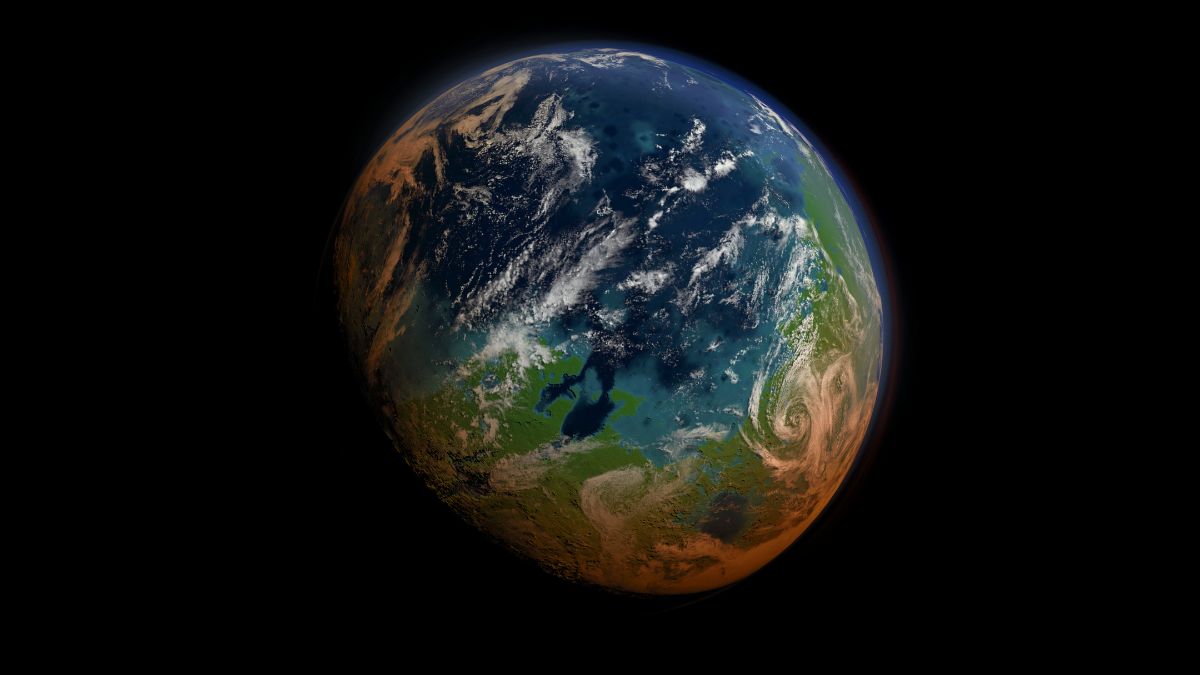
Mars has always captured our attention. It is our closest planetary neighbor that is not a scorching hothouse like Venus. We see its reddish tint in the night sky and send rovers to crawl across its dusty, rocky surface. We know it has giant canyons, towering volcanoes, and polar ice caps. It is a world that feels familiar, yet it is deadly silent, cold, and barren.
For decades, scientists and storytellers have asked a huge question: “Can we change Mars?” This idea is called terraforming. It is the process of taking a hostile, alien planet and re-engineering it to be like Earth. We are not just talking about building a small base with astronauts inside. We are talking about a future where people could walk outside on Mars, see a blue sky, feel a warm breeze, and breathe the air.
This is the biggest construction project imaginable, a dream of giving Earth a “sister planet.” But is it just science fiction, or could it one day be science fact? The dream is exciting, but the reality is filled with challenges that are almost as big as the planet itself. So, what would it actually take to turn the Red Planet green?
What Does ‘Terraforming’ Actually Mean?
The word “terraforming” literally means “Earth-shaping.” The “Terra” part comes from the Latin word for Earth. The goal of terraforming is to deliberately change a planet’s climate and atmosphere so that life from Earth, especially humans, could live there without needing a spacesuit.
To make Mars habitable, we would need to fix three main things. First, we need to thicken its atmosphere, which is currently far too thin to support life or liquid water. Second, we need to warm the entire planet up, from its current freezing-cold average temperature to something more comfortable. Third, we would need to change the new atmosphere’s chemical makeup, getting rid of toxic gases and adding breathable oxygen.
This is a process of starting a controlled, runaway greenhouse effect. The idea is to release gases trapped in the planet’s ice and soil, which would trap more heat, which would release more gases, and so on. It is an attempt to “re-start” a planet’s climate. It is the most ambitious idea humanity has ever had, and it would take centuries, or more likely, many thousands of years to complete.
Why Is Mars So Unfriendly to Life Right Now?
Before we can “fix” Mars, we have to understand just how broken it is from a human perspective. Right now, Mars is one of the most hostile environments in the solar system. If you were to step outside onto its surface without a high-tech spacesuit, you would not survive for even one minute.
There are four main problems:
- The Atmosphere: Mars has an atmosphere, but it is incredibly thin. The air pressure on the surface is less than 1% of Earth’s. This pressure is so low that it is below the “Armstrong limit.” This means that at the normal temperature of your body, your blood would literally boil. This thin air, which is 95% carbon dioxide ($\text{CO}_2$), also cannot stop radiation.
- The Temperature: Because the atmosphere is so thin, it cannot hold onto heat. Mars is extremely cold. The average temperature across the entire planet is a freezing -81 degrees Fahrenheit (-63 degrees Celsius). Even a “warm” summer day at the equator might only reach 70°F (20°C) before plunging back down to -100°F (-73°C) that same night. No liquid water can exist on the surface for long; it either freezes solid or turns directly into gas.
- The Radiation: This is a huge, invisible killer. Billions of years ago, Mars lost its global magnetic field. Earth’s magnetic field acts like a shield, protecting us from dangerous cosmic rays from deep space and the “solar wind” from our Sun. Mars has no such shield. The surface is constantly blasted with so much radiation that it is a serious long-term danger to astronauts and would destroy any Earth-life.
- The Soil: The Martian soil, or “regolith,” is full of toxic chemicals called perchlorates. These compounds, which are used in rocket fuel and fireworks, are harmful to the human thyroid gland. They would also make it very difficult to grow most Earth-plants directly in the soil.
How Would We Even Start to Warm Mars Up?
The very first step in any terraforming plan is to raise the temperature. The only way to do that is to thicken the atmosphere and start a greenhouse effect. The most common idea is to release the vast amounts of $\text{CO}_2$ (dry ice) and water ice that are frozen in the Martian polar ice caps and trapped in the soil. If we could turn that solid $\text{CO}_2$ into a gas, it would begin to trap heat from the Sun, which would warm the planet and release more $\text{CO}_2$, starting the cycle.
Several methods have been proposed to do this. One idea is to build giant orbital mirrors. These would be huge, thin mirrors in space, focusing sunlight onto the polar ice caps. This constant, extra sunlight would heat the dry ice and cause it to “sublimate,” meaning it turns directly from a solid into a gas, thickening the atmosphere.
A more direct approach would be to build factories on Mars. These factories would be designed to pump out “super” greenhouse gases, like perfluorocarbons (PFCs). These are man-made gases that are thousands of times more powerful at trapping heat than $\text{CO}_2$. A few of these factories, in theory, could start warming the planet much faster than mirrors. Some have even suggested crashing comets or asteroids into Mars to deliver heat and trapped gases, but this is extremely difficult to control and very dangerous. The idea of using nuclear weapons to melt the caps has also been mentioned, but most scientists agree this would be ineffective and would create harmful radioactive fallout.
Where Would We Get Enough Air to Breathe?
This is a two-part problem. First, you need enough air to create pressure. Second, you need the right kind of air, with oxygen.
The warming plan would solve the first part. As the planet warms, the $\text{CO}_2$ gas released from the poles and soil would thicken the atmosphere. The goal would be to get the air pressure high enough to at least pass the Armstrong limit, so your blood would not boil. This new, thicker atmosphere would also allow liquid water to flow on the surface without boiling away. But there is a big catch: you still could not breathe it. It would be almost 100% carbon dioxide, which is deadly to humans.
This is where the second, much longer, phase begins. We would need to add oxygen. The only known way to do this on a planetary scale is to use biology. This process is called ecopoiesis, which means “the making of a home for life.” We would have to introduce life from Earth, starting with the toughest organisms we have. First, we would seed the planet with genetically engineered microbes and lichens. These tiny lifeforms can survive in extreme cold, high radiation, and can “eat” the Martian rock for minerals.
Over hundreds or even thousands of years, these microbes would slowly process the $\text{CO}_2$ and release tiny amounts of oxygen as a waste product, just like plants do. After centuries of this, the soil might become healthy enough to support simple mosses. After more centuries, maybe we could plant hardy grasses. And after millennia, we might finally be able to grow pine trees. This is the same process that made Earth’s atmosphere breathable, but it took billions of years. We would be trying to speed it up, but it would still be an incredibly slow journey.
What Is the Biggest Problem Stopping Us from Terraforming Mars?
This all sounds like a great plan, but in 2018, NASA scientists published a study that was a major blow to the entire idea. The big question was: “Are the raw materials for terraforming actually on Mars?” Specifically, is there enough trapped $\text{CO}_2$ and water ice that we can easily get to?
After studying Mars for decades with multiple orbiters and rovers, the answer, unfortunately, appears to be no. The 2018 NASA study, led by Bruce Jakosky, looked at all the known “reservoirs” of $\text{CO}_2$. They measured the polar ice caps and estimated how much gas is trapped in the rock and soil. Their conclusion was that even if we used 100% of the $\text{CO}_2$ we can realistically access, we could only thicken the Martian atmosphere to about 7% of Earth’s.
This is not nearly enough. It would only raise the temperature by a small amount and would not be enough to keep liquid water stable. It would still be a cold, near-vacuum. The problem is that most of Mars’s original atmosphere was lost to space billions of years ago. The raw materials we need—the “building blocks” for a new atmosphere—are simply not there anymore. This single finding suggests that terraforming Mars using only the resources already on the planet is not possible with our current technology.
Could We Create an Artificial Magnetic Field for Mars?
Even if we could solve the “not enough gas” problem, perhaps by importing millions of comets (an almost impossible task), we would face the other “planet killer”: the lack of a magnetic field.
As we discussed, Earth’s magnetic field protects our atmosphere from the solar wind. The solar wind is a constant stream of high-energy particles flying off the Sun. On Mars, these particles hit the atmosphere directly. Over billions of years, this is what stripped Mars’s thick, ancient atmosphere away.
So, if we spent 100,000 years building a new, thick atmosphere, the solar wind would just start sand-blasting it away again. It would be like trying to fill a bucket with a giant hole in the bottom. We would have to constantly replenish the air, which is not sustainable.
To solve this, scientists have proposed a truly futuristic idea: building an artificial magnetic field for Mars. We would not have to re-start the planet’s core. Instead, we would build a giant machine, a powerful electromagnet, and place it in space between Mars and the Sun. This machine would be positioned at a special place called the “L1 Lagrange point,” where it would stay in a fixed position relative to Mars. This giant magnetic shield would act like a “windbreak,” deflecting the solar wind and allowing the planet to hold onto any new atmosphere we create. This idea is theoretically possible, but the scale of such a project is far beyond anything we can build today. It would be a structure thousands of miles wide, requiring enormous amounts of power.
What Are ‘Paraterraforming’ and Biodomes?
Because “full” terraforming seems so unrealistic, scientists and engineers have focused on more practical, smaller-scale ideas. If we cannot change the whole planet, why not just change a small part of it?
The most realistic and first step is building biodomes. These are what you typically see in movies about Mars bases. A biodome is a large, enclosed structure, like a giant bubble or a glass dome, where humans can live. Inside the dome, we would create our own “mini-Earth.” We would manufacture a perfect, breathable atmosphere, maintain a comfortable 72-degree temperature, build soil, grow plants for food and oxygen, and recycle all our water and air. Outside the dome, Mars would still be cold, deadly, and red. But inside, we could live safely without spacesuits. This is almost certainly how the first Martian cities will be built.
A much larger-scale version of this is called paraterraforming, which means “partial terraforming.” Instead of a building-sized dome, you would build a “roof” over an entire, large area. For example, we could find a deep crater or a canyon and build a massive, transparent lid over the top of it, sealing it off. This “roof,” which would need to be incredibly strong, would hold in a breathable atmosphere over an area of many square miles. You could have a whole town, with parks, lakes, and farms, all “under the lid.” This avoids the planet-wide problems of the magnetic field and lack of $\text{CO}_2$, but it is still an engineering challenge on a scale humans have never attempted.
Should We Even Be Allowed to Terraform Mars?
Beyond the massive scientific and engineering problems, there is one last, very important question: Should we? This is a huge ethical debate.
On one side, people argue that Mars is a dead, rocky world. It is not using its resources. Humanity, they say, needs a “backup planet” in case a disaster happens on Earth, like an asteroid impact or a climate catastrophe. Spreading life to another world, turning a dead planet into a living one, could be a great and noble achievement for our species. It is in our nature to explore, build, and expand.
On the other side, many scientists argue for planetary protection. Their argument is: what if Mars is not dead? We have not found life on Mars yet, but we also have not looked very hard. What if there are tiny, native Martian microbes (bacteria) surviving deep underground, perhaps in pockets of liquid water? If we begin terraforming, we would be dumping Earth life and changing the environment. Our “invader” microbes would almost certainly wipe out any native Martian life.
If we did this, we would destroy a “second genesis” of life before we even found it. We would never know how life can start on other planets. It would be the single greatest scientific and ethical crime in human history, like burning down an unknown, priceless library before ever reading one of its books. Many scientists argue that we have a moral duty to leave Mars as it is, to study it, and to protect it as a pristine, natural laboratory.
Conclusion
Terraforming Mars is one of the most exciting and inspiring ideas we have ever had. It is a dream of creating a new home for humanity among the stars. We have explored the grand ideas of how to do it, from giant space mirrors to seeding the planet with microbes.
However, when we look at the hard science, the dream meets a cold reality. As of 2025, the scientific consensus is that full, planet-wide terraforming is not a realistic goal. The 2018 NASA study showed that the raw materials—the carbon dioxide needed to build an atmosphere—are simply not there in amounts we can use. And even if they were, the lack of a magnetic field means any new atmosphere would be blown away into space.
The future of humanity on Mars is not likely to be one of walking in open-air forests. Instead, our future on the Red Planet will likely be in biodomes and paraterraformed cities. We will create small, artificial “Earthettes” under giant domes, living inside our protected bubbles while the cold, silent, and beautiful Martian landscape remains just outside the glass.
It forces us to think about our priorities. If we ever develop the god-like power to re-engineer an entire world, should we focus on building a new one, or should we use that incredible knowledge and energy to protect and heal the one we already have?
FAQs – People Also Ask
How long would it take to terraform Mars?
Even with futuristic technology, the most optimistic estimates suggest it would take several hundred years just to warm the planet and create a thick $\text{CO}_2$ atmosphere. To create breathable, oxygen-rich air using plants and microbes, it would likely take 100,000 years or more.
What is the biggest challenge to living on Mars?
The single biggest long-term danger for humans is the radiation. Mars has no magnetic field and a very thin atmosphere, so the surface is constantly hit by deadly cosmic rays and solar radiation. This can cause cancer and other health problems, meaning colonists would have to live underground or in heavily shielded habitats.
Could we breathe the air on Mars?
No, absolutely not. The Martian atmosphere is 95% carbon dioxide ($\text{CO}_2$), which is toxic to humans. It is also far too thin, with less than 1% of Earth’s air pressure. Without a spacesuit, a human’s blood would boil due to the low pressure.
Is there liquid water on Mars right now?
Scientists have confirmed there is a massive amount of water ice frozen in the polar ice caps and buried under the soil. There is strong evidence for “briny” (very salty) water flowing in some places, which can stay liquid at lower temperatures. However, there are no large, stable bodies of liquid fresh water on the surface.
What is the Armstrong limit and why does it matter on Mars?
The Armstrong limit is an altitude (or pressure) where water boils at the normal temperature of the human body (98.6°F or 37°C). The air pressure on Mars is below this limit. This means that without a pressurized spacesuit, the liquids in your body, like your tears, saliva, and the fluid in your lungs, would turn into gas, and your blood would boil.
Why did Mars lose its magnetic field?
Scientists believe that billions of years ago, the core of Mars cooled down. Earth has a molten, spinning outer core that acts like a giant electric dynamo, creating our magnetic field. The core of Mars, being a smaller planet, solidified. When the dynamo stopped, the magnetic field shut off.
What is a biodome on Mars?
A biodome is a completely enclosed, artificial habitat. It is like a giant, sealed greenhouse where humans could live on Mars. Inside, we would create our own breathable air, comfortable temperature, and high air pressure, allowing us to live and grow food without spacesuits.
What are perchlorates in Martian soil?
Perchlorates are toxic chemicals found in the Martian soil. They are bad for the human thyroid gland and would also make it difficult for Earth-based plants to grow. Any soil used for farming on Mars would first have to be “washed” or processed to remove these harmful chemicals.
Could we use nuclear bombs to warm Mars?
This idea has been proposed, but most scientists believe it would not work. The amount of energy needed to melt the ice caps is far greater than even our largest nuclear bombs could provide. Plus, it would spread dangerous radioactive fallout across the planet, making it even more hostile to life.
What is the difference between terraforming and paraterraforming?
Terraforming is the process of changing the entire planet to be like Earth. Paraterraforming (“partial-terraforming”) is the more realistic idea of building a huge, transparent “roof” or “lid” over a large area, like a crater or canyon. This lid would hold in a breathable atmosphere over a city-sized area, but the rest of the planet would be left unchanged.