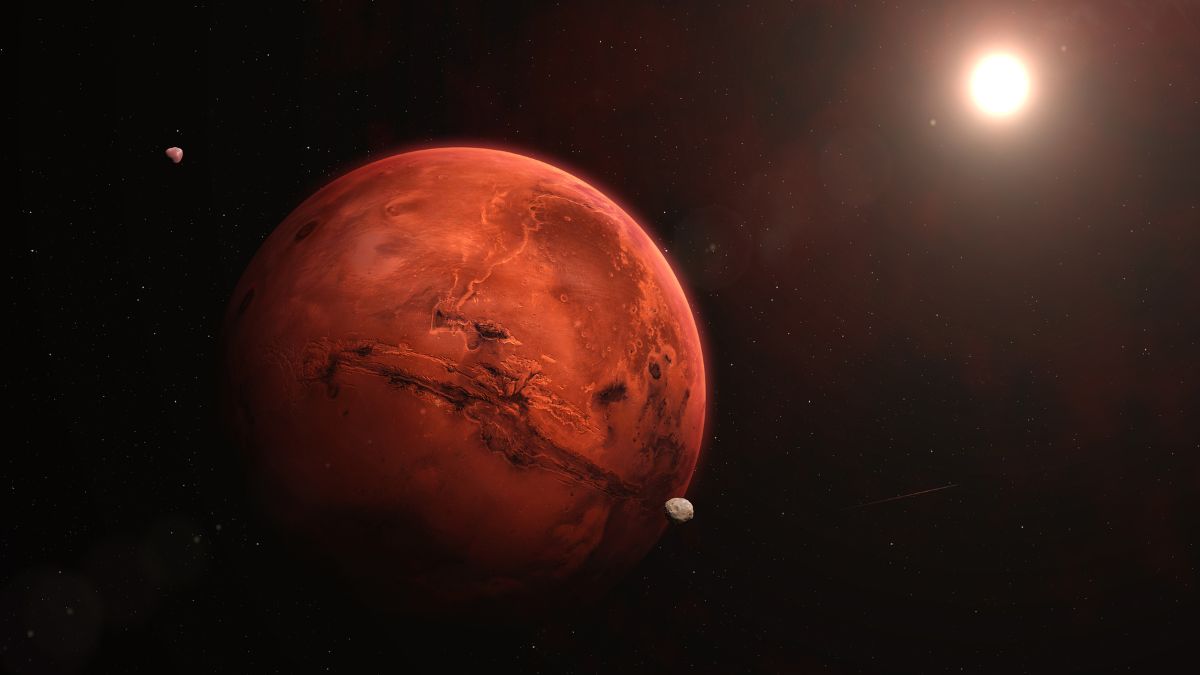
When we talk about Mars, the “Red Planet,” the first thing that often comes to mind is water. For decades, scientists have been hunting for it. We know that Mars is not a completely dry world. We can see vast, white polar ice caps with our telescopes, and we know these are made of both water ice and frozen carbon dioxide (dry ice). Our rovers and orbiters have sent back pictures of landscapes that were clearly shaped by water, like ancient, dried-up riverbeds, deep canyons, and massive lake basins.
The evidence is clear: Billions of years ago, Mars was a warm, wet planet. It had rivers, lakes, and possibly even a large, shallow ocean in its northern hemisphere. The Mars rovers, like Curiosity and Perseverance, are driving around in these ancient lakebeds right now, studying the rocks that formed at the bottom of that long-lost water. But this leads to the most important question of all: that water is all in the past. What about the present? Is there any liquid water on Mars today?
The search for liquid water is the central goal of Mars exploration. On Earth, every single living thing we know of, from the tiniest microbe to the largest whale, needs liquid water to survive. Finding it on Mars, even if it is just a small, salty pocket underground, would be the single greatest discovery in our search for life beyond Earth. But finding it on a frozen desert planet is incredibly difficult. So, if Mars is so cold and dry, where could this liquid water possibly be hiding?
Why Is Liquid Water So Important in the First Place?
You will often hear NASA scientists use the phrase “follow the water.” This has been the main strategy for exploring the solar system, and for good reason. It is all about the search for “habitability,” which is a simple word for a big idea: Does a place have the right conditions for life to exist? On our planet, the number one ingredient for a habitable environment is liquid water. It acts as a universal solvent, meaning it can dissolve nutrients and chemicals, move them around, and help along the chemical reactions that we call life.
If we can find a place on Mars that has liquid water today, that spot would instantly become the most interesting place on the planet. It would be a “habitable environment.” This does not mean we would find life there, but it would be the first place we would know to look. Any life on Mars would likely be simple, like bacteria. If life ever did get started on Mars billions of years ago when it was wet, it is possible that it retreated underground when the planet lost its atmosphere and froze. It might be surviving today in these small, hidden pockets of water.
There is another, more practical reason we are looking for water. When humans eventually travel to Mars, we cannot bring everything we need with us. A mission to Mars would be too long and the rockets too heavy. Astronauts will need to “live off the land.” Water is the most important resource they could find. They could drink it, use it to grow plants for food, and even split the water molecule (H2O) into its parts. The “H” is hydrogen, which can be used as rocket fuel, and the “O” is oxygen, which they can breathe. Finding a source of usable water on Mars is essential for the future of human exploration.
Why Can’t Liquid Water Exist on the Martian Surface?
This is the biggest problem in our search. The surface of Mars today is a terrible place for pure liquid water. It simply cannot last for more than a few moments. There are two main reasons for this: the air pressure and the temperature.
First, let’s talk about air pressure. The atmosphere on Mars is incredibly thin. It is about 100 times thinner than Earth’s atmosphere. At sea level on Earth, we have an air pressure that is strong enough to “push down” on water, holding it in its liquid state. On Mars, the air pressure is so low that this “lid” is gone. If you were to pour a cup of pure water onto the ground, it would not form a puddle. It would instantly start to boil and vaporize, turning directly into a gas (water vapor). This is true even though it is extremely cold.
The second reason is the temperature. Mars is a frozen desert. The average temperature for the entire planet is around minus 63 degrees Celsius (minus 81 degrees Fahrenheit). At the poles in winter, it can drop to minus 125 degrees Celsius (minus 195 degrees Fahrenheit). While it can get just above freezing at the equator on a summer day, it plummets well below freezing again every single night. Any pure water that did not boil away would freeze solid almost instantly. Because of this combination of low pressure and freezing temperatures, pure liquid water cannot be stable on the Martian surface. This is why the search for water has been forced to go underground.
What Happened to the Dark Streaks on Crater Walls?
For about a decade, scientists were very excited about a specific feature that seemed to break this rule. Orbiters spotted long, dark streaks that would appear on the slopes of crater walls. These features were named Recurring Slope Lineae, or RSLs. What made them so special is that they were seasonal. They would appear in the warm summer months, flow down the slopes, and then fade away as winter returned. This was the best evidence we had for liquid water on the surface of Mars.
The leading theory was not that this was pure water. Instead, scientists believed it was a “brine.” We will talk more about brines later, but they are just very, very salty water. This high salt content would act like antifreeze, allowing the water to stay liquid at much colder temperatures. The idea was that salty ice just under the surface would melt in the summer sun, “weep” out onto the slope, and flow downhill before it evaporated, leaving a dark, wet stain. This was a very exciting and popular theory.
However, this is one of the biggest updates in our search. In recent years, scientists have found new evidence that points to a different answer. More detailed analysis from orbiters, like the HiRISE camera, showed that these streaks behave just like dry sand or dust. They only appear on slopes that are steep enough for dry grains to avalanche. When scientists looked at the properties of these streaks, they did not match the signature of wet ground. It seems much more likely that the RSLs are just small, dry avalanches of dust and sand. The seasonal change might be caused by tiny changes in the air, not by melting water. As of 2025, most of the science community believes that RSLs are not liquid water. This was a disappointing result, but it helped scientists refocus their search in other, more promising places.
Are There Really Giant Lakes Hidden Under the South Pole?
If water cannot be on the surface, the next best place to look is under the surface. And in 2018, scientists announced a discovery that shocked the world. The European Space Agency’s Mars Express orbiter has an instrument called MARSIS. This is a ground penetrating radar that can send radio waves deep into the planet and listen for the “echo” that bounces back. It is a way of “seeing” underground. While scanning the southern polar ice cap, MARSIS detected an extremely “bright” reflection.
This bright spot was found about 1.5 kilometers (1 mile) beneath the ice. On Earth, scientists use this exact same radar technique to find subglacial lakes, which are bodies of liquid water trapped under the ice sheets in Antarctica. The signal from Mars looked identical to the signal from a subglacial lake on Earth. The data suggested there was a body of liquid water, about 20 kilometers (12 miles) wide, hidden deep beneath the Martian ice. This was not a small pocket; it was a large, stable lake. To stay liquid at those temperatures, it would have to be an incredibly salty brine, even saltier than Earth’s oceans.
This discovery is still a topic of intense debate. Since the original announcement, other studies have questioned this conclusion. Some scientists have shown that other materials, not just water, could create a similar bright reflection. A layer of specific minerals, like salty, iron rich clays, or layers of volcanic rock could “trick” the radar into looking like a lake. Also, the temperatures under the ice cap are believed to be so incredibly cold, it is very hard to explain how any water, even the saltiest brine, could stay liquid. So, is there a lake? The answer is a “maybe.” It remains a very interesting possibility, but the evidence is not certain.
What Did NASA’s InSight Lander Discover Deep Underground?
While the debate about the polar lake continues, a different NASA mission gave us the strongest evidence yet for liquid water on Mars. This evidence came from a very unexpected source: “Marsquakes.” The InSight lander, which successfully completed its mission in 2022, was not a rover. It was a robotic geologist that sat in one place. Its most important instrument was a seismometer, a super sensitive device designed to listen for vibrations traveling through the planet.
For several years, InSight listened to and recorded hundreds of Marsquakes. Scientists on Earth can study how the “waves” from these quakes travel through the planet. Just like an ultrasound can show us what is inside a human body, seismic waves can show us what is inside a planet. These waves change speed and shape when they pass through different materials, like solid rock, molten rock, or water.
In 2024, scientists analyzing all of InSight’s data announced a groundbreaking discovery. They found a large “anomaly” deep underground, located in the planet’s crust. This layer is between 10 and 20 kilometers (about 6 to 12 miles) below the surface. In this zone, the seismic waves slowed down in a way that is best explained by one thing: fractured rock that is “saturated,” or completely filled, with liquid water. This is not an open lake, but a huge, deep aquifer, like a giant sponge of rock and water. The amount of water trapped in this layer could be enormous, possibly more than was in Mars’s ancient oceans. This water is likely “fossil water” that has been trapped there for billions of years, protected from the harsh surface. This is, as of 2025, the most compelling evidence we have for a large, stable reservoir of liquid water on Mars today.
How Do Rovers Like Perseverance Help the Search?
It is easy to get confused about what the rovers are looking for. When you see news from the Perseverance or Curiosity rovers, it is almost always about water. But they are looking for the history of water, not liquid water in the present. Think of the rovers as field geologists with a rock hammer. Their job is to explore areas that we know used to be wet.
For example, the Perseverance rover is exploring Jezero Crater. Billions of years ago, this crater was a deep lake, fed by a flowing river that built a massive delta. Perseverance is driving on that ancient river delta right now. The Curiosity rover is exploring Gale Crater, which was also a long-lived lake. These rovers use their drills and lasers to study the rocks. They look for specific minerals like clays, sulfates, and carbonates. These are minerals that, on Earth, only form in the presence of liquid water. Finding them is like finding a “bathtub ring” that proves water was there for a very long time.
This job is critical because it tells us where to look for signs of ancient life. Perseverance is collecting rock samples that have the best chance of preserving “biosignatures,” which are the fossilized signs of past microbial life. A future mission, called Mars Sample Return, will fly to Mars, pick up these samples, and bring them back to Earth. So, the rovers are not looking for current water, but they are proving that Mars was once habitable and are collecting the evidence we need to search for an answer to the “Are we alone?” question.
What Is “Briny” Water and Why Is It Our Best Bet?
We have used the word “brine” several times, and it is a very important concept. As we learned, the surface of Mars is too cold and the air is too thin for pure water to stay liquid. But what if the water is not pure? Think about what we do on Earth in the winter to melt ice on our roads. We spread salt. Salt is a “depressant,” which means it lowers the freezing point of water.
The soil on Mars is full of special salts called “perchlorates.” The Phoenix lander, which landed near the north pole in 2008, confirmed these salts are widespread. These perchlorate salts are very good at lowering the freezing point of water. If you mix water with these salts, you create a brine that can stay liquid at temperatures as low as minus 70 degrees Celsius (minus 94 degrees Fahrenheit). This is cold enough to be liquid, at least for short times, in some places on Mars.
This is why scientists are not really looking for pure H2O. They are looking for these super-salty brines. These brines can also pull water vapor directly out of the thin Martian atmosphere, a process called “deliquescence.” This could create tiny, temporary pockets of liquid brine in the first few inches of soil. This is likely the only way liquid water could exist near the surface. While the RSL streaks are no longer our best example, the theory of brines is still the most likely way for any “near surface” water to exist.
Conclusion
The search for liquid water on Mars has been a story of high hopes and difficult challenges. We have learned that the Red Planet is not a simple, dry world. It is a complex planet with a watery past and a hidden, frozen present. The search has now clearly shifted. We are no longer focused on the surface; we are looking deep underground.
Our rovers, Perseverance and Curiosity, continue to paint a vivid picture of a past, habitable Mars, giving us a reason to keep looking. The mysterious “bright reflections” under the south pole, first thought to be lakes, are now a fascinating scientific puzzle that we still need to solve. And most recently, the data from the InSight lander has given us our strongest evidence yet: a vast, deep, and ancient reservoir of water locked in the planet’s crust. This deep water is far beyond our reach for now, but its discovery changes how we see Mars.
It tells us that the water from Mars’s ancient oceans did not all escape into space; much of it may be trapped deep underground. This completely changes our understanding of the planet’s water budget. It also gives us a new, tantalizing target in the search for life. If this deep, planet-wide water reservoir really exists, could it be a stable, hidden habitat where life has held on for billions of years?
FAQs – People Also Ask
Is there liquid water on Mars right now?
Yes, scientists believe there is. The strongest evidence, which came in 2024 from the InSight lander, points to a massive reservoir of liquid groundwater trapped in rock 10 to 20 kilometers deep. There may also be a disputed subglacial lake under the south pole.
Why is Mars’s atmosphere so thin?
Scientists believe Mars lost its global magnetic field billions of years ago. Without this protective field, the solar wind from the Sun slowly stripped away the planet’s thick, early atmosphere over millions of years, leaving the thin one we see today.
What did the Mars rovers find?
The rovers (like Curiosity and Perseverance) have found overwhelming evidence of ancient liquid water. They have found dried-up riverbeds, lakebeds, and rocks with minerals like clays and sulfates, which can only form in the presence of water.
What are the polar ice caps on Mars made of?
The Martian polar caps are made of two things. The very large, permanent caps are made mostly of water ice, just like on Earth. They also have a thin, seasonal “cap” of frozen carbon dioxide (dry ice) that forms on top of them during the Martian winter.
What is a subglacial lake?
A subglacial lake is a body of liquid water that is trapped underneath a thick glacier or ice sheet. On Earth, they are found in places like Antarctica, and scientists in 2018 announced they may have found one under the southern polar ice cap of Mars.
Did NASA really find an ocean on Mars?
NASA found evidence of two different “oceans.” First, rovers have confirmed that Mars used to have a large, shallow ocean on its surface billions of years ago. Second, the InSight lander recently found evidence for a current “ocean” of groundwater, a massive amount of liquid water trapped in rock deep underground.
What are Recurring Slope Lineae (RSLs)?
These are dark, seasonal streaks that appear on steep, sunny slopes on Mars. For many years, scientists thought they were the best evidence for liquid water on the surface, but most scientists now believe they are just avalanches of dry sand and dust.
What is briny water?
Briny water is water that is extremely salty, much saltier than Earth’s oceans. Because salt acts as an antifreeze, briny water can stay liquid at much colder temperatures than pure water. This is the only type of water that could possibly exist near Mars’s cold surface.
What was the InSight lander’s mission?
The InSight lander was a stationary science platform, not a rover. Its main mission was to study the interior of Mars. It used a seismometer to listen for “Marsquakes” and a heat probe to measure the planet’s internal temperature.
Could there be life in the water under Mars’s surface?
This is the main reason scientists are so excited. The deep groundwater discovered by InSight is completely protected from the harsh radiation on the surface. If it has a source of energy and nutrients, it is possible that microbial life could exist there, safe from the surface.