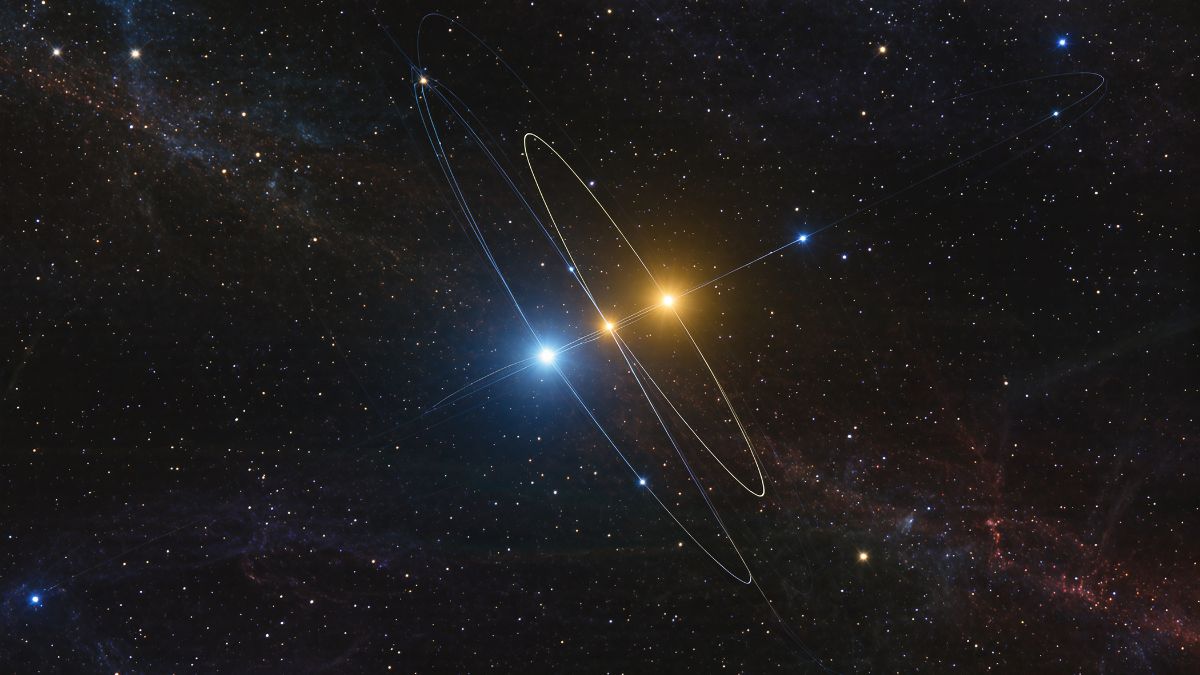
When we look up at the night sky, all stars look like tiny, pinpricks of light. Even our own Sun, which is massive, looks like a small disk. It is hard to grasp just how enormous these objects can be. Our Sun is actually an average sized star. There are stars out in the universe so large they make our Sun look like a grain of sand. We call these giant stars “supergiants” and “hypergiants,” and they challenge our understanding of what is possible in space.
Finding the single “biggest” star sounds like a simple task. You might expect a clear winner, a champion that holds the title. However, in astronomy, the answer is rarely that easy. The universe is vast, and measuring things that are thousands of light years away is extremely difficult. The star we think is the biggest today might lose its title tomorrow as our technology gets better and we make new discoveries.
The question itself is also tricky. When we ask what is the “biggest,” we could mean two very different things. Do we mean the star that takes up the most space, the one with the largest width or volume? Or do we mean the star that has the most stuff packed into it, the one with the most mass or weight? These two things are not the same, and the record holders are completely different stars. So, which one truly deserves the title?
What Does ‘Biggest’ Mean for a Star?
This is the most important question we need to answer. Let’s break down the two ways to measure “biggest” using a simple example. Imagine you have a giant, fluffy ball of cotton candy. It is huge. It might be bigger than your head and hard to wrap your arms around. It has a very large volume (it takes up a lot of space). Now, imagine you have a small, solid ball of steel, like a cannonball. It might fit in the palm of your hand, but it is incredibly heavy. It has a very large mass (it contains a lot of matter).
Stars are just like this. Some stars are like the cotton candy. They are enormous in size, puffed up, and spread out. Their outer layers are very thin, almost like a vacuum. These stars are the “largest” by volume. Other stars are like the cannonball. They are much smaller, very dense, and tightly packed. These stars are the “most massive” by mass.
So, when we ask, “What is the biggest star?” we are really asking two separate questions. The first question is: What is the largest star by radius? The second question is: What is the most massive star? The answers to these questions take us to two very different and fascinating objects in our galaxy. One is a cool, bloated red giant, and the other is a blindingly hot, bright blue star.
So, What Is the Largest Known Star by Size?
The current champion for the star with the largest known radius, the one that takes up the most space, is called Stephenson 2-18. It is also known as St2-18. This star is a red hypergiant. This means it is an enormous star that is in the late stages of its life. It is located in our own Milky Way galaxy, in a star cluster called Stephenson 2, which is about 19,000 to 20,000 light years away from Earth. Because it is so far away and hidden by dust, we cannot see it with our eyes.
Just how big is Stephenson 2-18? The numbers are difficult to imagine. Astronomers estimate its radius is about 2,150 times the radius of our own Sun. If you were to replace our Sun with Stephenson 2-18, its surface would swallow the orbits of Mercury, Venus, Earth, Mars, and even Jupiter. The edge of the star would stretch all the way out past the orbit of Saturn. Our entire inner solar system would be inside this single star.
To put this in another perspective, let’s think about volume. The volume of a sphere is related to its radius cubed. This means if Stephenson 2-18 is 2,150 times wider than the Sun, it would take almost 10 billion Suns to fill up the same amount of space. If you were in a spaceship traveling at the speed of light, it would take you about 14 seconds to fly around the Sun. To fly around Stephenson 2-18, it would take you nearly nine hours. It is a truly colossal object, the undisputed king of size as far as we know.
What Happened to UY Scuti, the Old Record Holder?
If you have read about this topic before, you might be thinking, “Wait, I thought the biggest star was UY Scuti?” For many years, UY Scuti was considered the largest star. It is also a red supergiant star, and its old measurements suggested it was about 1,700 times the radius of the Sun. This would have also made it large enough to swallow Jupiter’s orbit. It was featured in countless articles and videos as the biggest star in the universe.
However, this highlights how difficult it is to measure these distant stars. The size of a star is not measured directly. Astronomers calculate it based on its brightness, its temperature, and, most importantly, its distance. For a long time, the distance to UY Scuti was not known very well. The estimates were based on older methods, which had a lot of uncertainty.
Then, a space observatory called Gaia came along. Gaia’s mission is to create an incredibly precise 3D map of our galaxy, measuring the exact positions and distances of billions of stars. When Gaia measured UY Scuti, it found something surprising. The star was actually much closer to us than previously thought. The new, more accurate distance is around 5,100 light years, not the 9,500 light years of the older estimates. Because it is closer, its true brightness (its luminosity) is actually much lower. When astronomers recalculated its size with this new, lower brightness, the star’s estimated radius shrank dramatically. Today, UY Scuti is thought to be somewhere between 750 and 900 times the radius of the Sun. This is still gigantic, big enough to reach past the orbit of Mars, but it is nowhere near the size of Stephenson 2-18.
What Is the Most Massive Star We Have Found?
Now let’s look at the other kind of “biggest”: the cannonball. What is the star with the most mass? The winner in this category is a star named R136a1. This star is a monster, but in a completely different way. It is located about 163,000 light years away in the Large Magellanic Cloud, a small satellite galaxy that orbits our own Milky Way. It is part of a very young, very dense, and very bright star cluster called R136, which sits inside the beautiful Tarantula Nebula.
While Stephenson 2-18 is a cool, red, and puffed up giant, R136a1 is the exact opposite. It is a Wolf Rayet star, which is incredibly hot, incredibly bright, and shines with a brilliant blue white light. Its surface temperature is over 46,000 Kelvin (or about 82,000 degrees Fahrenheit). For comparison, our Sun’s surface is only about 5,500 Kelvin. R136a1 is also one of the most luminous stars known, shining almost 7.3 million times brighter than our Sun.
The most amazing thing about R136a1 is its mass. Astronomers estimate it contains about 170 to 230 times the mass of our Sun. This is an enormous amount of matter packed into one object. We are not even sure how a star can get this massive. The old theory was that stars could not form above 150 solar masses. R136a1 breaks that rule. The current idea is that it did not form this way alone. It probably formed from two or more smaller (but still very massive) stars that were in a tight orbit and eventually spiraled into each other and merged. But here is the catch: R136a1 is not the largest star by size. Its radius is “only” about 30 to 40 times that of our Sun. It is a star of extreme density and weight, not extreme size.
How Do Scientists Even Measure These Stars?
This is a great question. We cannot just use a giant ruler. All these stars are just tiny points of light in our best telescopes. The process is a brilliant piece of scientific detective work that relies on a few key steps. It also explains why the measurements, and the “record holders,” can change so often.
First, astronomers must figure out the star’s distance. This is the hardest and most important part. For relatively close stars (like UY Scuti), we can use a method called parallax. This involves observing the star from two different points in Earth’s orbit (for example, in June and in December) and seeing how much it appears to shift against the background stars. The Gaia satellite is the expert at this. For very distant stars (like Stephenson 2-18), parallax is too hard. Astronomers have to look at the star cluster it belongs to and use other “standard candles” or reference points to estimate the distance, which leads to more uncertainty.
Second, they measure the star’s apparent brightness. This is simply how bright the star looks to us on Earth. This is the easy part. But how bright it looks is not how bright it is. A dim light bulb right in front of your face looks brighter than a giant spotlight a mile away.
Third, they combine distance and apparent brightness to find the star’s true brightness (luminosity). Once they know the distance, they can calculate how bright the star really is. If they find out the star is closer than they thought (like UY Scuti), its true brightness goes down. If it is farther, its true brightness goes up.
Fourth, they measure the star’s temperature. They do this by looking at its color. Just like a hot piece of metal glows red, then orange, then white blue, a star’s color tells us its surface temperature. Red stars are cool (like Stephenson 2-18 at 3,200 Kelvin). Blue stars are very hot (like R136a1 at 46,000 Kelvin).
Finally, they calculate the size (radius). There is a physical law that connects a star’s true brightness, its temperature, and its surface area. Using this formula, astronomers can plug in the brightness and temperature they just measured, and the formula tells them how much surface area the star must have. From the surface area, they get the radius. This is why the distance is so critical. If the distance measurement is wrong, the true brightness calculation is wrong, and the final size calculation will also be wrong. This is what happened to UY Scuti.
Why Are These Giant Stars So Big?
Why would a star like Stephenson 2-18 puff up to such an incredible size? It is all about the star’s life cycle. A star is a giant engine that spends its life in a constant battle between gravity and energy. Gravity tries to crush the star inward. The nuclear fusion in its core creates energy (light and heat) that pushes outward, balancing gravity.
For most of its life, a star fuses hydrogen atoms into helium atoms in its core. This is what our Sun is doing right now. This is called the “main sequence.” But massive stars burn through their hydrogen fuel very, very quickly. While our Sun will live for 10 billion years, a massive star might only live for 10 or 20 million years.
When a massive star runs out of hydrogen in its core, gravity starts to win. The core compresses and gets incredibly hot. It gets so hot that it can start fusing the helium it made into heavier elements, like carbon and oxygen. This new fusion process releases a huge new wave of energy. At the same time, a shell of hydrogen around the core gets hot enough to start fusing, too. All this new energy pushes the star’s outer layers outward. The star begins to expand, and expand, and expand. It swells up, becoming a red supergiant or hypergiant. The outer layers get pushed so far from the core that they cool down, which is why they glow red. The star is not adding new material. It is just puffing up its existing atmosphere like a giant, hot balloon. The outer layers of Stephenson 2-18 are incredibly thin, less dense than the air we breathe.
What Will Happen to These Giant Stars?
One thing these giant stars do not have is a long life. They live fast and die young. Our Sun, an average star, will live for about 10 billion years. Stephenson 2-18, despite its massive size, is only about 14 to 20 million years old. It is already near the end of its life. Because it is so large, it is burning through its fuel at an unbelievable rate.
When a star this big finally runs out of fuel, gravity wins the battle once and for all. The core will collapse in a fraction of a second. This collapse triggers a catastrophic explosion called a supernova. For a brief time, this single exploding star can outshine its entire galaxy, which contains hundreds of billions of other stars. The explosion of a star like Stephenson 2-18 would be one of the most violent events in the universe.
What is left behind after the explosion? For a star as massive as Stephenson 2-18, the collapsed core will continue to crush itself under its own gravity until it becomes a black hole. The fate of R136a1, the most massive star, is even more extreme. It is so massive that it might explode in a rare and total “pair-instability supernova” that blows the star completely apart, leaving nothing behind at all. Or, it might collapse directly into a very large black hole without a traditional supernova. Either way, its end will be spectacular.
Why Are There Probably Even Bigger Stars Out There?
It is almost certain that Stephenson 2-18 is not the “biggest” star in the entire universe. It is only the largest one we know about. Think about it: Stephenson 2-18 is in our own Milky Way galaxy. The Milky Way has over 100 billion stars. And there are trillions of other galaxies in the observable universe, each with billions or trillions of their own stars. We have only explored a tiny, tiny fraction of our own cosmic neighborhood.
The problem is detection. Most of the universe is simply too far away to measure individual stars. Even in our own galaxy, most stars are hidden by thick clouds of dust and gas, which is why the Stephenson 2 cluster was only discovered in 1990. As our telescopes get more powerful, like the James Webb Space Telescope, we will be able to peer through more dust and see farther.
It is very likely that in the coming years, a new star will be discovered that takes the crown from Stephenson 2-18. And then another star will take the crown from that one. Astronomy is a field of constant discovery, and the record for the “biggest” star is written in pencil, not in permanent ink. The universe is always bigger, stranger, and more wonderful than we can imagine.
Conclusion
So, what is the biggest known star? As we have seen, the answer depends on what you mean by “biggest.”
If you mean the largest star by size, the champion is Stephenson 2-18. It is a puffed up red hypergiant so enormous that it would swallow Saturn’s orbit if it were in our solar system. If you mean the most massive star with the most “stuff,” the winner is R136a1. It is a super hot, super bright, and super heavy blue star that is like a cannonball compared to the cotton candy of St2-18.
These two stars show us the amazing variety and scale of objects in our universe. They also teach us that science is always a work in progress. The record holder for “largest star” has changed before, and it will almost certainly change again as we get better at measuring the cosmos. What other undiscovered giants are out there, waiting in the dark?
FAQs – People Also Ask
Is Stephenson 2-18 really the largest star?
As of our current understanding in 2025, Stephenson 2-18 is the largest known star by radius, or physical size. It is estimated to be around 2,150 times the radius of our Sun. However, these measurements are difficult to make and have large uncertainties, so it is possible this record will be broken by a new discovery.
Why is UY Scuti no longer the largest star?
UY Scuti was considered the largest star for many years. However, new, more accurate distance measurements from the Gaia space observatory found that UY Scuti is much closer to Earth than previously thought. Because it is closer, its calculated true brightness and size are smaller than the old estimates, making it smaller than Stephenson 2-18.
Can we see Stephenson 2-18 from Earth?
No, you cannot see Stephenson 2-18 with the naked eye or even a typical backyard telescope. It is located about 19,000 light years away and is heavily obscured by clouds of interstellar dust. Astronomers can only study it using powerful telescopes that can see in infrared light, which can pass through the dust.
What is the most massive star known?
The most massive known star is R136a1. It is not the largest in size, but it contains the most mass, estimated at 170 to 230 times the mass of our Sun. It is an extremely hot, bright, and dense blue star in a neighboring galaxy.
How many Earths could fit inside the Sun?
The Sun is much larger than Earth. Its radius is about 109 times that of Earth. If the Sun were a hollow ball, you could fit approximately 1.3 million Earths inside of it. This helps give a sense of scale, especially when you then consider that 10 billion Suns could fit inside Stephenson 2-18.
What would happen if Stephenson 2-18 was our Sun?
If Stephenson 2-18 replaced our Sun, life on Earth would not be possible. The star’s surface would extend far beyond the orbit of Saturn. This means Mercury, Venus, Earth, Mars, Jupiter, and Saturn would all be inside the star and would be instantly vaporized.
Why are red hypergiant stars so big but not very heavy?
Red hypergiants like Stephenson 2-18 are big because they are at the end of their lives. They have run out of hydrogen fuel in their core and have “puffed up” as they started burning heavier elements. Their outer layers are expanded like a giant balloon, so their density is extremely low. Most of their mass is still in the core, but their volume is enormous.
Is Betelgeuse bigger than our Sun?
Yes, Betelgeuse is a very famous red supergiant star and it is much bigger than our Sun. Its size is not perfectly known, but it is estimated to be about 750 to 1,000 times the radius of the Sun. If it replaced our Sun, it would easily swallow the orbits of Mercury, Venus, Earth, and Mars.
How long do these giant stars live?
These giant and massive stars live very short lives. Our Sun will live for about 10 billion years, but a star like Stephenson 2-18 or R136a1 will only live for a few million years. They burn through their fuel incredibly fast because of their great mass, leading to a quick and violent death.
What is the difference between a supernova and a hypernova?
A supernova is the powerful explosion of a dying massive star. A hypernova is an even more powerful type of supernova, releasing 10 to 100 times more energy. These extremely energetic explosions are thought to come from the death of the most massive stars, like R136a1, and are one of the events that can create a black hole.