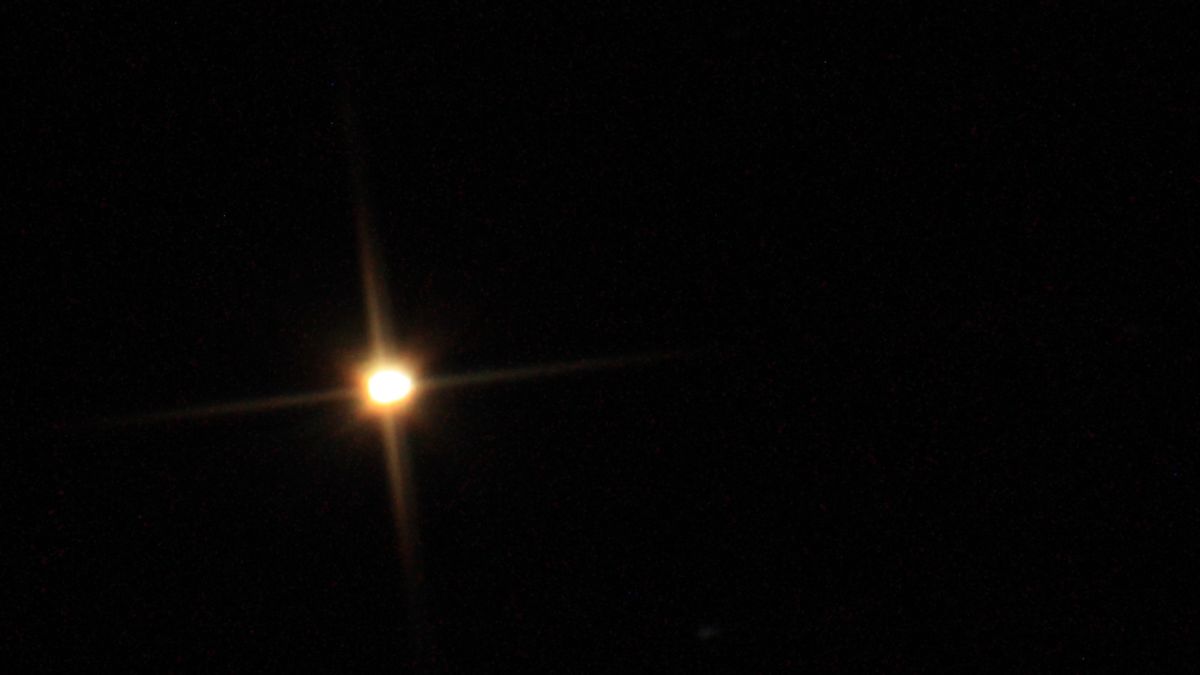
In the night sky, there is a famous pattern of stars, or constellation, known as Orion the Hunter. You can often see its three-star “belt.” If you look at Orion’s right shoulder, you will see a bright star that glows with a distinct, reddish-orange color. This star is named Betelgeuse. It is one of the most famous and well-known stars in our entire sky.
Betelgeuse is not just any star. It is a “red supergiant.” The “supergiant” part means it is incredibly large, and the “red” part means it is in the final stages of its life. Stars like Betelgeuse do not live forever. They burn through their fuel very quickly, and when they run out, they end their lives in a huge, powerful explosion. This event is called a supernova. Because Betelgeuse is so old and so massive, scientists know it is going to explode.
This star is a top candidate for the next supernova in our own galaxy, the Milky Way, that we will be able to see clearly from Earth. This has led many people to ask what that will be like. We are not sure if it will happen in our lifetime or in thousands of years. But if it does, it will be the greatest show in the sky for all of human history. So, if this giant star finally does explode, what exactly will we see here on our planet?
What Is Betelgeuse and Why Is It So Special?
Betelgeuse is a star that truly tests our imagination. When we look up at it, it just looks like a tiny dot of reddish light, but it is one of the largest stars we know of. It is what astronomers call a red supergiant. To understand how big “supergiant” is, let’s compare it to our own Sun. If we were to magically remove our Sun and place Betelgeuse in the center of our solar system, its size would be astonishing.
This single star is so enormous that its surface would stretch past the orbits of Mercury, Venus, Earth, and Mars. It would even stretch past the asteroid belt and all the way out to the orbit of Jupiter. Our entire planet, and all our inner neighbors, would be inside the star. It is more than 700 times wider than our Sun and shines with the light of more than 100,000 Suns. This incredible size is what makes it so special.
Besides its size, Betelgeuse is special because of its age. It is an old star, but not in the way we think of age. Our Sun is about 4.6 billion years old and is only middle-aged. Betelgeuse is only about 8 to 10 million years old, which sounds young, but for a star this massive, it is already at the end of its life. Massive stars are like giant engines that burn their fuel at a very fast and furious rate. They live fast and die young. Betelgeuse has now used up the main fuel in its center, and this is the signal that its life is almost over.
This combination of being so large, so bright, and so close to the end of its life makes it a fascinating object for everyone. It is also relatively close to us in galaxy terms. It is about 650 light-years away. This is far enough to be safe, but close enough that when it does explode, we will have a front-row seat. It is one of the very few stars this close to us that is ready to go supernova. This is why astronomers and sky-watchers are paying so much attention to it.
What Happens When a Star Like Betelgeuse Explodes?
When a giant star like Betelgeuse explodes, it is called a “core-collapse” or “Type II” supernova. This process is one of the most violent events in the entire universe. It all starts deep in the center, or core, of the star. For its entire life, the star has been in a constant battle with itself. Gravity is always trying to crush the star inward, while the heat and pressure from burning fuel (nuclear fusion) pushes outward.
For millions of years, Betelgeuse has been burning hydrogen into helium, then helium into carbon, then carbon into oxygen, and so on. It keeps burning heavier and heavier elements to create the outward pressure it needs to fight gravity. This process works until the star starts to make iron in its core. Iron is a problem. Burning iron does not create energy; it actually uses energy. Iron is like the “ash” of the star’s fire. When the core fills with iron, the fire goes out.
At this moment, the outward push stops completely. Gravity, which has been trying to crush the star for millions of years, finally wins. And it wins instantly. The core of the star, which is already heavier than our Sun but only the size of Earth, collapses in on itself in less than a second. It shrinks down to the size of a city, becoming unbelievably dense.
This sudden, catastrophic collapse is called an implosion. This implosion is then followed by an even more powerful explosion. The collapsing material becomes so dense that it “bounces” off the new, ultra-dense center. This creates a powerful shockwave that blasts outward through all the outer layers of the star. This shockwave is what we see as the supernova. It hurls the star’s layers out into space at millions of miles per hour, releasing more energy in a few seconds than our Sun will produce in its entire 10-billion-year life.
How Bright Would the Betelgeuse Supernova Look from Earth?
This is the main question everyone wants to know. The light from this explosion would be truly, unbelievably bright. It would be the brightest object in the night sky, by far, other than the Moon. But how bright is that? Let’s use some comparisons that we are all familiar with.
First, let’s think about the full Moon. The full Moon is very bright. It can light up your backyard and cast shadows. Scientists estimate that the Betelgeuse supernova, at its brightest, would shine with about the same brightness as a half-Moon or even a full Moon. This is not a guess; it is based on calculations of how much energy the explosion releases and how far away the star is. All that light would be coming from a single point, a “new star” in the sky.
Now, let’s compare it to Venus. Venus is often called the “evening star” or “morning star.” It is the brightest planet and the brightest star-like object in our sky, much brighter than any other star. The Betelgeuse supernova would be thousands of times brighter than Venus. It would completely outshine every other star and planet.
What about the Sun? It is important to know that the supernova would not be as bright as the Sun. The Sun is our own star and is incredibly close to us. The supernova would be 650 light-years away. So, while it would be a new and brilliant light, it would not be a “second Sun” in terms of brightness. It would not replace the Sun, but it would be so bright that it would completely change the way our night sky looks. This intense light would be the first thing we notice, and it would signal that the giant star has finally met its end.
Would We Be Able to See the Supernova During the Day?
Yes, absolutely. The explosion would be so bright that we could easily see it in the middle of the day. This is a very rare and special event. Normally, we cannot see any stars during the daytime. This is not because the stars are gone, but because the light from our Sun is so bright that it scatters in our atmosphere. This scattered light is what makes the sky blue, and it easily drowns out the faint light from distant stars.
However, the Betelgeuse supernova would be in a completely different class. Its light would be so intense that it would “punch through” the blue of the sky. We would be able to look up and see the Sun in one part of the sky, and in another part, we would see this new, brilliant point of light. It would look like a very, very bright star that forgot to turn off when the Sun came up.
This daytime visibility would be one of the most amazing parts of the event. It would be a constant reminder, day and night, that something incredible had happened in our galaxy. In the past, very few supernovas have been bright enough to be seen in the daytime. The last one that was this well-documented was in the year 1054, when astronomers in China and other parts of the world recorded a “guest star” that was visible during the day for 23 days.
The Betelgeuse supernova would be much closer and much brighter than that one. It would likely be visible in the daytime for weeks, and possibly for several months. It would be a shared global experience, with people all over the world able to go outside during their lunch break, look up, and point out the new star shining in the daylight sky.
How Long Would the “Betelgeuse Star” Shine in Our Sky?
A common misunderstanding about a supernova is that it is a quick “flash,” like a firework that is gone in a second. This is not the case. A supernova is a long, drawn-out event that unfolds over months. The explosion itself is fast, but the light and heat it creates last for a very long time.
The show would start with a sudden, rapid brightening. The star would go from its normal brightness to its peak brightness—as bright as the half-Moon—in just a few days. This peak brightness would be incredible. It would hold this dazzling brightness for several days or maybe even a few weeks. During this time, it would be the talk of the world, easily seen every day and casting shadows at night.
After this peak, the supernova would slowly begin to fade. But “slowly” is the key word. It would not just disappear. It would likely remain brighter than Venus, the brightest planet, for many weeks. It would continue to be visible to the naked eye, without a telescope, for many, many months. Some estimates suggest we could still see it in the night sky for a year, or perhaps even two years, as it gradually gets dimmer and dimmer.
During this long fade, it would also change color. The initial blast would be incredibly hot, shining with a brilliant blue-white light. As the expanding cloud of gas from the explosion cools down and gets bigger, the color would change. It would likely shift from blue-white to a bright yellow, then to orange, and finally fading back into a deep red before it disappears from our view forever. It would be like watching a cosmic ember slowly cool down over months.
What Would Happen to the Constellation Orion?
This is one of the most interesting and permanent effects of the explosion. The constellation Orion the Hunter is one of the most famous and easily recognized patterns in the sky. For all of human history, people have looked up and seen that shape: the three stars of the belt, the “sword” hanging from the belt, the bright blue star Rigel as the left foot, and the red star Betelgeuse as the right shoulder.
When Betelgeuse explodes, that familiar shape will be temporarily and dramatically changed. For the first few weeks, Orion will have a new, impossibly bright star where its shoulder should be. The constellation will look completely unbalanced, with this one brilliant point of light outshining everything else. It would be like one of the stars in the Big Dipper suddenly becoming as bright as the Moon.
But the biggest change would come after the supernova fades away. After a year or two, the light from the explosion will be gone. And so will Betelgeuse. The star that formed Orion’s shoulder for all of human civilization will simply be gone from the night sky. The constellation will be permanently altered.
Future generations would look up at a different Orion. They would see the belt, the sword, and the star Rigel, but the right shoulder would be missing. There would just be an empty patch of dark sky. We would be the generation that got to see the change happen. We would be the ones to tell stories to our children about the “star that used to be there,” the giant red star that lit up our sky for a year and then vanished forever. It would be a powerful, cultural event that would change our maps of the sky.
Is the Betelgeuse Supernova Dangerous to Earth?
This is a very important question, and the answer is a clear and simple “no.” The Betelgeuse supernova will be completely safe for Earth and for all life on it. It will be the biggest light show in recorded history, but it will only be a show. We can all watch without any worry.
The reason we are safe is distance. For a supernova to be dangerous, it would have to be extremely close to us. Scientists estimate the “danger zone” for a supernova is about 50 light-years. An explosion inside this zone could send out enough harmful radiation, like gamma rays, to damage our planet’s ozone layer. But Betelgeuse is not 50 light-years away. It is about 650 light-years away, more than 10 times the safe distance.
At 650 light-years, we are so far away that all the truly dangerous radiation will have spread out and become harmlessly weak by the time it reaches us. Our atmosphere and our planet’s magnetic field will easily protect us from any high-energy particles. The only things that will reach us in large amounts are light (which we will see) and tiny, harmless particles called neutrinos.
Neutrinos are “ghost particles.” They are created in the billions during a supernova, and they will fly right through the solar system. In fact, as you read this, billions of neutrinos from our own Sun are passing through your body and the entire Earth every second, and we do not feel a thing. They do not interact with us. The neutrinos from Betelgeuse will be the very first signal that the explosion has happened (arriving a few hours before the light), but they will be totally undetectable without very special scientific equipment. So, we can all relax and enjoy the view.
What Is the “Great Dimming” and Does It Mean It Will Explode Soon?
A few years ago, in late 2019 and early 2020, astronomers got very excited. Betelgeuse suddenly started to get dimmer. It faded dramatically, losing more than half of its usual brightness. It became so faint that it was hard to see. This event was nicknamed the “Great Dimming.” Many people wondered if this was the star “powering down” right before the big explosion. Was this the sign we had been waiting for?
Scientists pointed all their best telescopes at the star to figure out what was happening. After a lot of research, they found the most likely answer, and it was not that the star was about to explode. Instead, it seems Betelgeuse “sneezed.” The star is so old and unstable that it blew off a huge bubble of its own gas and material, like a giant “surface mass ejection.”
This cloud of hot gas traveled outward from the star. As it moved away, it cooled down and condensed into a massive cloud of dust. This dust cloud then drifted between Betelgeuse and Earth, acting like a giant smokescreen. The star itself did not get dimmer; we were just looking at it through a thick, dusty filter that was blocking the light. After a few months, the dust cloud drifted away, and Betelgeuse returned to its normal brightness.
So, does this mean it is not going to explode soon? Not exactly. While the Great Dimming itself was not the final collapse, it does show us that the star is very active and unstable. It is behaving exactly like a red supergiant at the end of its life should. It is shedding its outer layers and is very chaotic. This tells us that it is definitely in its final phase. The problem is, this “final phase” in space terms is very long. “Soon” could mean tomorrow, next year, or it could mean 10,000 years from now. It might even be 100,000 years. We simply do not have a way to know the exact date of the explosion.
What Will Be Left Behind After the Explosion?
The supernova is the end of the star, but it is the beginning of two new and amazing things. The explosion does not just disappear. It leaves behind a beautiful reminder in the sky, and a strange new object where the star used to be.
First, all those outer layers of the star that were blasted into space will keep traveling outward. This expanding cloud of gas and dust is called a “supernova remnant.” This cloud will be filled with all the elements the star created during its life, like oxygen, carbon, and silicon. As this cloud expands over thousands of years, it will glow with beautiful colors as it mixes with the gas and dust already in space. A famous example of this is the Crab Nebula, which is the remnant of the supernova seen in 1054. In the place where Betelgeuse once was, a new, beautiful nebula will slowly form and grow for thousands of years, a cosmic memorial to the star.
Second, what about the core? The center of the star that collapsed to trigger the explosion does not get blown away. It stays behind. This collapsed core becomes one of the strangest objects in the universe. For a star of Betelgeuse’s size, it will almost certainly become a neutron star.
A neutron star is an object with the mass of one or two Suns, but it is crushed down to be only about 10 to 15 miles wide—the size of a single city. It is so dense that a single teaspoon of its material would weigh more than Mount Everest. It is a single, giant atom nucleus. This tiny, spinning, super-dense object is all that will remain of the giant star’s center. It will be hidden deep inside the new, glowing nebula. So, Orion will not just have an empty space; it will have a new, invisible neutron star and the faint, growing ghost of the star that used to be.
Conclusion
The eventual explosion of Betelgeuse will be, without a doubt, the single greatest astronomical event in human history. It will be a completely safe, planet-wide light show. We will see a “new star” appear in our sky, one so bright that it will rival the Moon and be clearly visible in the middle of the day.
This amazing sight will not be a brief flash; it will last for months, slowly fading and changing colors before disappearing. When it is gone, it will be gone forever, permanently changing the shape of the famous constellation Orion. While we do not know if it will happen in our lifetimes or for our distant descendants, we know that it is a powerful reminder of how active and dynamic the universe truly is.
If you could tell a future human, one who will look up at an Orion without its bright red shoulder, one thing about what it was like to see Betelgeuse in the sky, what would you say?
FAQs – People Also Ask
How far away is Betelgeuse from Earth?
Betelgeuse is estimated to be about 650 light-years away from us. This is very far, but it is still considered “nearby” in the scale of our Milky Way galaxy, which is 100,000 light-years across.
What color will the Betelgeuse supernova be?
The explosion will be so hot that at its peak, it will shine with an intense, brilliant blue-white light. As it slowly cools down over many months, it will likely change color to yellow, then orange, and finally a dull red before it fades away.
Has Earth ever seen a supernova like this before?
Yes, but it has been a long time. The last supernova in our galaxy that was clearly visible was Kepler’s Star in 1604, but it was much farther away. The most famous one was in 1054 AD, which created the Crab Nebula and was bright enough to be seen in the day. The Betelgeuse event is expected to be much, much brighter than any of these.
Will the Betelgeuse supernova make our planet hotter?
No, it will have absolutely no effect on our planet’s temperature or climate. Even though it will look very bright, the actual amount of heat energy that reaches us from 650 light-years away is tiny. It is purely a visual event for us on Earth.
What is the difference between a supernova and a nova?
A supernova is the complete and total destruction of a star, releasing an incredible amount of energy. A nova is a much smaller event that happens on the surface of a star called a white dwarf, and the star itself survives. A supernova is millions of times more powerful than a nova.
Could we hear the Betelgeuse explosion?
No, we would not hear anything. Sound needs a medium to travel through, like air or water. Space is a vacuum, which means it is empty. There is nothing to carry the sound waves from the explosion to Earth, so it will be a completely silent event.
Do we know the exact date Betelgeuse will explode?
No, we have no way of knowing the exact date. “Soon” in astronomical terms can mean tomorrow, next year, in 1,000 years, or even in 100,000 years. All we know is that the star is in the final stage of its life.
What kind of star is Betelgeuse?
Betelgeuse is a red supergiant. This is a type of star that is very massive (much bigger than our Sun) and is very old (for a massive star). It has used up the hydrogen fuel in its core and has swelled up to an enormous size.
Will the explosion send asteroids or comets toward us?
No, the explosion will have no effect on the asteroids or comets in our own solar system. Betelgeuse is much too far away to push or pull on any objects near Earth. The blast wave will be contained within its own star system.
What is a neutron star?
A neutron star is the super-dense core left behind after a giant star goes supernova. It is what happens when gravity crushes the star’s center so tightly that protons and electrons merge to form neutrons. A neutron star has more mass than our Sun but is squeezed into the size of a small city.