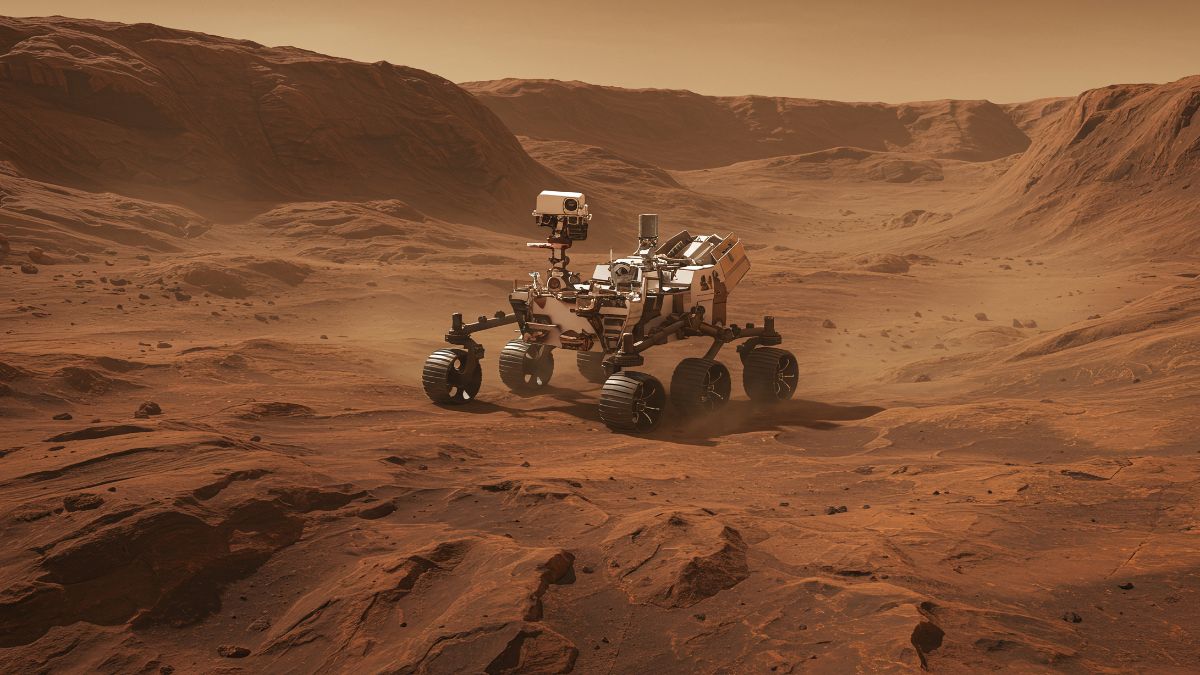
For decades, humanity has dreamed of setting foot on Mars. But the journey to the Red Planet is incredibly long, difficult, and dangerous. NASA and its partners around the world are working on a plan, and a big part of that plan is the Artemis program, which will take us back to the Moon. As part of this plan, they are building something completely new: a small space station that will orbit the Moon, not the Earth. This outpost is called the Lunar Gateway.
This Gateway is a huge step for human exploration. It will be the most distant space station humans have ever built, located about a thousand times farther from Earth than the International Space Station (ISS). It’s designed to be a science lab, a command center, and a home-away-from-home for astronauts exploring the Moon. It’s a key piece of the puzzle for learning how to live and work in deep space, far from the safety of our home planet.
But many people have a simple question: if the main goal is to get to Mars, why are we building a space station around the Moon first? It might seem like a detour. However, this lunar outpost is actually one of the most important steps we must take to make the giant leap to Mars possible. How exactly can this small station, orbiting our rocky neighbor, serve as the key to reaching another planet?
What Exactly Is the Lunar Gateway?
The Lunar Gateway is a small, versatile space station that will be placed in a special orbit around the Moon. Think of it as a base camp. If you were going to climb a giant, unexplored mountain, you wouldn’t try to go from the ground to the peak in one single climb. You would first set up a high-altitude base camp. You would stock this camp with supplies, learn about the environment, and use it as a safe place to start your final push to the summit. The Gateway is that base camp for deep space. Mars is the summit. It is a core part of NASA’s Artemis program. The station will not be a huge complex like the International Space Station. Instead, it will be a smaller, more focused outpost. It will provide a place for astronauts to live and work during missions to the Moon. It will also serve as a vital communications hub, connecting lunar explorers with Mission Control back on Earth. Most importantly, it is being designed to operate autonomously, meaning it can use advanced robotics and computers to manage itself for long periods when no crew is aboard.
How Is the Gateway Different from the International Space Station?
When people hear “space station,” they almost always picture the International Space Station, or ISS. The ISS has been a huge success, orbiting about 250 miles above Earth for over two decades. However, the Gateway is a completely different kind of station, designed for a different purpose. The first major difference is location. The ISS is in low-Earth orbit, safely tucked inside Earth’s protective magnetic field, which shields it from the worst of deep space radiation. The Gateway will be in lunar orbit, almost 250,000 miles away. At this distance, it is fully exposed to the harsh environment of deep space, including solar flares and cosmic rays, just like a crewed ship on its way to Mars would be.
The second difference is size and crew. The ISS is massive, about the size of an American football field, and has been continuously crewed by astronauts since the year 2000. The Gateway will be much smaller, especially in its first years. It is more like a small cabin. It is not intended to be permanently inhabited. Instead, astronauts will visit it for specific missions, such as preparing for a landing on the Moon’s surface, and then leave. The station will then operate on its own. This forces NASA and its partners to build highly reliable, automated systems that can survive for years without human hands-on repair, which is exactly what will be needed for a Mars mission.
Who Is Building This New Space Station?
A project as complex and ambitious as the Gateway is too big for any one country to build alone. Just like the ISS, the Lunar Gateway is a major international collaboration. This teamwork is essential for sharing the enormous cost and for bringing together the best technology and expertise from around the globe. NASA is leading the effort and is providing the first two main components, as well as the Orion spacecraft that will carry astronauts to the station.
However, key partners are building other essential parts. The European Space Agency (ESA) is a major contributor. They are building the I-HAB, a large international habitat module where astronauts will live and conduct research. ESA is also building the ESPRIT module, which will provide refueling capabilities and advanced communications. The Japan Aerospace Exploration Agency (JAXA) is contributing to the I-HAB’s life support systems and will also provide a habitat module. The Canadian Space Agency (CSA) is responsible for one of the most critical external pieces: the Canadarm3. This will be a highly advanced, self-repairing robotic arm that can operate on the outside of the station to inspect, maintain, and repair the outpost, even when no astronauts are present. This international partnership is a blueprint for how humanity will explore deep space together.
Where Exactly Will the Gateway Orbit the Moon?
The Gateway’s orbit is one of its most clever features. It will not be in a simple, low circle around the Moon’s equator. Instead, it will be placed in a very special, highly efficient path called a Near-Rectilinear Halo Orbit, or NRHO. This sounds very technical, but the idea behind it is brilliant. It is a very long, oval-shaped orbit that is precisely balanced between the gravity of the Earth and the Moon. At its closest point, the Gateway will pass about 1,900 miles over the Moon’s North Pole. Then it will swing out very far, traveling over 43,000 miles away from the Moon’s South Pole.
This unique seven-day orbit has three huge advantages. First, it is extremely stable. This means the Gateway will need to use very little fuel to stay on its path, which is a big deal when all your fuel has to be launched from Earth. Second, this orbit provides a constant line of sight to Earth. This means astronauts at the Gateway and on the lunar surface will almost always have direct communication with Mission Control. Third, this path gives astronauts access to the entire Moon, including the scientifically fascinating and resource-rich South Pole, where water ice is believed to be trapped in craters. It is the perfect parking spot in deep space.
What Are the Main Parts of the Lunar Gateway?
The Gateway will be built in pieces on Earth and then assembled in space, much like the ISS was. The station will be launched in stages, with the first launch being the most critical. This launch will carry the first two “foundational” modules, which will be connected on Earth before being sent to space together on a powerful rocket, such as the SpaceX Falcon Heavy.
The first of these modules is the Power and Propulsion Element (PPE). This is the station’s powerhouse and engine room. It will generate all the station’s electricity using huge, advanced solar arrays. It also has a revolutionary new kind of engine. Instead of using traditional chemical rockets, it uses advanced solar electric propulsion. This system takes electricity from the solar panels and uses it to create a very gentle, but constant, thrust. It’s incredibly fuel-efficient and can move the entire station to different orbits around the Moon over time.
The second module is the Habitation and Logistics Outpost (HALO). This is the first place astronauts will live and work. It’s the “studio apartment” of the Gateway, providing pressurized living space, life support, command and control systems, and several docking ports. These ports will allow NASA’s Orion spacecraft to park, as well as the lunar landers that will take astronauts down to the surface. Later missions will add more modules from international partners, like the ESA’s I-HAB, to give the crew more room to live and conduct science.
Why Do We Need a Station at the Moon to Go to Mars?
This is the central question. The answer comes down to gravity and logistics. A trip to Mars is not like a trip to the Moon. It takes six to nine months just to get there, and the total mission could last two to three years. To survive this journey, astronauts need a very large, very complex spaceship, often called a Deep Space Transport. This ship needs to carry years’ worth of food, water, air, and fuel. Building a ship this massive and launching it from Earth in one go is almost impossible with our current technology. Earth’s gravity is just too strong, and the “rocket equation” means you need a truly gigantic rocket to escape it.
This is where the Gateway changes the game. Instead of building the Mars ship on Earth, we can build it in pieces. We can launch these individual pieces on smaller, cheaper rockets. These pieces would then fly to the Lunar Gateway, which acts as an assembly yard in deep space. In the low-gravity environment of lunar orbit, robots and astronauts can put the Mars ship together. The ship can then be fully fueled at the station, perhaps even using fuel processed from water ice on the Moon one day. Astronauts would take a “quick” trip from Earth to the Gateway on the Orion spacecraft. They would then transfer to their fully built and fueled Mars ship and begin the long voyage from there. It’s much easier to start a journey to Mars from the Moon’s orbit than from the surface of the Earth. The Gateway is the crucial staging post that makes this possible.
How Will the Gateway Help Us Test Technologies for Mars?
A three-year mission to Mars is a journey into total isolation. There is no turning back, and there is no resupply. If a critical system like the air-recycling machine or the water purifier breaks, the crew cannot wait for a repair part from Earth. It’s a life-or-death situation. Every piece of equipment must be 100% reliable. We cannot test these systems properly on the ISS. The ISS is too close. If a life support system fails on the ISS, the crew can be safely back on Earth in a matter of hours. This safety net doesn’t exist on the way to Mars, and it doesn’t exist at the Gateway.
The Gateway is our deep space proving ground. It will be the place where we test the next generation of life support systems. These are called “closed-loop” systems, and their goal is to recycle nearly 100% of all water (including from sweat and urine) and to scrub all the carbon dioxide from the air, turning it back into breathable oxygen. These systems will have to run perfectly on the Gateway for years at a time to prove they are ready for Mars. The Gateway will also test new radiation shielding, advanced communication systems, and autonomous robotics. We will learn how equipment breaks down in the harsh deep space environment and, more importantly, how to fix it when Earth is days, not hours, away. We will practice for Mars at the Moon.
What Kind of Science Will Happen on the Gateway?
While the Gateway is a vital stepping stone to Mars, it is also a world-class science platform in its own right. Its unique position outside Earth’s magnetic field and away from Earth’s “noise” makes it a perfect spot for new discoveries. Scientists are excited to place instruments on the outside of the Gateway to study our Sun. With a constant view of the Sun, the Gateway can study solar flares and space weather. Understanding this weather is critical for learning how to predict dangerous radiation storms and protect astronauts on future deep space missions.
The Gateway will also be a platform for astrophysics, allowing telescopes to look out into the universe from a stable, clear vantage point. It will also look back at our own planet, providing a new perspective on Earth’s climate and atmosphere. Finally, it will revolutionize lunar science. Astronauts on the Gateway will be able to remotely control rovers on the Moon’s surface in real time, with no light-speed delay. This is like telesurgery for geology. They could guide a rover into a crater, collect samples, and analyze them in the station’s lab, all before deciding which samples are valuable enough to send back to Earth.
What Are the Challenges in Building the Gateway?
Building the most remote space station in human history is, without a doubt, one of the hardest things we have ever tried to do. The challenges are enormous. The first is simply the launch. The first two modules, PPE and HALO, are being joined together on Earth and will be launched as one single, massive payload. This will be an extremely complex launch, and everything must work perfectly. Once in space, the modules must deploy their solar arrays and use their own high-tech engines to slowly and carefully fly themselves all the way to lunar orbit, a journey that will take many months.
The deep space environment is another huge challenge. The station has to be designed to survive extreme temperatures and constant, high levels of radiation that can damage electronics. The communication delay is also a factor. It takes light over a second to travel from the Earth to the Moon. That’s a two-to-three-second round-trip delay in every conversation. Mission Control cannot operate the station in “real-time” the way they do with the ISS. The station’s computers and its robotic systems must be smart enough to handle many problems on their own. Finally, coordinating the schedules, budgets, and technical designs among so many different international partners is a massive management challenge, but it is one that is essential to success.
Conclusion
The Lunar Gateway is far more than just a small station orbiting the Moon. It is a bold and essential new step in our journey off our home planet. It serves as a testbed for the critical technologies we need to keep astronauts alive on a multi-year trip to Mars. It is a science laboratory that will give us new views of the Sun, the Earth, and the Moon. And most importantly, it is the strategic base camp, the deep-space harbor, where we will assemble and launch the next generation of spacecraft that will finally carry human footprints to the Red Planet. The road to Mars is long, but it runs directly through the Moon, and the Gateway is the bridge we are building to get there.
As we prepare to build this permanent outpost so far from home, what new skill do you think will be most important for an astronaut to have?
FAQs – People Also Ask
Why is the Gateway in a halo orbit?
The Gateway will be in a Near-Rectilinear Halo Orbit (NRHO) because this special path is very stable and requires very little fuel to maintain. This orbit also provides a constant view of Earth for communication and gives astronauts easy access to the entire lunar surface, especially the South Pole.
Will astronauts live on the Gateway full time?
No, the Gateway is not designed to be permanently crewed like the International Space Station. Astronauts will visit the station for specific missions, such as Artemis landings on the Moon, and the station will use advanced robotics and AI to run itself when it is empty.
What rocket will launch the first Gateway modules?
The first two core modules of the Gateway, the Power and Propulsion Element (PPE) and the Habitation and Logistics Outpost (HALO), are scheduled to be launched together. They will be launched on one of the world’s most powerful rockets, the SpaceX Falcon Heavy.
How long will it take to get to the Lunar Gateway from Earth?
The journey from Earth to the Gateway will take much longer than a trip to the ISS. Astronauts traveling on NASA’s Orion spacecraft will take approximately five days to reach the station in its lunar orbit.
What is the HALO module on the Gateway?
HALO stands for Habitation and Logistics Outpost. It is the first pressurized living and working cabin for the astronauts. It provides life support, command and control for the station, and the docking ports where the Orion spacecraft and lunar landers will connect.
What does the PPE module do?
The PPE is the Power and Propulsion Element, which is the station’s powerhouse. It uses large, advanced solar arrays to generate electricity. It also uses a highly efficient solar electric propulsion system, which provides a gentle thrust to move the station and adjust its orbit.
How does the Gateway help with Moon landings?
The Gateway acts as a meeting point in lunar orbit. Astronauts will launch from Earth in the Orion capsule and dock at the Gateway. There, they will transfer to a separate human landing system, like SpaceX’s Starship HLS, which will be waiting to take them down to the surface of the Moon.
What is Canadarm3?
Canadarm3 is a highly advanced, next-generation robotic arm being built by the Canadian Space Agency. It will be attached to the outside of the Gateway and will use artificial intelligence to conduct maintenance, inspect the station, move cargo, and even help with science experiments, all without astronauts needing to go outside.
Can the Gateway itself travel to Mars?
No, the Gateway station will always stay in orbit around the Moon. It is a staging post, not the vehicle for the Mars journey. A separate, much larger Deep Space Transport vehicle will be assembled and fueled at the Gateway before it begins the long trip to Mars.
When will the Lunar Gateway be ready for astronauts?
The first two modules, PPE and HALO, are being integrated on Earth and prepared for their launch. After this combined spacecraft launches and completes its long journey to lunar orbit, it will undergo testing. The first astronaut crew is planned to visit the Gateway as part of the Artemis IV mission.