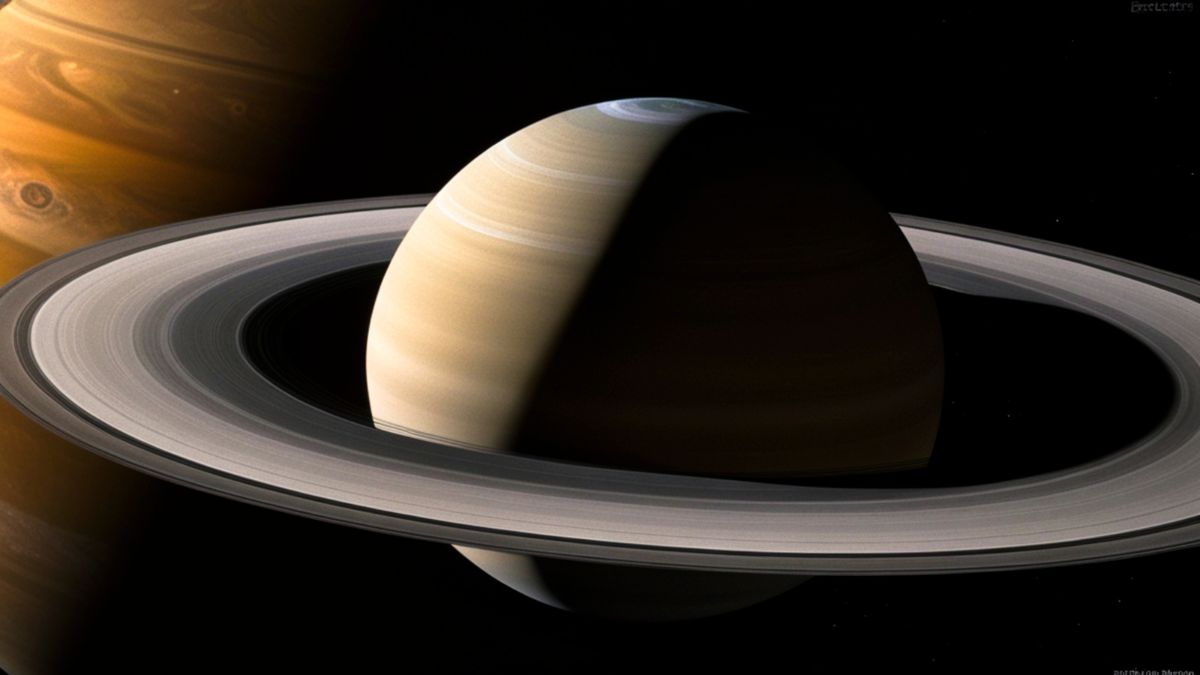
Saturn is the jewel of our solar system. For as long as we have had telescopes, people have been amazed by its beautiful, shining rings. They are what make the planet so famous. When we think of Saturn, we think of its rings. They seem permanent, as if they have been there forever and will be there forever. For many years, scientists believed this, too. They thought the rings were as old as the planet itself, which formed over four billion years ago.
It turns of that this is not true. New discoveries have completely changed our understanding of Saturn. The latest science shows that Saturn’s rings are not permanent at all. In fact, they are disappearing right now, as you read this. And they are vanishing at a speed that scientists call “shocking” and a “worst case scenario.” This is not a slow, gentle process. It is a very active and fast one. The planet is in the middle of a process that is destroying its most famous feature.
This discovery is one of the most surprising findings from our recent exploration of the solar system. It means that we are living in a very special, and very short, window of time when Saturn looks this beautiful. It also solves a few long standing mysteries about the planet. But it raises a brand new question that is just as exciting. How can a system of rings that stretches for thousands of miles across space just fall apart?
What Are Saturn’s Famous Rings Actually Made Of?
Before we can understand how the rings are disappearing, we need to know what they are. From a telescope on Earth, the rings look like a solid, smooth disc, almost like a giant vinyl record. But they are not solid at all. If you could fly a spacecraft through them, you would see that they are actually made of billions and billions of individual pieces of ice and rock. Most of these particles are not big. Some are as tiny as a speck of dust, while others are the size of a small car or even a house.
The most important fact about the rings is their material. Scientists have confirmed that the rings are about 99 percent pure water ice. This is the key to their beauty. It is all this ice that makes the rings so bright and reflective. They act like a giant, shattered mirror, catching the sunlight and shining it back across space for us to see. The other one percent of the material is a light coating of rocky dust and other chemicals, which they have picked up over time.
Even though the ring system is incredibly wide, stretching over 175,000 miles (282,000 kilometers) from one side to the other, it is shockingly thin. In most places, the main rings are only about 30 feet (10 meters) thick. In a few places, they might get as thick as a kilometer, but this is rare. This is why they are so hard to see when we look at them from the side. They are wider than 20 Earths lined up in a row, but in most places, they are thinner than a three story building.
Why Will Saturn’s Rings Seem to Vanish in 2025?
You might have heard news that Saturn’s rings are going to “disappear” in 2025. This is true, but it is important to know that this is a temporary event. It is a line of sight trick, not the real, permanent disappearance we are talking about. Saturn takes about 29.5 Earth years to orbit the Sun, and just like Earth, it is tilted on its axis. This tilt means that our view of the rings from Earth changes over time. Sometimes, we see them tilted wide open, showing their full glory. At other times, we see them tilted so they are perfectly edge on.
In March 2025, Earth will be in a position where we see the rings exactly edge on. Because the rings are so incredibly thin, as we just discussed, they will seem to vanish completely when viewed with small telescopes. It is like holding a sheet of paper at eye level and turning it so you only see the thin edge. The paper is still there, but it becomes a nearly invisible line. This event is called a “ring plane crossing,” and it happens about every 13 to 15 years.
This visual trick is a great reminder of just how thin the rings are. After 2025, our viewing angle will slowly improve, and the rings will gradually “reappear,” getting wider and brighter in our sky until they reach their maximum tilt again years later. This temporary event is fascinating for astronomers, but it is not the same as the real and permanent destruction that is happening to the rings every single day. The real vanishing is a much more dramatic process.
So, What Is Really Causing the Rings to Disappear?
The real reason Saturn’s rings are disappearing is a process that scientists have named “ring rain.” It is exactly what it sounds like: the rings are literally raining down onto the planet. This is not a gentle sprinkle, but a constant, heavy downpour of ice particles being pulled from the rings and dumped into Saturn’s upper atmosphere. This process is happening right now, and it is a one way trip for the ring material. Once it leaves the rings, it is gone for good.
This rain is caused by a two step process. First, something has to knock the ring particles out of their stable, happy orbit. This is done by two main things. The first is sunlight. The Sun’s powerful ultraviolet (UV) light hits the tiny ice particles, giving them a small electrical charge. The second force is micrometeoroids. These are tiny, high speed specks of dust from comets or asteroids that are constantly flying through the solar system. When these tiny dust specks smash into a ring particle, they vaporize the ice and create a cloud of charged water molecules.
Once these ice particles are electrically charged, they are no longer just controlled by Saturn’s gravity. Now, they can be grabbed by Saturn’s giant, powerful magnetic field. This magnetic field, which is thousands of times stronger than Earth’s, traps the charged particles and funnels them down along invisible magnetic pathways, just like how Earth’s magnetic field funnels solar particles to create the Northern Lights. Gravity then takes over and pulls these captured particles down into Saturn’s upper atmosphere at high speed, where they burn up and become part of the planet.
How Fast Is Saturn Actually Losing Its Rings?
This is the part that truly shocked the scientific community. The ring rain is not just a tiny leak. It is a flood. Based on data from spacecraft, scientists have calculated the amount of material that is raining down on the planet. The number is staggering. Every single second, hundreds of kilograms of ring material are being destroyed. To put that in perspective, the amount of water falling onto Saturn from its rings is enough to fill an Olympic sized swimming pool every 30 minutes.
This is the “worst case scenario” rate that scientists had estimated, and it seems to be the one that is actually happening. This enormous rate of loss means the rings are not just slowly fading away; they are being actively and rapidly torn apart. This flow of material is changing the planet’s atmosphere and, more importantly, it is draining the rings of their mass. The rings may look huge and solid, but they are a limited resource. They are a lake with a giant drain hole open at the bottom.
This rate of loss is what allows scientists to put a clock on the rings’ lifespan. If you know how much material is in the rings and how fast the material is leaving, you can calculate how long they have left. The rings are losing so much mass, so quickly, that their days are numbered. This discovery changed Saturn from a static, timeless monument into a dynamic, changing world that is evolving on a timescale we can actually understand.
When Will Saturn’s Rings Be Completely Gone?
Based on the flood of material that scientists have measured, they have made a clear prediction. At the current rate of loss, Saturn’s rings will be completely gone in about 100 million years. Some other estimates that assume a slower rate of “ring rain” give the rings up to 300 million years. But even 300 million years is an incredibly short amount of time in the life of our solar system. The solar system is 4.5 billion years old. One hundred million years is just a cosmic blink of an eye.
This timeline is perhaps the most mind blowing part of the entire discovery. It means that we are alive at a very, very special moment. It means that humans have evolved to the point of building telescopes and spacecraft during the tiny, fleeting window of time when Saturn has its magnificent rings. If intelligent life had existed on Earth 300 million years ago, they would have looked up at Saturn and seen a plain, ringless planet, much like Jupiter. And 100 million years from now, any future inhabitants of Earth will look at Saturn and see the same plain, ringless planet.
We just happen to be here at the exact right time to see Saturn in its full glory. This discovery transforms our view of the planets. They are not fixed, unchanging objects. They are active, evolving places, and their features can be temporary. The rings we see today are not an ancient feature, but a temporary gift. We are privileged to be the generation that not only gets to see them, but also the one that finally understood that they are not going to last.
How Did Scientists Prove This Was Happening?
This discovery was not made overnight. It was the result of decades of work by two of the most famous space missions in history. The first clues came in the 1980s from NASA’s twin Voyager probes. As they flew by Saturn, they spotted strange, dark bands in Saturn’s upper atmosphere, its ionosphere. Scientists suspected these bands were shadows, but not shadows of light. They were “shadows” where the ring rain was falling, neutralizing the charged gas in the atmosphere. They also measured a strange chemical composition that did not make sense. It was a mystery they could not solve.
The real proof came decades later from the Cassini spacecraft. Cassini orbited Saturn for 13 years, from 2004 to 2017, studying the planet, its rings, and its moons in incredible detail. In its final year, Cassini performed a series of daring moves called the “Grand Finale.” It performed 22 dives, flying through the unexplored 1,200 mile (2,000 kilometer) gap between the planet and its innermost ring. For the first time, a spacecraft was right in the middle of the “ring rain.”
During these dives, Cassini’s instruments could directly “taste” and “sniff” the material that was falling in. Its Cosmic Dust Analyzer and its mass spectrometers sampled the particles. They found exactly what the ring rain theory predicted: a heavy shower of water molecules, methane, ammonia, carbon monoxide, and complex organic compounds pouring from the rings into the atmosphere. Cassini directly measured the flow. It confirmed the Voyager mystery and proved that the ring rain was real and was happening at the “worst case scenario” rate.
Why Do Scientists Think the Rings Are Surprisingly Young?
The fact that the rings are disappearing so fast leads to another, equally shocking conclusion: the rings must be very young. For a long time, astronomers assumed the rings formed at the same time as Saturn, 4.5 billion years ago. But if that were true, and they have been raining down on the planet for that long, they should have been gone billions of years ago. The fact that they are still here, but disappearing fast, means they cannot be that old.
There is another piece of evidence for this. The rings are too clean. As we know, they are 99 percent pure water ice. For 4.5 billion years, they would have been constantly bombarded by micrometeoroids and space dust. This constant “pollution” would have made the rings dark, dirty, and rocky. They would look more like the faint, dark rings of Jupiter or Uranus. But they are not. They are bright, shiny, and icy. This “cleanliness” means they have not been around long enough to get dirty.
Based on how “dirty” the rings are, and how much mass they have (which Cassini measured during its Grand Finale), scientists have calculated their age. The new, stunning estimate is that Saturn’s rings are likely only 10 million to 100 million years old. This is incredibly young. It means the rings probably formed when dinosaurs were still walking on Earth. They are not an original part of Saturn, but a recent addition.
If They Are So Young, How Did the Rings Form?
This is now one of the biggest and most exciting questions in planetary science. If the rings are not original, where did they come from? Scientists are not 100 percent sure, but there are two main theories, and both involve a giant, cosmic catastrophe. The old idea that the rings were just leftover material from Saturn’s formation is now very unlikely because of their young age and icy purity.
The leading theory is that Saturn used to have another large, icy moon. This moon, perhaps the size of Saturn’s current moon Mimas, was orbiting the planet. Sometime in the last 100 million years, something happened. Perhaps its orbit became unstable, or it was pulled by the gravity of another moon. It wandered too close to Saturn, crossing a critical boundary known as the “Roche limit.” At this point, Saturn’s immense gravity was stronger on the side of the moon facing the planet than it was on the far side. This tidal force tore the moon apart, ripping it into billions of icy pieces that then spread out to form the beautiful rings we see today.
A second, similar theory suggests that this icy moon was not torn apart by gravity, but was shattered in a massive collision. Perhaps a giant comet or another large object from the outer solar system smashed into it at high speed. This collision would have instantly vaporized and shattered the moon, creating a cloud of icy debris that settled into the ring system. Either way, the rings are likely the glittering, icy remains of a long lost moon.
What Does This “Ring Rain” Do to Saturn Itself?
The rings are not just disappearing; they are actively changing the planet they orbit. The constant downpour of water and other chemicals has a direct and measurable effect on Saturn’s upper atmosphere, its ionosphere. The ionosphere is a layer of gas that is charged by sunlight, and it plays a key role in the planet’s “space weather” and auroras. The “ring rain,” which is mostly neutral water, falls into this layer and “quenches” it. This means it neutralizes the charged particles.
This is what creates the dark bands that the Voyager spacecraft saw decades ago. The places where the rain is heaviest have less charged gas, making them appear as dark “shadows” in the atmosphere. The rain is literally casting an electrical shadow on the planet. This process also changes the chemistry of Saturn’s upper air, dumping huge amounts of water and organic compounds into a place that is normally dominated by hydrogen and helium.
This discovery links the rings and the planet in a way scientists never expected. They are not two separate systems. They are one single, connected system where the rings are feeding material directly into the planet. The rings are essentially a weather system for Saturn’s upper atmosphere, controlling its chemistry and temperature in the regions where the rain falls. Scientists are still studying what long term effects this massive influx of water will have on the planet’s lower atmosphere and weather patterns.
Why Are Saturn’s Rings So Different from Other Planets’?
This entire story of disappearing rings also helps solve another long standing mystery: why is Saturn the only planet with such big, bright rings? We know that the other gas giants in our solar system, Jupiter, Uranus, and Neptune, all have rings. But their rings are pathetic in comparison. They are thin, faint, dark, and hard to see. They are made mostly of dark, dusty, rocky material, not the bright, reflective ice that makes Saturn’s rings so glorious.
The “young and disappearing” ring theory provides a beautiful answer. Perhaps Saturn is not special, but just lucky. It is possible that the other giant planets also had big, beautiful, icy rings in their distant past. But their rings formed billions of years ago. Over time, the same “ring rain” process happened to them. Their magnificent ice rings have already rained down onto their planets, been destroyed, and vanished.
According to this idea, the faint, dark rings we see around them today are just the “leftovers.” They are the tiny bit of rocky, dusty pollution that remained after all the ice was gone. In this case, Saturn is not the “lord of the rings” forever. It is just the last one. We are seeing Saturn in its prime, a phase that Jupiter and the other giants passed through billions of years ago. In 100 million years, Saturn will look just like them: a giant planet with only a few faint, dark rings to hint at its glorious past.
Conclusion
The discovery that Saturn’s rings are disappearing is a profound one. It changes our view of the solar system from a static, finished place to one that is full of active, fast paced change. The rings, long a symbol of permanence, are actually one of the youngest and most temporary features we can see. They are the beautiful, glittering debris from a catastrophic event that happened in our solar system’s recent past.
We are incredibly fortunate to be living in the brief, special window of time when Saturn is at its most beautiful. We are the first generation to understand their true nature, and we will be among the last to see them in their full glory. The “ring rain” is a constant, powerful reminder that the universe is always in motion, and even its most massive monuments can fade away.
Does this discovery make you see the night sky as a place of constant, rapid change rather than a fixed, permanent one?
FAQs – People Also Ask
Why are Saturn’s rings going to disappear in 2025?
They are not really disappearing in 2025. This is a temporary optical illusion caused by Saturn’s tilt. From Earth’s point of view, we will be seeing the rings perfectly edge on, and because they are so thin, they will become invisible to most telescopes for a short time.
What is the real reason Saturn’s rings are disappearing?
The rings are being pulled into the planet by a process called “ring rain.” Tiny particles of ice from the rings get an electrical charge from sunlight and tiny meteor strikes. Saturn’s giant magnetic field then grabs these particles and pulls them down into the planet’s upper atmosphere.
How fast are the rings vanishing?
Scientists estimate that enough icy material to fill an Olympic sized swimming pool is raining down on Saturn every 30 minutes. This is considered a very fast and “shocking” rate of loss, which means the rings will not last long in cosmic terms.
How long do Saturn’s rings have left?
Based on the “worst case scenario” rate of ring rain that has been measured, scientists predict the rings will be completely gone in about 100 million years. Some other estimates give them as long as 300 million years, but both are very short timeframes.
How do we know the rings are disappearing?
The first clues came from the Voyager probes in the 1980s, which saw strange dark bands in Saturn’s atmosphere. The final proof came from the Cassini spacecraft, which flew between the rings and the planet in 2017 and directly measured the “ring rain” particles falling in.
How old are Saturn’s rings?
Scientists now believe the rings are very young, not old. Instead of being 4.5 billion years old like the planet, they are likely only 10 million to 100 million years old. This is known because they are so “clean” and bright, as they have not had time to be “polluted” by space dust.
How did Saturn get its rings?
Since the rings are so young, they likely formed from a giant catastrophe. The leading theory is that one of Saturn’s large, icy moons either wandered too close and was torn apart by the planet’s gravity, or it was shattered by a massive collision with a comet.
What will Saturn look like without its rings?
Saturn will look very much like its neighbor, Jupiter. It will be a large, striped gas planet, but it will be missing its most famous and beautiful feature. It will look plain and “naked” to future astronomers who will only know of its rings from our old data.
Do other planets have rings?
Yes, Jupiter, Uranus, and Neptune all have rings, but they are very different from Saturn’s. Their rings are extremely faint, dark, and thin, and are made of dusty rock, not bright ice. They are very difficult to see from Earth.
Why are Saturn’s rings so different from Jupiter’s?
The new theory suggests that Jupiter’s rings are dark and dusty because they are ancient. It is possible Jupiter also had big, icy rings billions of years ago, but they have already rained down onto the planet, leaving only the dark, rocky “pollution” behind. We are just seeing Saturn before this process is complete.