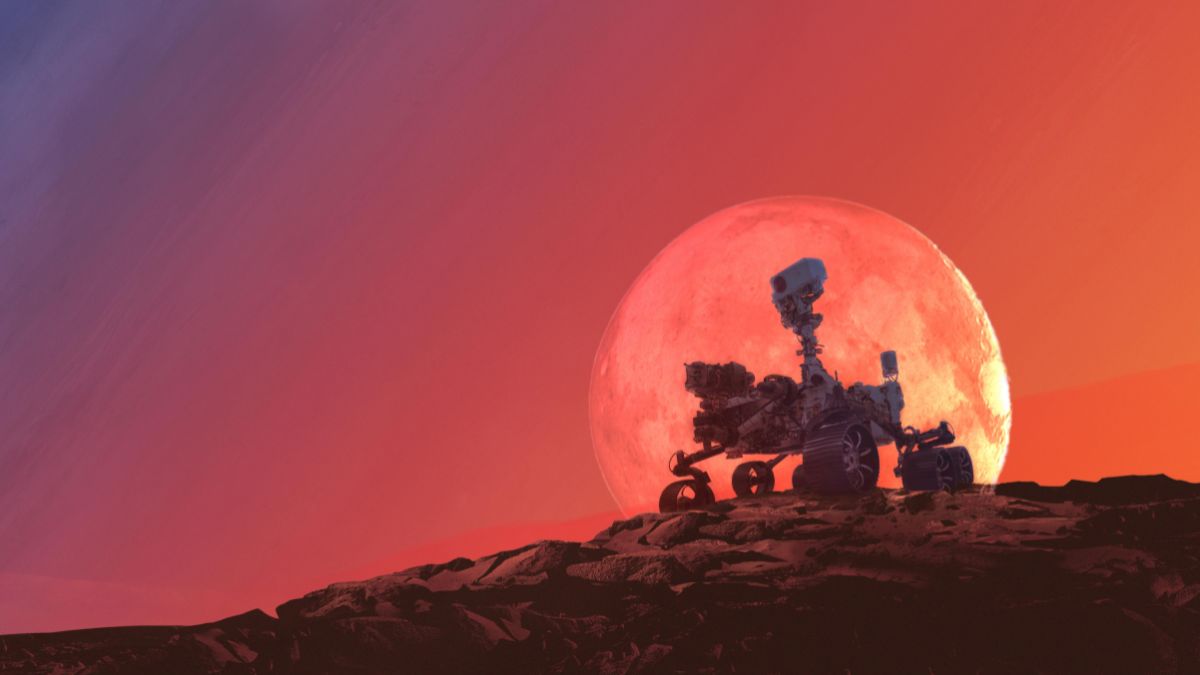
Mars is our neighbor in space, a cold, dusty, and reddish world. For decades, humans have been sending robotic explorers, called rovers, to drive across its surface and learn its secrets. Most of these rovers have come from the United States. But in 2021, China successfully landed its very first rover on the Red Planet. This rover was part of the Tianwen-1 mission and was given the name Zhurong, after an ancient Chinese god of fire.
The Zhurong rover was not just a small step; it was a huge leap in space exploration. It made China only the second country to ever operate a rover on Mars. Its mission was to study a large, flat area in the northern half of Mars called Utopia Planitia. This name means “Nowhere Land Plain.” Scientists were very excited about this landing spot because they believe it was once the bottom of a giant ocean, billions of years ago. Zhurong was equipped with special tools, including cameras, a weather station, a laser to study rocks, and a ground-penetrating radar to see beneath the surface.
For just over one Earth year, Zhurong drove across the Martian soil, collecting a massive amount of new data. Its mission was only supposed to last about 90 days, but it worked for much longer. The information it sent back has given scientists a new and surprising look at Mars, both in its ancient past and in its more recent history. So, what did this impressive rover actually find beneath the red dust?
Where Exactly Did Zhurong Land on Mars?
Zhurong landed in a very specific place called Utopia Planitia. This is not just a random flat area. It is one of the largest and oldest impact basins in our entire solar system. An impact basin is a giant bowl-shaped hole left behind by a massive asteroid or comet collision billions of years ago. This particular basin is huge, more than 3,000 kilometers wide. Because it is a lowland area, scientists have long had a theory that if Mars ever had a large ocean, the water would have flowed downhill and collected right here. They even have a name for this possible ancient ocean: Oceanus Borealis, or the “Northern Ocean.”
Choosing this spot was a brilliant move. It was flat, which made it a much safer place to land the spacecraft. But it was also scientifically fascinating. It was like landing a robotic geologist on the dried-up seabed of Earth’s Mediterranean Sea. Zhurong was not just looking at rocks; it was exploring a place that might have been the single most habitable environment on ancient Mars. Its main job was to find clues in the soil and rocks that could prove water was once there. It was looking for the “shoreline” of this long-lost ocean, and it had a special tool to look for it deep underground.
Did Zhurong Find Evidence of an Ancient Ocean?
Yes, this was one of Zhurong’s biggest and most exciting discoveries. While the rover’s cameras saw a flat plain covered in dust and rocks, its most powerful tool was looking at what was hidden below. Zhurong carried a special instrument called the Rover Penetrating Radar (RoPeR). This tool works like an ultrasound or a fish-finder. As the rover drove, the radar sent signals deep into the ground. When those signals hit something different, like a new layer of rock or soil, they bounced back. This allowed scientists to create a 3D map of the ground under the rover, down to about 100 meters deep.
This radar map revealed something amazing. Deep beneath the flat, dusty surface, there were clear, distinct layers of buried material. These layers were not jumbled or messy. They were neatly stacked, one on top of the other, just as you would expect to see in sedimentary rock on Earth. Sedimentary layers are formed when mud, sand, and minerals settle at the bottom of a body of water, like a lake or an ocean, and are slowly buried and pressed together over millions of years. This discovery was the strongest evidence yet that Zhurong was indeed driving on the floor of an ancient ocean. It was a “smoking gun” for Mars’s wet and watery past.
What Did Zhurong’s Radar See Deep Underground?
The ground-penetrating radar did more than just find layered sediments. Because it could see so deep, it painted a much more complex picture of the history of Utopia Planitia. The radar data showed that the ocean did not just dry up once and disappear. Instead, the layers suggested there were multiple episodes of flooding and drying. It is possible this great northern ocean grew and shrank several times over a very long period, perhaps due to changes in the planet’s climate. The radar found evidence of what might be buried channels or deltas from ancient rivers that fed into this ocean.
This detailed underground map is incredibly important. The surface of Mars has been blasted by radiation and changed by wind for billions of years, which can destroy evidence of past life. But deep underground, these buried layers are protected. They are like a history book that has been closed and sealed. If any simple life forms, like microbes, ever existed in that ancient ocean, their chemical traces might still be preserved in those buried layers. Zhurong’s radar has shown future missions exactly where they should drill to find these pristine samples from Mars’s ancient, habitable past.
Did Zhurong Find Signs of Recent Water?
This was perhaps Zhurong’s most surprising discovery. Everyone expected to find evidence of ancient water from billions of years ago. But Zhurong found evidence of recent water, and possibly even liquid water activity happening today. As the rover drove, its cameras and its composition detector (called MarSCoDe) looked closely at the sand dunes in the area. They noticed that the surfaces of these dunes had features like crusts, cracks, and small, pebbly granules. These features looked strangely familiar, like the marks left behind on a salty beach on Earth after the tide goes out and the water evaporates.
When Zhurong used its instruments to analyze the chemistry of these dunes, it found they were rich in hydrated minerals. “Hydrated” simply means the minerals have water molecules ($H_2O$) locked inside their crystal structure. The rover found things like hydrated sulfates, hydrated silica (which is a form of opal), and chlorides, which are types of salt. Scientists put all these clues together and came up with a fascinating theory. They believe that during the Martian winter, thin layers of frost (water ice) form on the dunes. The salts in the soil then act like antifreeze, just as we use salt to melt ice on our roads. This salt lowers the melting point of the ice, allowing it to melt into a tiny amount of liquid salty water, or “brine,” at temperatures well below freezing. This liquid brine moves through the sand, and when it evaporates, it leaves behind the crusty, hydrated minerals that Zhurong found. This suggests that small amounts of liquid water may exist on Mars’s surface even today, which has huge implications for the search for modern life.
What Did Zhurong Learn About the Martian Soil?
Besides looking for water, Zhurong had a key job: to study the ground itself. When building future bases or sending human explorers, we need to know what the soil is like. Is it soft and powdery, or is it hard and firm? Zhurong studied this by doing something called “terramechanics,” which is the science of how vehicles move on different surfaces. By measuring how much its wheels slipped and how much power it took to drive, Zurong found that the soil in Utopia Planitia has a high “bearing strength.” This is great news. It means the ground is firm and can support heavy objects, making it a good, stable location for future missions.
The rover’s MarSCoDe instrument also zapped the soil and rocks with a laser to identify their chemical makeup. It confirmed that the soil is, as expected, very rich in iron oxide, which is what gives Mars its rusty red color. But it also found that the rocks and soil are very similar to some volcanic rocks on Earth. More importantly, it found that many of these rocks had been chemically changed, or “weathered.” This weathering was not just from wind. The chemical signatures suggested that water had flowed over these rocks or soaked into them for a long time, slowly changing their composition. This adds even more weight to the idea that this entire area was once a very wet environment.
How Did Zhurong Study the Weather and Wind?
Zhurong was not just a geologist; it was also a mobile weather station. It carried a set of instruments called the Mars Climate Station (MCS). For its entire mission of 347 Martian days (or sols), this station was constantly measuring the temperature, air pressure, wind speed, and wind direction. This gave scientists a full year’s worth of weather data from a brand-new location on Mars. This is vital for understanding the modern Martian climate, its seasons, and its powerful dust storms. The rover’s data helped confirm that Utopia Planitia is a very cold place, but its weather patterns are complex.
Zhurong also had a microphone, making it only the second rover, after NASA’s Perseverance, to record the sounds of Mars. It captured the sound of the Martian wind, which scientists can use to better understand air density and turbulence. The rover also studied the wind in a more visual way. Its high-resolution cameras (NaTeCam) took detailed pictures of the sand dunes. These dunes are shaped by the wind, and by looking at their size and shape (called “transverse aeolian ridges”), scientists could confirm the main wind direction. The camera’s pictures matched the data from the weather station perfectly, showing how the wind is actively sculpting the surface of Mars today.
What Did Zhurong Discover About Mars’s Magnetic Field?
This is one of Zhurong’s most unique and important scientific findings. Unlike Earth, Mars does not have a global magnetic field today. Our magnetic field acts like a shield, protecting our atmosphere and surface from harmful space radiation. Scientists believe Mars used to have a strong magnetic field, but it died billions of years ago. This allowed the Sun’s energy to strip away Mars’s thick atmosphere and water, turning it into the cold desert we see today. However, patches of “fossil” magnetism can still be found locked in ancient rocks.
Zhurong carried a special instrument called a magnetometer (RoMAG) to measure the magnetic field right from the surface. Scientists expected to find a weak magnetic signal from the ancient rocks in Utopia Planitia. But they found something even more surprising: the magnetic field was extremely weak, almost zero. It was much weaker than orbital satellites had predicted and far weaker than what NASA’s InSight lander found at its location. This is a huge clue. It could mean one of two things. Either the crust here is so incredibly old that it formed before Mars’s magnetic field ever switched on, or the giant asteroid impact that created the Utopia basin was so powerful that the heat “erased” or demagnetized all the rocks. Both possibilities help scientists build a better timeline of Mars’s dramatic and violent early history.
Is the Zhurong Rover Still Working in 2025?
This is a very common question, and the answer is both sad and happy. Zhurong was a fantastic success, far outliving its planned 90-day mission. It operated for 347 Martian days, driving over 1.9 kilometers and sending back a huge amount of data. However, as of 2025, the Zhurong rover is no longer working. Its mission ended in May 2022 when it entered a planned hibernation to survive the harsh Martian winter. During this time, temperatures drop dramatically, and large dust storms can block the sun. Zhurong is solar-powered, so it needs sunlight to charge its batteries and stay warm.
The plan was for the rover to automatically wake itself up in the spring when it got enough sunlight. Unfortunately, that never happened. Scientists in China and observers around the world watched for a signal, but Zhurong remained silent. Later images taken by NASA’s Mars Reconnaissance Orbiter (MRO) from space confirmed the problem. The rover, which was once clean, is now visibly covered in a thick layer of red dust. This dust is blocking its solar panels, preventing it from recharging its batteries. The rover even had special “butterfly-wing” panels designed to tilt and shake off dust, but that action itself requires power, which the rover no longer has. While scientists have said it is likely inactive “forever,” its mission was a complete triumph.
Conclusion
The Zhurong rover was a groundbreaking mission that changed our understanding of Mars. It did not just prove that China could land and operate on the Red Planet; it delivered world-class science. Zhurong’s ground-penetrating radar gave us the clearest look yet at the floor of an ancient, vast ocean, revealing a history of layered sediments buried deep underground.
Even more surprising, its instruments found strong evidence that tiny amounts of salty, liquid water might exist on the surface of Mars today, forming crusty patches on sand dunes. It gave us a year-long weather report, measured the surprisingly weak magnetic field, and tested the strength of the soil. Even though Zhurong is now silent, covered in the red dust it went to study, the data it sent home will be analyzed by scientists for decades. What other new secrets about Mars are still waiting to be found in the information it collected?
FAQs – People Also Ask
Why was the Zhurong rover named Zhurong?
The rover was named after a figure from ancient Chinese mythology. Zhurong is known as the god of fire, which was seen as a fitting name for a mission to Mars, often called the “Fire Planet” in China and other East Asian cultures.
What was the Tianwen-1 mission?
Tianwen-1 was China’s first independent mission to Mars. It was extremely ambitious, as it included three spacecraft in one launch: an orbiter to circle the planet, a lander to go to the surface, and the Zhurong rover to explore.
How did Zhurong land on Mars?
Zhurong used a very complex landing system. First, a heat shield protected it as it entered the atmosphere. Then, a large parachute deployed to slow it down. Finally, a rocket-powered landing platform fired its engines to hover and gently lower the rover to the ground.
Did Zhurong find liquid water on Mars?
Zhurong found strong evidence for recent liquid water activity. Its instruments found hydrated minerals and crusts on sand dunes, which scientists believe are formed when frost melts into a very salty brine (liquid water) at low temperatures.
What did Zhurong’s ground penetrating radar find?
Its radar, called RoPeR, found layered structures buried deep underground, as deep as 100 meters. Scientists believe these layers are sedimentary deposits, which is very strong evidence of a large, ancient ocean that once filled the Utopia Planitia basin.
How long did the Zhurong rover last?
The rover was designed for a primary mission of 90 Martian days. It was a great success and operated for much longer, lasting 347 Martian days (which is 356 Earth days) before it entered hibernation in May 2022.
Why did the Zhurong rover stop working?
The Zhurong rover stopped working because a severe Martian winter and dust storms coated its solar panels with a thick layer of dust. This dust prevents sunlight from reaching the panels, so the rover cannot recharge its batteries to wake up from hibernation.
What is Utopia Planitia?
Utopia Planitia, or “Nowhere Land Plain,” is a vast, flat basin in the northern hemisphere of Mars. It is one of the largest known impact craters in the solar system, and scientists chose it as Zhurong’s landing site because they believe it was once the floor of an ancient ocean.
How does Zhurong compare to NASA’s rovers?
Zhurong was China’s first Mars rover and was solar-powered, similar to NASA’s Spirit and Opportunity rovers. NASA’s newer rovers, Curiosity and Perseverance, are much larger and are nuclear-powered. Zhurong carried unique instruments, like its powerful ground radar and a surface magnetometer, that provided new types of data.
Did Zhurong find any signs of life?
No, the Zhurong rover did not find any direct evidence of past or present life. Its mission was not to find life itself, but to find evidence of past habitable environments. Its discoveries of an ancient ocean and recent liquid water show that the conditions for life may have existed there.