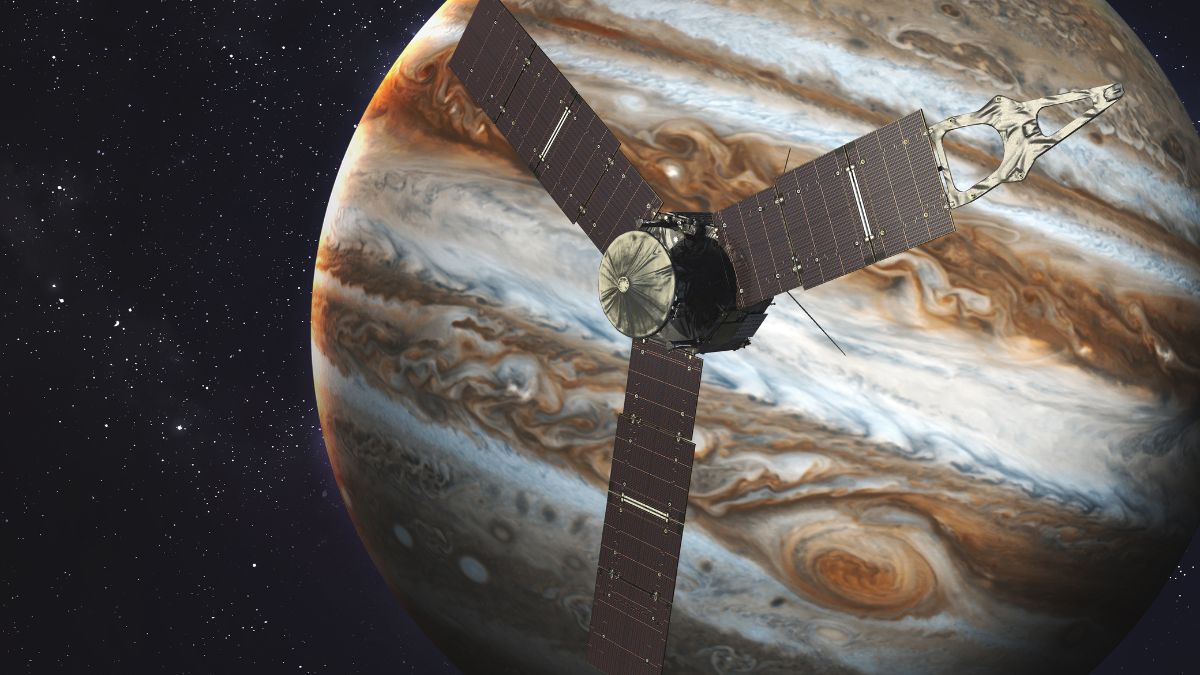
Jupiter is the king of our solar system. It is a massive, swirling giant of gas so large that all the other planets could fit inside it. For centuries, we have looked at it through telescopes and seen a tan-colored, striped ball with a famous “Great Red Spot.” But in recent years, our view of this giant world has completely changed. We are no longer seeing a calm, striped planet. We are seeing a wild, chaotic, and beautiful world of violent storms, deep, colorful clouds, and strange cyclones at its poles.
This new view comes from NASA’s Juno spacecraft. Juno is a robotic explorer that has been orbiting Jupiter since 2016. Its job is to fly closer to the planet than any other spacecraft in history. It skims just a few thousand miles above the cloud tops, traveling at incredible speeds. During these close flybys, its camera, called JunoCam, snaps pictures. These images are sent back to Earth, and they are unlike anything we have ever seen. They look less like space photos and more like works of art.
These new, breathtaking images are not just pretty. They are packed with scientific data that is helping us understand what is happening deep inside Jupiter’s atmosphere. The mission was extended, and Juno is now sending back amazing new close-up photos of Jupiter’s giant moons, including the volcanic moon Io. But what makes these pictures so special, and what new secrets are they revealing about the gas giant?
What Is the Juno Mission and Why Is It at Jupiter?
The Juno mission is a NASA project designed to study the planet Jupiter from its core to its clouds. The spacecraft was launched in 2011 and took five years to travel all the way to Jupiter, finally arriving in July 2016. The name “Juno” comes from Roman mythology. Juno was the wife of the god Jupiter (who is the Roman version of the Greek god Zeus). In the myths, Jupiter hid himself behind a veil of clouds, but Juno was able to peer through them and see his true nature. This is exactly what the spacecraft is designed to do.
Juno’s main goals are not to take pictures. Its main job is to understand what is inside the planet. It is trying to answer some of our biggest questions about Jupiter: Does it have a solid, rocky core, or is it just gas all the way down? How much water is in its deep atmosphere? How does its powerful magnetic field work? And what creates Jupiter’s powerful auroras, which are like Earth’s northern lights but much, much stronger? To do this, Juno is packed with special science tools, like a microwave radiometer that can “see” deep below the clouds.
To get its power, Juno uses three massive solar panels. Each panel is as long as a city bus. This makes Juno the most distant solar-powered spacecraft ever. Because Jupiter’s radiation is so strong, Juno has to fly in a very special path. It makes a long, looping, 34-day orbit that looks like a giant, stretched-out egg. Most of the time it is far away from Jupiter, safe from the radiation. But on each loop, it dives in for a close, two-hour “science pass,” flying very fast from the north pole to the south pole. This is when it collects most of its data and takes its amazing pictures.
Why Do Juno’s Pictures Look So Different from Other Photos of Jupiter?
This is the most common question people ask about the mission. For decades, we saw Jupiter through the eyes of the Voyager probes or the Hubble Space Telescope. Those pictures showed Jupiter as a flat, striped, pale orange marble. But Juno’s pictures show a vibrant, swirling, and chaotic world. The storms look like they are three-dimensional, with textures that look like frothy cream swirling in coffee. There are two main reasons for this dramatic difference: Juno’s orbit and its camera.
First, the orbit. Old missions flew past Jupiter’s equator, or middle. This gave us a good side-on view, showing the planet’s famous “belts” and “zones,” which are the light and dark stripes. But Juno flies in a polar orbit. This means it flies directly over the north pole, down across the equator, and out over the south pole. This is a point of view we have never had before. It is like looking at the top and bottom of a basketball instead of just the side. This new angle reveals that the poles do not have stripes at all. Instead, they are covered in strange, massive cyclones that we never knew existed.
Second, the pictures are processed by the public. The camera, JunoCam, was included on the mission to get the public excited about the science. NASA takes the raw, black-and-white data from the camera and uploads it to a website. Then, “citizen scientists” all over the world—regular people who are amateur astronomers, artists, and graphic designers—download the raw files. They use computer software to “process” them. They stitch the raw image strips together, balance the color, and enhance the contrast and shadows. This enhancement brings out the fine details and the amazing colors, turning the scientific data into the breathtaking works of art we see online. The deep blues, rich browns, and creamy whites are all based on real data, but they are amplified to show us the beauty and complexity of the storms.
What New Things Have We Seen in Jupiter’s Clouds?
Thanks to its polar orbit, Juno has completely rewritten our understanding of Jupiter’s poles. The biggest discovery was that the poles are covered in giant cyclones. At the north pole, there is one giant storm right at the center, with eight other cyclones spinning around it. At the south pole, there is a similar pattern, with one central storm and five others circling it. These storms are huge, each one as wide as the United States. They are packed together in a strange geometric pattern that scientists did not think was possible. And they are very stable; they do not seem to be merging or flying apart.
Juno also gives us amazing “up close” views of the weather in other parts of the planet. We can see towering “pop-up” clouds. These are bright, white clouds that rise high above the main cloud decks, a bit like tall thunderstorm clouds on Earth. Scientists believe these are plumes of ammonia-water ice that are rising up from deep within the planet’s atmosphere. These features help scientists understand the “engine” that drives Jupiter’s weather.
The images also show off the amazing complexity of the clouds. We see “filaments” and “eddies” swirling everywhere. The different colors tell us about the chemistry and altitude of the clouds. The white clouds are typically the highest, made of ammonia ice. The darker, reddish-brown clouds are lower down. The beautiful blue-green areas are thought to be the deepest regions we can see, where the clouds have cleared away, and we are looking deeper into the atmosphere. The images show how these different layers interact, creating the “marbled” and “frothy” look that makes the pictures so famous.
What Has Juno Shown Us About the Great Red Spot?
The Great Red Spot is Jupiter’s most famous feature. It is a giant anti-cyclone, which is like a hurricane on Earth but spinning in the opposite direction. It is so big that the entire planet Earth could fit inside it. Humans have been watching it for at least 300 years. But we have always had one big question: Is it just a thin storm that floats on the top of the clouds, or is it a deep feature?
Juno has finally answered this question. Using its special microwave instrument, Juno was able to “see” beneath the visible clouds. It has flown directly over the Great Red Spot several times to measure its “roots.” The data was shocking. Juno discovered that the Great Red Spot is not shallow at all. It is incredibly deep. The storm’s roots go down at least 500 kilometers (about 300 miles) into Jupiter’s atmosphere. This is much, much deeper than any storm on Earth. Our hurricanes are shallow by comparison, only going down 10 miles or so.
This incredible depth is likely the reason the storm has been so stable and has lasted for so long. It is not just a weather event on the surface; it is connected to the deep, inner workings of the planet itself. The JunoCam images of the Great Red Spot are also stunning. They show the incredible power of the storm, with massive, swirling tendrils of clouds being pulled into its crimson-colored center. We can see smaller, white storms being “eaten” by the giant red spot, which shows how it feeds itself and stays active.
Is Juno Taking Pictures of Jupiter’s Moons?
Yes, and these are some of the most exciting new images from the mission. When Juno finished its primary mission in 2021, NASA gave it an “extended mission.” The team is using Jupiter’s gravity to slowly change the spacecraft’s orbit. This new path is allowing Juno to fly very close to Jupiter’s four largest moons, the “Galilean moons” that were first seen by Galileo in 1610. These moons are worlds in their own right, and Juno is giving us our best view of them in over 20 years.
First, in June 2021, Juno flew past Ganymede. This is the largest moon in the entire solar system, even bigger than the planet Mercury. Juno’s images showed its icy, cratered surface in amazing detail. We could clearly see the two different types of terrain on Ganymede: old, dark, cratered regions, and younger, lighter regions that are covered in long, parallel grooves. These grooves are a sign of ancient tectonic activity on the icy moon.
Next, in September 2022, Juno flew by Europa. This is one of the most exciting places to search for life. Europa is an ice-covered moon that scientists are almost certain has a giant, salty liquid water ocean hidden beneath its frozen crust. Juno’s images helped map this icy crust, showing the long, reddish-brown cracks and “chaos terrain,” which are areas where the icy shell looks like it has been broken up and refrozen.
Most recently, Juno has been making a series of very close flybys of Io. These flybys in 2024 and 2025 are the main event of the extended mission. Io is the most volcanically active place in the solar system, with over 400 active volcanoes. Juno’s brand new, breathtaking images are showing us these volcanoes in action. We can see massive plumes of sulfur erupting from the surface and giant, dark lava lakes like “Loki Patera.” These are the first close-up pictures of Io we have had in decades, and they are helping scientists understand the volcanic engine that powers this incredible moon.
What Are Jupiter’s Auroras and How Does Juno See Them?
Just like Earth, Jupiter has auroras, which we call the northern and southern lights. But Jupiter’s auroras are on a completely different scale. They are thousands of times more powerful and energetic than Earth’s. They are also permanent; they never stop. Juno’s mission is to figure out what causes them. While JunoCam takes pictures in visible light, Juno has other special “cameras” that see in ultraviolet and infrared light. These are the instruments that can see the auroras.
The pictures Juno has sent back of the auroras are amazing. They show a giant, glowing ring of light at both the north and south poles. But they also revealed a very strange “footprint.” Juno discovered that the auroras are not just caused by the solar wind, which is what causes them on Earth. They are also caused by Jupiter’s moons!
The volcanic moon Io is constantly spewing out a ton of material (mostly sulfur and oxygen) into space. This material gets caught in Jupiter’s giant magnetic field and forms a ring, or “torus,” of electrified gas around the planet. As Jupiter spins, this material is shot down into the atmosphere at the poles, causing the auroras. Juno can actually see a “spot” in the aurora that is the magnetic footprint of Io. It is like the end of a giant electrical wire connecting the moon to the planet. Juno has also seen the footprints of the other moons, Ganymede and Europa. This shows a complex and powerful electrical connection between Jupiter and its moons that we are just beginning to understand.
Who Takes and Processes These Amazing Pictures?
One of the most unique and engaging parts of the Juno mission is that the public is a key part of the camera team. The JunoCam is a “citizen science” camera. This means NASA actively partners with the public to make these images possible. The process is a true collaboration and is open to anyone in the world who has a computer and an internet connection.
It all starts with planning. Before one of Juno’s close flybys, called a “perijove,” NASA posts the spacecraft’s planned path on the Mission Juno website. Then, citizen scientists can discuss and vote on what features they want the camera to take pictures of. Amateur astronomers on Earth take new pictures of Jupiter and upload them to help the team see what storms are active and worth imaging.
Then, when Juno makes its fast flyby, the camera takes a series of long, thin image strips. These raw images are beamed back to Earth, which can take hours or days. The images that arrive are not pretty. They are black-and-white, distorted, and look dark and fuzzy. NASA puts all this raw data on the website. This is where the magic happens. Hundreds of people download these files and get to work. They use image processing software to correct the distortion, add color filters, sharpen the details, and enhance the shadows. They are “digital artists” who are “painting by numbers” using real scientific data. They then upload their finished, beautiful creations back to the NASA website for everyone to see. When you see a new, breathtaking picture of Jupiter from Juno, you are almost always looking at the work of one of these talented citizen scientists.
Conclusion
The Juno spacecraft has completely changed our view of Jupiter. We no longer see a distant, static, striped ball. We now see a dynamic, living, and violent world that is more beautiful and complex than we ever imagined. Thanks to Juno’s unique polar orbit, we have discovered the strange, geometric cyclone storms at its poles. We have learned that the Great Red Spot is not just a surface storm but a deep-rooted feature that goes hundreds of miles down.
And now, in its extended mission, Juno is giving us brand new, breathtaking views of the Galilean moons. We are flying over the icy, ocean-filled world of Europa and the massive, grooved moon Ganymede. Most recently, we are getting our first close-ups in 20 years of the fiery, volcanic moon Io. These new images are helping us understand not just Jupiter, but the entire “Jovian system” as a family of connected worlds. It shows us a world of wild weather, powerful magnetic fields, and intense auroras. And perhaps the most inspiring part is that we are all invited along for the ride, helping to create these beautiful images from the raw data. What other amazing secrets will this mission reveal before it finally ends?
FAQs – People Also Ask
How long will the Juno mission last?
The Juno mission has been extended by NASA. The current plan is for the mission to continue its science operations through September 2025, or until the spacecraft’s systems can no longer function in Jupiter’s harsh radiation environment.
How fast does Juno fly when it passes Jupiter?
During its closest approach to Jupiter, called a “perijove,” Juno is the fastest human-made object ever. It reaches speeds of over 209,000 kilometers per hour (130,000 miles per hour) relative to the planet.
What is a “perijove”?
“Perijove” is the name for the point in Juno’s orbit when it is closest to Jupiter. The spacecraft spends most of its time far away, but every 34 days it makes a very fast, very close dive (the perijove) to collect its science data and take pictures.
Why is Jupiter’s Great Red Spot shrinking?
Yes, astronomers have observed that the Great Red Spot has been getting smaller for the last several decades. It is now about half the width it was 100 years ago. Juno’s data is helping scientists understand why this is happening, but the exact reason is still a mystery.
Does Jupiter have a solid core?
This is one of Juno’s main questions. The most recent data suggests that Jupiter does not have a small, solid, well-defined core like Earth. Instead, it seems to have a “fuzzy” or “diluted” core, where heavy elements are mixed with the liquid metallic hydrogen, extending out to a large portion of the planet’s radius.
How does Juno survive Jupiter’s radiation?
Jupiter is surrounded by the most powerful and dangerous radiation belts in the solar system. To survive, Juno’s most sensitive computers and electronics are protected inside a “radiation vault.” This vault is a box made of titanium, with walls that are about half an inch thick, which shields the “brains” of the spacecraft.
What are the “pearls” on Jupiter?
The “string of pearls” is a nickname for a series of giant, white, oval-shaped storms that are found in Jupiter’s southern hemisphere. Juno has taken many high-resolution images of these storms, which are a type of anti-cyclone, as it passes over them.
What is JunoCam?
JunoCam is the visible-light camera on the Juno spacecraft. It was included on the mission primarily for public outreach. NASA makes the raw images from JunoCam available to the public, and “citizen scientists” are the ones who process the data to create the beautiful, artistic images we see.
Did Juno find water on Jupiter?
Yes, but not as an ocean. Juno’s microwave instrument can measure the amount of water deep in Jupiter’s atmosphere. Early data suggests there is more water than we thought, especially near the equator. This helps scientists understand how Jupiter and the solar system formed.
Why is the spacecraft named “Juno”?
The spacecraft is named after the goddess Juno from Roman mythology. In the myths, the god Jupiter was her husband, and he liked to hide his misbehavior behind a veil of clouds. Juno was the only one who could peer through the clouds to see what he was really doing. The spacecraft does the same thing, peering through Jupiter’s clouds to see its secrets.