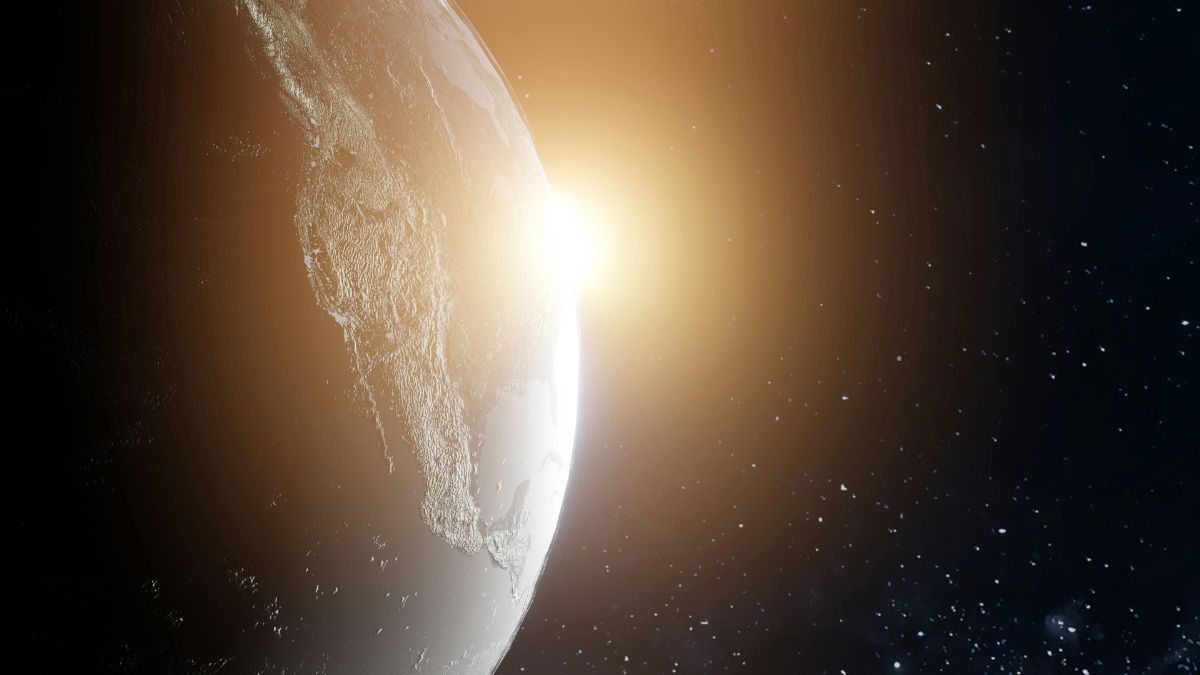
Our Sun is the center of our solar system, a giant, hot star that gives us light and warmth. We often think of it as a perfect, glowing ball of light that is always the same. But the Sun is actually a very active and dynamic place. It has weather, storms, and changing features, much like a planet, but on an incredibly powerful scale.
The most famous signs of the Sun’s activity are dark patches that temporarily appear on its surface. These patches are called sunspots. They are not permanent marks but rather “freckles” that show up, move across the Sun’s face, and then fade away. Some are small, but many can grow to be several times larger than the entire planet Earth.
These sunspots might just look like blemishes, but they are the key to understanding the Sun’s behavior. They are the areas where massive solar storms are born. These storms can send huge amounts of energy and matter flying through space, and when Earth is in the way, we can feel the effects. But how can a simple dark spot on the Sun be powerful enough to reach our planet?
What Exactly Is a Sunspot?
A sunspot is an area on the Sun’s surface that looks dark because it is cooler than the areas around it. When we say “cool” on the Sun, it is all relative. The normal surface of the Sun, called the photosphere, is about 10,000 degrees Fahrenheit (5,500 degrees Celsius). A large sunspot might be “only” 6,500 degrees Fahrenheit (3,500 degrees Celsius). It is still hotter than anything we can imagine, but the temperature difference makes it look dark in comparison.
If you could somehow take a sunspot off the Sun and place it in the night sky by itself, it would shine brighter than a full moon. It only appears dark because the “normal” surface of the Sun is so incredibly bright. Sunspots have two parts: a very dark inner region called the umbra, and a slightly lighter, surrounding region called the penumbra. They are not holes; they are just like cooler “islands” on the Sun’s bright ocean of hot gas. These spots can last anywhere from just a few days to several months, and they often appear in groups.
Why Do Sunspots Form on the Sun?
Sunspots are not random. They are the visible sign of intense magnetic activity happening inside the Sun. The Sun is not a solid rock; it is a giant ball of electrically charged gas called plasma. This plasma is constantly moving, flowing, and boiling. This movement creates massive, powerful magnetic fields.
Here is where it gets interesting. The Sun does not rotate like a solid ball. The equator of the Sun spins much faster (about 25 days) than its poles (about 35 days). This is called “differential rotation,” and it causes the Sun’s magnetic field lines to get stretched, twisted, and tangled up like a giant mess of rubber bands.
Sometimes, a part of this magnetic field becomes so tangled and intense that it “punches” or “breaks through” the Sun’s surface. When this happens, the intense magnetic pressure pushes aside the hot, rising gas from below. It essentially puts a “cap” on the area, blocking the normal flow of heat. This “cap” is the sunspot. The area cools down, and we see it as a dark patch. So, every sunspot you see is a place where an extremely powerful magnetic field, thousands of times stronger than Earth’s, has burst out of the Sun.
What Is the 11-Year Solar Cycle?
The number of sunspots we see is not constant. It rises and falls in a regular, predictable pattern called the solar cycle. This cycle lasts, on average, about 11 years. It is like the Sun has a long, slow “heartbeat” of activity.
This 11-year period measures the time between two peaks of sunspot activity. The cycle starts at solar minimum, a time when the Sun is very quiet. During this phase, there might be no sunspots at all for weeks or months. Then, slowly, more and more sunspots begin to appear, and they appear at different locations on the Sun.
Over the next five to six years, the activity builds. The number of sunspots increases, and solar storms become much more common. This peak of activity is called the solar maximum. After reaching its peak, the Sun’s activity slowly calms down again over the next five to six years, returning to a new solar minimum. Then, the entire 11-year cycle starts over. Interestingly, this cycle is also tied to the Sun’s magnetic field flipping. At each solar maximum, the Sun’s north and south magnetic poles completely switch places. It takes another 11 years for them to flip back, making the full magnetic cycle 22 years long.
Where Are We in the Solar Cycle Right Now in 2025?
This question is very important right now. We are currently in Solar Cycle 25. This cycle officially began in December 2019, when the Sun was at its last solar minimum. When this cycle started, scientists at NASA and NOAA (the National Oceanic and Atmospheric Administration) made a prediction. They predicted that Solar Cycle 25 would be a relatively weak cycle, very similar to the last one (Solar Cycle 24), with a peak of activity happening around July 2025.
However, the Sun has been full of surprises. Since 2022, the Sun’s activity has ramped up much faster and much more strongly than the official prediction. The number of sunspots seen each month has consistently been higher than what was forecasted. This has led scientists to update their thinking.
Based on the very high activity we saw in 2023 and 2024, many experts now believe the solar maximum did not wait for 2025. Instead, the peak of Solar Cycle 25 likely occurred in late 2024. But this does not mean the show is over. The “maximum” is not a single day; it is a broad period of high activity that can last for more than a year. This means that right now, in 2025, we are still in this very active phase. We can expect to see many large sunspots, frequent solar flares, and a significantly higher chance of solar storms heading toward Earth for all of 2025.
How Do Sunspots Create Solar Flares and CMEs?
Sunspots themselves are just the visible symptom. The real action comes from the tangled magnetic fields that create them. These magnetic fields in “active regions” (the areas around sunspots) store enormous amounts of energy. As the Sun’s plasma moves, these fields get more and more twisted. Eventually, they get so stressed that they “snap” and reconfigure, like a rubber band breaking. This sudden release of energy is what causes solar storms.
These storms come in two main forms:
- Solar Flares: A solar flare is an intense, giant flash of radiation. It is a burst of X-rays and extreme ultraviolet light. Because this is light, it travels at the speed of light. If a solar flare erupts, it takes only 8 minutes for its radiation to reach Earth. This radiation cannot physically harm a person on the ground, as our atmosphere protects us. But it can strongly affect the upper part of our atmosphere (the ionosphere) that we use for communication.
- Coronal Mass Ejections (CMEs): This is the one we worry about most. A CME is not a flash of light; it is a massive explosion of matter. A CME blasts a giant bubble of plasma and magnetic field, weighing billions of tons, away from the Sun. This “cloud” of solar material travels through space at incredible speeds, from 300 to over 2,000 kilometers per second. If a CME is aimed at Earth, it takes 1 to 3 days to cross the 93 million miles and slam into our planet. A CME is what causes a “geomagnetic storm.”
Sunspots are the launch pads for these events. The more sunspots there are, and the more magnetically complex they are, the higher the chance of a major solar flare or a CME.
How Do Solar Storms Damage Our Technology?
When a CME (a geomagnetic storm) hits Earth, it does not destroy the planet. It interacts with Earth’s natural magnetic shield, the magnetosphere. This collision of magnetic fields creates powerful electrical and magnetic changes that can cause serious problems for our modern, technology-dependent lives.
Here is how it breaks down:
- Power Grids: The changing magnetic field from the storm creates “geomagnetically induced currents” (GICs) on the ground. These are basically uncontrolled, extra electric currents that flow through long metal conductors. The longest conductors we have are our high-voltage power lines. This extra current flows into the giant transformers at power substations. These transformers are not designed for this type of current. They can “saturate,” overheat, and in extreme cases, melt or even burn out. This can trip safety systems and cause widespread, cascading blackouts. In 1989, a solar storm knocked out power to the entire province of Quebec, Canada, for nine hours.
- Satellites: Satellites in orbit are outside the protection of most of our atmosphere. They are hit directly by the high-energy particles from the storm. This can cause “single-event upsets,” where a particle hits a microchip and flips a 0 to a 1, causing a “phantom command” or crashing the satellite’s computer. The storm can also cause “spacecraft charging,” where parts of the satellite build up a static charge. This can lead to an “arc discharge” (a spark) that fries sensitive electronics. A severe storm can permanently damage or destroy multi-million dollar satellites.
- GPS and Radio: When a solar flare’s radiation hits, it “ionizes” our upper atmosphere. This can cause radio blackouts, especially for high-frequency radio used by airplanes and ships for long-distance communication. The CME that follows can also stir up the ionosphere, scrambling GPS signals. This makes GPS locations inaccurate or completely unavailable, which is a major problem for navigation, aviation, and even financial systems that rely on precise timing from GPS.
How Do Sunspots Cause the Northern and Southern Lights?
There is one very beautiful and harmless effect of solar storms. Sunspots do not directly cause the aurora, but the CMEs that erupt from their active regions are the engine. The beautiful lights we see are the direct result of a geomagnetic storm hitting our planet.
When the cloud of particles from a CME arrives, Earth’s magnetic field funnels these high-energy particles toward the North and South Poles. These particles, traveling at very high speeds, then slam into the gases in our upper atmosphere (about 60 to 200 miles up).
This collision “excites” the atoms of gas, meaning it gives them extra energy. The atoms do not want to hold this extra energy for long. To calm down, they release this energy in the form of tiny flashes of light. When billions and billions of atoms do this at once, we see the amazing, dancing curtains of the aurora. The color we see depends on which gas was hit:
- Oxygen (the most common) glows green at lower altitudes and red at very high altitudes.
- Nitrogen (the second most common) glows blue and purple.
During a solar maximum like the one we are in during 2025, the storms are stronger. This pushes the aurora “oval” much farther south than normal. That is why during big solar storms, people can see the Northern Lights in places like the middle of the United States or the United Kingdom, far from the Arctic Circle where they usually appear.
What Was the Carrington Event?
When we talk about the dangers of solar storms, scientists always point to one “worst-case scenario” event from history. This is the Carrington Event of 1859. It was the most powerful geomagnetic storm ever recorded in human history, and it happened during the solar maximum of Solar Cycle 10.
It was named after Richard Carrington, a British astronomer who was sketching a large group of sunspots on September 1, 1859. He suddenly saw an intensely bright “white light flare” erupt from the sunspot group. Just 17.6 hours later (an incredibly fast transit), the CME slammed into Earth.
In 1859, we had no satellites, no power grid, and no GPS. The most advanced technology was the telegraph system. The Carrington Event completely overwhelmed it. The induced currents in the telegraph wires were so strong that they gave operators electric shocks. Telegraph paper reportedly caught on fire. The “auroral current” was so powerful that many telegraph stations disconnected their batteries entirely, and the lines continued to work, powered only by the storm itself.
The auroras were seen globally. People in the Caribbean and Hawaii reported seeing the red and green lights, which were so bright that people in the US woke up in the an-night, thinking it was dawn. If an event of this magnitude happened today in 2025, the results would be catastrophic. It could cause continent-wide blackouts that might last for weeks or months, destroy trillions of dollars worth of satellites, and shut down our entire modern way of life, from the internet and banking to water and transportation systems.
How Do Scientists Watch and Predict Solar Storms?
Because the threat is so real, scientists have created a “space weather forecast” system. We cannot stop solar storms, but we can see them coming.
Scientists use a fleet of satellites to watch the Sun 24 hours a day, 7 days a week. Spacecraft like NASA’s Solar Dynamics Observatory (SDO) monitor the Sun in many different wavelengths of light. This allows forecasters at NOAA’s Space Weather Prediction Center (SWPC) to see sunspots as they form, even before they rotate onto the side of the Sun facing Earth. They closely watch the “magnetic complexity” of sunspot groups. A simple magnetic spot is usually calm, but a large, complex spot with mixed-up magnetic fields (called a “beta-gamma-delta” region) is like a ticking time bomb, very likely to erupt.
When a CME does erupt, satellites can watch the cloud as it leaves the Sun and model its path to see if it will hit Earth. Our best and most important “tripwire” is the DSCOVR satellite. It is parked in space 1 million miles away, directly between the Sun and Earth. It gets hit by the solar storm first, about 15 to 60 minutes before the storm reaches our planet. It beams an alert to Earth, giving power grid operators, airlines, and satellite controllers a crucial, short-term warning to put their systems into a “safe mode” to try and ride out the storm.
Conclusion
Sunspots are far more than just dark “freckles” on our star. They are the visible engines of the Sun’s magnetic heart, driving a cycle of calm and chaos that repeats every 11 years. They are the source of solar flares and massive CMEs that travel millions of miles to our planet.
These solar storms are a powerful reminder that we live in a dynamic solar system. They can create the breathtaking beauty of the aurora, but they also pose a very real threat to the modern technological world we have built. As we move through the very active solar maximum of Solar Cycle 25 in 2025, watching our Sun is more important than ever.
Now that you know our technology is so deeply connected to the Sun’s activity, does it change how you think about our place in the solar system?
FAQs – People Also Ask
What do the X, M, and C classes of solar flares mean?
Solar flares are graded on a lettered scale, like hurricane categories. C-class flares are minor and have few noticeable effects on Earth. M-class flares are medium-sized; they can cause brief radio blackouts at the poles. X-class flares are the largest and most intense. An X-class flare can cause planet-wide radio blackouts and create strong radiation storms.
Can a sunspot or solar storm destroy Earth?
No. A solar storm, even a massive Carrington-level event, cannot physically destroy the planet. Our atmosphere and magnetic field protect all life on the surface from the harmful radiation. The primary danger is not to life itself, but to the technological infrastructure (power grids, satellites) that our modern civilization depends on.
How long does a geomagnetic storm last?
When a CME hits Earth, the main part of the resulting geomagnetic storm typically lasts for 24 to 48 hours. However, the effects on technology, such as satellite operations and power grid stability, can linger for several days as the whole Earth system settles back to normal.
Why is Solar Cycle 25 so much stronger than predicted?
Scientists are still studying this, but it highlights that we still have a lot to learn about the Sun. Solar cycle prediction is very difficult. The Sun’s internal “dynamo” (the process that creates its magnetic field) is incredibly complex. The initial predictions were based on the weakness of the previous cycle, but it appears the Sun’s internal activity was “re-energized” more quickly than expected.
Can we see sunspots from Earth without a telescope?
Sometimes, yes, but you must never look directly at the Sun. During a very active period, some sunspot groups can grow so large they are visible to the naked eye. To see them, you must use special-purpose, certified “eclipse glasses” or a solar filter for a camera or telescope. Looking at the Sun without a proper filter will cause instant and permanent blindness.
What was the 1989 Quebec blackout?
On March 13, 1989, a powerful geomagnetic storm from a CME hit Earth. This storm created massive ground currents that overloaded the Hydro-Québec power grid. Safety systems tripped in seconds, plunging the entire province of Quebec, Canada—more than 6 million people—into darkness for over nine hours. This event was a major wake-up call for the power industry.
Why are satellites so vulnerable to solar storms?
Satellites are in the vacuum of space, with no atmosphere to protect them. They are directly exposed to high-energy particles that can damage their solar panels and short-circuit their electronics. Storms also heat the Earth’s upper atmosphere, making it expand, which creates more “drag” on low-orbit satellites and can cause them to fall out of orbit, as happened to a batch of Starlink satellites in 2022.
Do sunspots affect Earth’s climate or temperature?
The Sun’s output does change slightly during the solar cycle. At solar maximum, the Sun is about 0.1% brighter than at solar minimum. This small change does have a minor impact on Earth’s climate, but it is not the main driver of the long-term global warming trend we are currently experiencing. The effect of human-caused greenhouse gases is far more significant.
What is the solar wind?
The solar wind is a constant stream of charged particles (mostly protons and electrons) that flows from the Sun’s outer atmosphere (the corona) in all directions. It is different from a CME, which is a single, massive explosion. The solar wind is always blowing, and it is this wind that carries the CMEs to Earth and creates the magnetosphere around our planet.
How can I see the aurora?
To see the aurora, you need three things: a dark sky (away from city lights and not during a full moon), clear weather, and a geomagnetic storm. During the 2025 solar maximum, your chances are much higher. You can check “space weather forecast” websites or apps from sources like NOAA or specific aurora trackers. They will show you the “Kp-index,” a measure of storm activity, and tell you how far south the aurora might be visible.