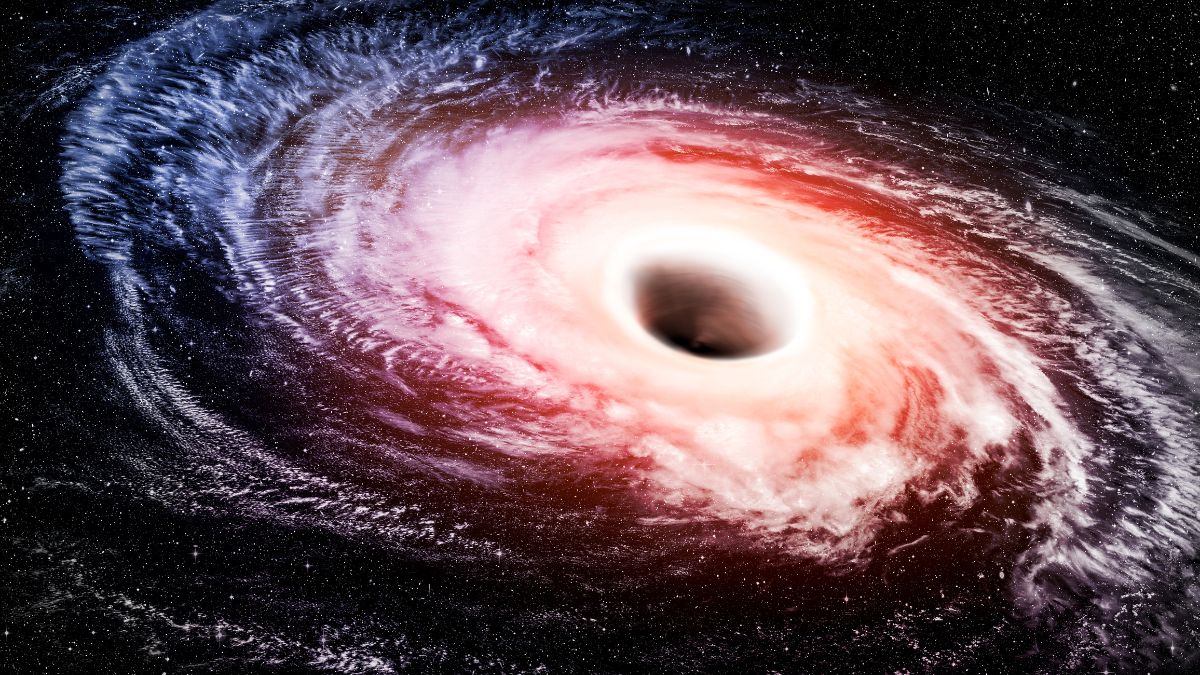
At the very heart of our home galaxy, the Milky Way, lies a cosmic giant. This giant is a supermassive black hole named Sagittarius A* (pronounced Sagittarius A-star). For a long time, scientists thought of it as a relatively quiet and sleeping monster. Unlike the supermassive black holes in other galaxies, which are often seen violently feasting on stars and gas, ours seemed to be on a strict diet. It sits calmly, more than 26,000 light years away from Earth, pulling in only small wisps of cosmic dust.
However, recent discoveries are changing this peaceful picture. Astronomers have found compelling evidence that our galaxy’s central black hole was not always so calm. By looking at the region around Sagittarius A* with powerful telescopes, they have uncovered faint, ghost-like structures that point to a violent and energetic past. These structures look like enormous chimneys or exhaust vents, funneling material away from the galactic center. This discovery suggests that our black hole once had a massive outburst, sending a powerful blast of energy across the galaxy.
This finding raises a fascinating idea: that our supermassive black hole might be “leaking” the remnants of this ancient energy. This isn’t a leak in the way a tap drips water, but rather a slow, continuous outflow of superheated gas and particles from a cataclysmic event that happened millions of years ago. The evidence of this cosmic eruption is still visible today, giving us a window into our galaxy’s turbulent history. So, what exactly did astronomers find, and what does this ancient cosmic exhaust pipe tell us about our galaxy’s violent past?
What is Sagittarius A* and why is it important?
Sagittarius A*, often shortened to Sgr A*, is the supermassive black hole located at the exact center of the Milky Way galaxy. It is the gravitational anchor that holds our galaxy together, with everything, including our own solar system, orbiting around it. Its importance cannot be overstated; studying it helps us understand not only how our galaxy formed and evolved but also the fundamental laws of physics under extreme conditions. While we cannot see the black hole itself, as its gravity is so strong that not even light can escape, we can observe its effects on the stars and gas clouds that orbit it.
The scale of Sgr A* is almost impossible to comprehend. It has a mass that is about four million times greater than our own Sun. Yet, all of that mass is squeezed into a region of space smaller than the orbit of Mercury. The stars closest to Sgr A* move at incredible speeds, some traveling at several thousand kilometers per second. By tracking the orbits of these stars over decades, astronomers were able to precisely calculate the mass and location of the black hole, providing the first concrete proof of its existence. Sgr A* serves as our very own cosmic laboratory, allowing scientists to test theories of gravity and black hole behavior in ways that would be impossible anywhere else.
How can a black hole ‘leak’ if nothing escapes its gravity?
This is an excellent question that gets to the heart of a common misconception about black holes. It is true that once something crosses a black hole’s “event horizon”—its point of no return—it can never escape. However, the energy “leak” we are talking about does not come from inside the black hole. Instead, it comes from the material that is swirling around it, just outside the event horizon. This region is called the accretion disk, a spinning, superheated platter of gas, dust, and stellar debris that is slowly being pulled toward the black hole.
Think of a black hole as a very messy eater. As it pulls material from the accretion disk, not everything goes down smoothly. The intense gravitational and magnetic forces in the disk heat the material to millions of degrees, causing it to glow brightly in X-rays and other forms of light. Sometimes, a huge amount of this energy and material is violently ejected back out into space before it ever reaches the event horizon. These ejections take the form of powerful jets or winds that travel at nearly the speed of light. So, the “leak” is not from inside the black hole but is actually a powerful outflow of leftover energy from its last big meal. This process is what creates the structures we now see as evidence of a past eruption.
What evidence suggests our black hole had a past outburst?
The primary evidence comes from observations made by advanced space telescopes, particularly those that can see in X-ray and radio light, which are invisible to our eyes. Using NASA’s Chandra X-ray Observatory and the European Space Agency’s XMM-Newton, astronomers have identified two enormous structures extending hundreds of light years above and below the galactic plane. They have been nicknamed “galactic chimneys.” These columns of hot gas seem to be venting energy from the galactic center directly into intergalactic space. They act like exhaust vents for a massive energy release that must have occurred in the past.
But the chimneys are just one part of a much larger puzzle. They appear to be connected to even bigger structures known as the “Fermi Bubbles.” Discovered in 2010, the Fermi Bubbles are two gigantic, balloon-like lobes of high-energy gas extending about 25,000 light years above and below the Milky Way’s disk. They are completely invisible in normal light but shine brightly in gamma rays and X-rays. Scientists believe these bubbles are the smoking gun—the leftover remnants of a tremendously powerful eruption from Sagittarius A* that happened a few million years ago. The galactic chimneys appear to be the channels through which the energy from that eruption was funneled outwards to inflate these massive bubbles.
How powerful was this ancient energy eruption?
The energy required to create the Fermi Bubbles and the galactic chimneys is staggering. Scientists estimate the eruption from Sagittarius A* was millions of times more powerful than a supernova, which is the explosive death of a massive star. To put it in another perspective, this single event likely released as much energy as hundreds of thousands of stars would produce over their entire lifetimes. This was not a small burp; it was a galaxy-altering explosion that sent a shockwave of superheated plasma screaming through the galactic halo.
This blast would have been powerful enough to clear out gas and dust for thousands of light years around the galactic center. The material within the Fermi Bubbles is still incredibly hot, reaching millions of degrees Celsius even after millions of years. This tells us that the initial explosion was an event of almost unimaginable violence. It likely occurred when a massive gas cloud or a large star cluster wandered too close to Sagittarius A* and was torn apart by its gravity. The resulting feast would have overloaded the black hole’s accretion disk, causing it to unleash this colossal amount of energy. It completely reshaped the environment at the center of our galaxy, and its afterglow is what we are still studying today.
Does this ‘leak’ pose any danger to Earth?
This is a very natural question to ask, but the answer is a clear and resounding no. There is absolutely no danger to Earth or our solar system from this ancient eruption or any potential future activity from Sagittarius A*. There are several key reasons for this. First and foremost is distance. Our solar system is located about 26,000 light years away from the galactic center. That is an immense distance, and we are safely tucked away in one of the Milky Way’s spiral arms, far from the chaotic and high-energy environment of the core.
Second, the energy from this ancient eruption was not directed towards us. The galactic chimneys and Fermi Bubbles show that the jets of energy were blasted out perpendicular to the flat disk of the galaxy, where most of the stars, including our Sun, reside. Our solar system is safely within the disk, so the blast went “up” and “down” relative to us, not outwards in our direction. Finally, the event in question happened millions of years ago. We are simply observing the ancient aftermath. While Sagittarius A* is a powerful object, its influence at our distance is far too weak to have any direct impact on our daily lives. We are more likely to be affected by our own Sun than by the giant sleeping at the galaxy’s heart.
What tools are scientists using to study this phenomenon?
Uncovering the secrets of our galaxy’s center requires a whole team of powerful telescopes, each designed to look at the universe in a different way. Since much of the galactic center is obscured by thick clouds of dust and gas, we cannot see it well with regular optical telescopes that detect visible light. Instead, scientists rely on telescopes that can detect other forms of light, like X-rays, gamma rays, radio waves, and infrared.
- Chandra X-ray Observatory: This NASA space telescope is crucial for studying the hot, high-energy gas in the galactic chimneys. Its incredibly sharp X-ray vision allows it to map out the precise shape and temperature of these structures, providing direct evidence of the energy flow.
- XMM-Newton: The European Space Agency’s X-ray telescope works alongside Chandra. While Chandra provides sharper images, XMM-Newton is more sensitive to faint X-rays over a wider area, helping to map the full extent of the hot gas.
- Fermi Gamma-ray Space Telescope: This telescope was the one that first discovered the massive Fermi Bubbles. It detects the highest-energy form of light, gamma rays, which are produced by cosmic rays zipping through the bubbles.
- MeerKAT Radio Telescope: Located in South Africa, this array of radio dishes is exceptionally good at mapping magnetic fields and lower-energy particles. It has revealed mysterious radio filaments within the galactic center, which are likely related to the past energetic activity.
By combining data from all of these instruments, astronomers can piece together a complete picture of the event. Each telescope provides a different clue, and together, they tell the story of our black hole’s explosive past.
Could Sagittarius A* erupt like this again in the future?
It is certainly possible, but it is not something that is expected to happen anytime soon. For Sagittarius A* to have another eruption on the scale of the one that created the Fermi Bubbles, it would need a massive amount of fuel. This means a very large gas cloud or even a star would have to fall into its accretion disk. Currently, Sgr A* is in a starvation phase. The amount of material trickling into it is very small, which is why it is so quiet compared to the supermassive black holes in more active galaxies.
Astronomers do track objects near the galactic center. In 2014, they watched a gas cloud called G2 pass very close to the black hole, but it mostly survived the encounter, and the expected fireworks never happened. This shows that feeding the black hole is not as easy as it might seem. While it is theoretically possible that a star could be knocked onto a collision course with the black hole, such events are rare, happening on timescales of tens of thousands to millions of years. So, while our galaxy’s heart will almost certainly roar to life again someday, it is a future that is millions of years away. For the foreseeable future, we can expect it to remain the sleeping giant we know today.
Conclusion
The discovery that our galaxy’s supermassive black hole, Sagittarius A*, is “leaking” energy has transformed our understanding of the Milky Way. We now know that the quiet giant at our galactic center was once a source of incredible violence and power. The galactic chimneys and the enormous Fermi Bubbles are fossils of this ancient eruption, painting a picture of a past where our galaxy’s heart was far more active than it is today. This “leak” is not a present danger but a ghost of energy from an event that occurred millions of years ago.
By studying these cosmic remnants with an array of powerful telescopes, we are piecing together the dramatic history of our own galaxy. We have learned that the center of the Milky Way is not a static place but a dynamic environment shaped by immense forces over billions of years. The evidence of this ancient outburst serves as a powerful reminder that even in our own cosmic backyard, there are still profound secrets waiting to be discovered. As we continue to gaze into the heart of our galaxy, what other secrets of its energetic history are waiting to be uncovered?
FAQs – People Also Ask
How big is the black hole at the center of the Milky Way?
Sagittarius A* has a mass about four million times that of our Sun. However, its actual physical size, defined by its event horizon, is relatively small, with a diameter of about 24 million kilometers, which is less than half the size of Mercury’s orbit around the Sun.
Can we see Sagittarius A* with a normal telescope?
No, we cannot see Sagittarius A* with a normal optical telescope. This is for two reasons: first, a black hole itself emits no light, and second, the galactic center is hidden behind dense clouds of interstellar dust and gas that block visible light from reaching us.
What are the Fermi bubbles?
The Fermi Bubbles are two gigantic, symmetrical lobes of hot gas and cosmic rays extending about 25,000 light years above and below the center of the Milky Way. They are invisible in normal light but glow in gamma rays and X-rays, and are believed to be the remnants of a massive energy eruption from Sagittarius A* a few million years ago.
How long ago did the black hole eruption happen?
Scientists estimate that the powerful eruption from Sagittarius A* that created the Fermi Bubbles and the galactic chimneys occurred approximately 2 to 4 million years ago. We are observing the ancient aftermath of this incredibly energetic event from a safe distance.
What is an accretion disk?
An accretion disk is a flattened, rotating structure of gas, dust, and other debris that forms around a massive object like a black hole or a star. As the material spirals inward due to gravity, it heats up to extreme temperatures from friction and compression, often emitting intense radiation.
Is our solar system moving towards the galactic center?
No, our solar system is in a stable orbit around the galactic center, much like the Earth orbits the Sun. We are moving at about 230 kilometers per second (or about 515,000 miles per hour), but this speed keeps us in a roughly circular path that will take about 230 million years to complete one full orbit.
Could a star falling into the black hole cause another leak?
Yes, if a star were to get too close to Sagittarius A*, it would be torn apart by tidal forces in what is known as a tidal disruption event. The stellar material would then form an accretion disk, and the process of the black hole consuming it could cause another massive release of energy, similar to the one in the past.
What is the event horizon of a black hole?
The event horizon is the boundary around a black hole beyond which nothing, not even light, can escape its gravitational pull. It is often referred to as the “point of no return.” Anything that crosses the event horizon is trapped forever and will eventually be pulled into the singularity at the center.
How do scientists know the leak is made of energy and not just light?
Scientists know the leak contains more than just light because of the types of radiation they detect. The X-rays come from extremely hot gas (matter) that has been energized, and the radio waves reveal fast-moving charged particles spiraling in magnetic fields. This shows a flow of both matter and energy, not just light.
Why is our galaxy called the Milky Way?
Our galaxy is called the Milky Way because, from Earth, it appears as a hazy, milky band of faint light stretching across the night sky. This band is actually the combined light from billions of distant stars in the galaxy’s disk, viewed from our position within it. The ancient Greeks called it galaxias kyklos, or “milky circle.”