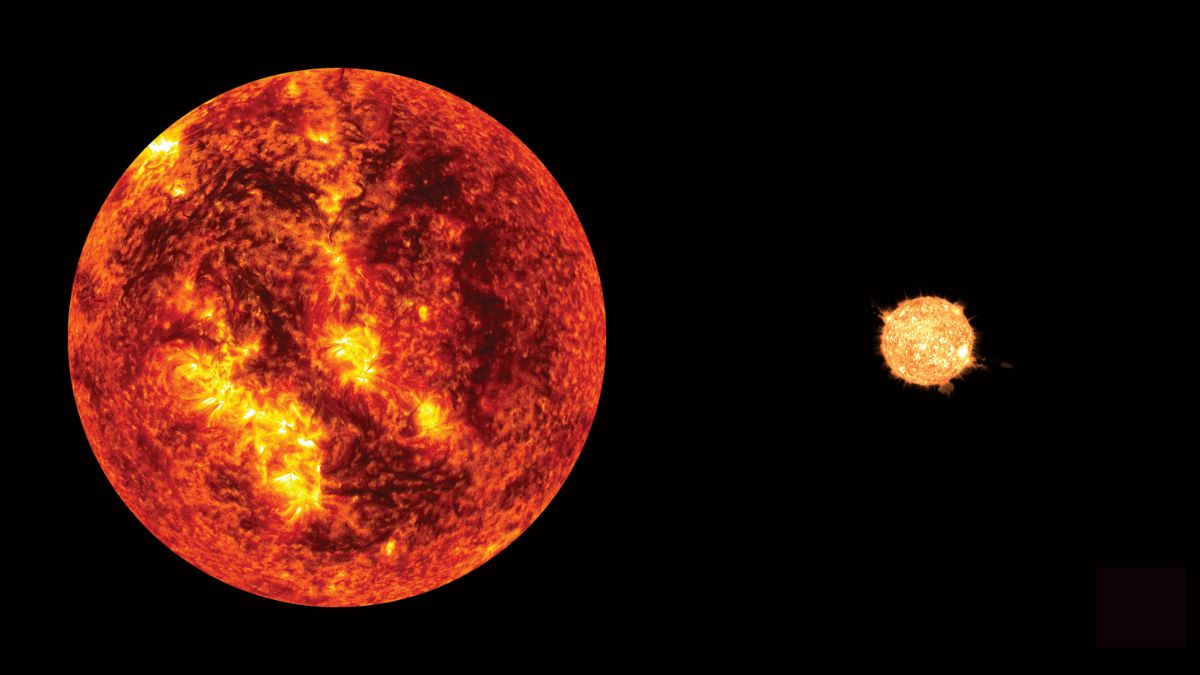
When we look up at the night sky, we see thousands of twinkling points of light. Most of these are stars, giant balls of hot gas just like our own Sun. But not all stars are created equal. Some are small and dim, while others are incredibly large and bright. One of the most famous and fascinating stars in our sky is Betelgeuse, the bright reddish star that marks the shoulder of the constellation Orion.
Our Sun is the center of our solar system and the source of all life on Earth. To us, it seems enormous. It is so big that you could fit one million Earths inside it. But in the grand universe, our Sun is actually a very average, medium sized star. Betelgeuse, on the other hand, is not average at all. It is a true giant. It is in a completely different class of star, known as a red supergiant.
Comparing Betelgeuse to our Sun is like comparing a small pebble to an entire mountain. The difference in size is hard to fully grasp because the numbers are just too big to feel real. But understanding this difference helps us see how varied and amazing the universe truly is. It also gives us a peek into the future, showing us what happens when a truly massive star reaches the end of its life. Just how big is this stellar giant?
What Exactly Is Betelgeuse?
Betelgeuse is one of the most recognizable stars we can see without a telescope. You can find it easily in the winter sky (in the Northern Hemisphere) as the bright, orange red “shoulder” of the hunter, Orion. Its name comes from Arabic, and it is a star that has fascinated people for centuries. But to astronomers, Betelgeuse is special for a different reason. It is what we call a red supergiant. This is a title given to stars that are enormous, relatively cool in temperature (which is why they look red), and, most importantly, very old and near the end of their lives.
Stars spend most of their lives, billions of years, in a stable phase called the “main sequence.” Our Sun is in this phase right now. During this time, they turn hydrogen gas into helium gas in their core, which creates all their light and heat. But Betelgeuse was born much, much heavier than our Sun. Because it was so heavy, it burned through its hydrogen fuel incredibly fast. While our Sun is 4.6 billion years old and only about halfway through its life, Betelgeuse is only about 10 million years old and is already dying. It has used up the hydrogen in its core and has “puffed up” into the giant star we see today.
This puffing up process is what makes it a supergiant. The star’s core gets very hot and dense, while its outer layers expand outwards over a massive distance. This makes the star’s surface cool down, changing its color from a bright blue white (which it was in its youth) to the orange red we see now. So, when you see Betelgeuse, you are looking at a star that is in the final, dramatic stage of its life. It is one of a handful of stars that are so large and relatively close to us that telescopes can actually see it as a disk, rather than just a point of light.
How Big Is Betelgeuse in Numbers?
Let’s try to put the size of Betelgeuse into numbers we can understand. The size of stars is often measured in “solar radii.” One solar radius is the size of our Sun. Our Sun’s diameter is about 865,000 miles (or 1.4 million kilometers) across. It is a huge number, but it is our starting point. When scientists measure Betelgeuse, the numbers are staggering. Betelgeuse is not perfectly round, and it actually pulsates, meaning it gets slightly bigger and smaller over time. Because of this, its exact size is hard to pin down.
However, most estimates place the size of Betelgeuse at somewhere between 700 and 1,000 times the radius of our Sun. Let’s use a middle number, around 900 times, to get an idea. If our Sun has a diameter of 865,000 miles, then Betelgeuse has a diameter of roughly 778 million miles (or 1.2 billion kilometers). This number is so large it almost loses meaning. Let’s think of it differently. If you were in a spaceship that could fly at the speed of light (which is 186,000 miles per second), it would take you about 4.5 seconds to cross the Sun. To cross Betelgeuse, it would take you over an hour.
Another way to think about it is in volume. If you think of the Sun as a basketball, Betelgeuse would be a sphere large enough to contain an entire professional sports stadium. The volume of Betelgeuse is even more shocking. If you could fit one million Earths inside the Sun, you could fit roughly 700 million Suns inside Betelgeuse. It is one of the largest stars we know of in our galaxy.
What If Betelgeuse Replaced Our Sun?
This is perhaps the best way to truly understand the scale of Betelgeuse. Imagine we could magically remove our Sun and place Betelgeuse in the center of our solar system. The result would be catastrophic and completely change what our solar system looks like. The first thing we would notice is that we would be inside the star. The physical surface of Betelgeuse, its outer layer, would stretch far out into space.
Our Sun is 93 million miles away from Earth, a distance we call one “astronomical unit” (AU). The surface of Betelgeuse would stretch much, much farther than that. It would easily swallow the first planet, Mercury. It would then swallow the second planet, Venus. It would, of course, completely swallow the third planet, Earth. Our entire planet would be vaporized deep within the fiery, thin atmosphere of this supergiant star. But it would not stop there.
The surface of Betelgeuse would continue to stretch past the orbit of the fourth planet, Mars. It would even stretch past the Asteroid Belt. Most astronomers believe the surface of Betelgeuse would extend all the way out to the orbit of the fifth planet, Jupiter, the largest planet in our solar system. All the inner planets, the rocky worlds of Mercury, Venus, Earth, and Mars, would simply be gone, consumed by the star. Only the outer gas giants, like Saturn, Uranus, and Neptune, would remain, orbiting this new, monstrous sun from a great distance. Our solar system would be unrecognizable.
Why Is Betelgeuse So Big But Not As Heavy?
This is one of the most interesting parts about Betelgeuse. We know it is incredibly large in volume, but what about its mass? Mass is the measure of how much “stuff” or matter an object contains. You might think that because Betelgeuse is 700 million times the volume of the Sun, it must be 700 million times as heavy. But this is not true at all. Betelgeuse is a great example of the difference between size and mass.
While Betelgeuse is enormous, its mass is only estimated to be about 10 to 20 times the mass of our Sun. This might sound strange. How can something be so big but not so heavy? The answer is density. Density is how tightly packed the matter is in a given space. Betelgeuse has a very, very low density. It is an extremely “puffy” star.
Think of it this way: our Sun is like a small, heavy rock. Betelgeuse is like a gigantic cloud of cotton candy. The cotton candy takes up a huge amount of space, but it is mostly air and is very light for its size. The rock is small, but all its “stuff” is packed tightly together, making it heavy (or dense). The outer layers of Betelgeuse are like a hot, reddish vacuum, far less dense than the air we breathe on Earth. Its massive size is just its thin, outer atmosphere that has puffed up over millions of miles. Its core is very dense, but the rest of the star is incredibly spread out. This low density is a key feature of a star in its final red supergiant phase.
Why Did Betelgeuse Get So Big?
The size of Betelgeuse is a direct result of its life story. A star’s life is a constant battle between two forces: gravity and energy. Gravity is the force pulling all the star’s gas inward, trying to crush it. The energy from nuclear fusion in the star’s core is the force pushing outward, trying to make it expand. For most of a star’s life, these two forces are in perfect balance. This is the main sequence, where our Sun is.
Betelgeuse, however, was born as a massive star, perhaps 20 times the mass of our Sun. Because it had so much mass, its gravity was incredibly strong. To fight this intense gravity, its core had to burn its fuel (hydrogen) at an extremely fast and violent rate. It was like a giant SUV burning through a full tank of gas in minutes, while our Sun is like a small, efficient car sipping its gas for a long journey. After only about 10 million years, Betelgeuse ran out of hydrogen fuel in its core.
When the hydrogen ran out, the outward push stopped. Gravity won, and the core collapsed. This collapse made the core even hotter, hot enough to start burning its backup fuel: helium. This new, hotter energy source was so powerful that it violently pushed the star’s outer layers outward. This expansion was enormous, pushing the star’s atmosphere hundreds of millions of miles into space. This is the “puffing up” process that turned it from a smaller, hotter blue star into the giant, cooler red supergiant we see today. It is big because it is dying.
What Was the “Great Dimming” of Betelgeuse?
A few years ago, from late 2019 to early 2020, Betelgeuse did something that excited astronomers all over the world. It suddenly became much dimmer. It faded so much that it was noticeable to everyone, even without a telescope, changing the familiar look of the Orion constellation. This event was nicknamed the “Great Dimming.” For a while, many people wondered if this was it, if the star was finally about to explode as a supernova.
However, scientists studying the star with powerful telescopes, including the Hubble Space Telescope, solved the mystery. Betelgeuse did not dim because it was about to explode. It dimmed because it “sneezed.” As a red supergiant, Betelgeuse is not a stable, perfect ball. Its surface boils and bubbles with giant cells of hot gas. What happened was that the star ejected a massive bubble of hot gas from its surface. This gas cloud, which was many times the size of our Sun, traveled out into space.
As the gas cloud moved away from the star, it cooled down. This cooling caused the gas to condense into solid particles, forming a giant cloud of “stardust” or soot. This huge dust cloud then floated between us and Betelgeuse, blocking a large part of its southern side from our view. It was like a cosmic cloud passing in front of the star, making it look much dimmer from Earth. By the middle of 2020, the dust cloud had moved on, and Betelgeuse returned to its normal brightness. This event was incredible for science, as it allowed us to watch, in real time, how stars create the very dust that later forms new stars and planets.
When Will Betelgeuse Finally Explode?
Betelgeuse is a ticking time bomb. Because it is a red supergiant and has already run out of its main fuel, we know its life will end in a massive explosion called a supernova. This is the fate of all stars that are born with this much mass. The question everyone asks is: when? The exciting, and perhaps scary, answer is that it could be “soon.”
However, “soon” in astronomy means something very different from “soon” in human terms. Based on its size, age, and behavior, scientists predict that Betelgeuse will explode sometime within the next 100,000 years. It could be tomorrow night, or it could be 100,000 years from now. There is no way to know for sure. This is a very short amount of time in the life of the universe, but it means we will almost certainly not see it happen in our lifetimes.
When it does finally explode, it will be one of the most spectacular sights ever seen from Earth. Betelgeuse is about 650 to 700 light years away. This is close enough to give us an amazing show, but safely far enough away that the explosion will not harm us or our planet. The supernova will become incredibly bright. It will be so bright that it will be easily visible during the daytime. At night, it will shine as brightly as a crescent moon, casting shadows on the ground. This “new star” will be visible for weeks or even months before it slowly fades away, leaving behind a beautiful, expanding cloud of gas called a nebula.
Did Scientists Just Find a New Star Hiding Next to Betelgeuse?
For a long time, astronomers have tried to understand Betelgeuse’s behavior. It pulsates, it dims, and its exact mass and age are hard to pin down. One recent discovery has made the story even more interesting. In 2025, scientists announced that they had confirmed the existence of a smaller companion star orbiting Betelgeuse. This “little brother” star has been nicknamed “Betelbuddy” or “Siwarha.”
Finding this star was extremely difficult. Betelgeuse is so incredibly bright that it is like trying to spot a tiny firefly flying right next to a giant, blinding stadium searchlight. The glare from Betelgeuse hides anything nearby. But by using very advanced telescope techniques, astronomers were able to find this much smaller companion star.
This discovery is a big deal. Having another star orbiting Betelgeuse changes many of our calculations. The gravity of this companion star could be affecting Betelgeuse, perhaps pulling material from it or influencing its pulsations and dimming. This discovery complicates our understanding and makes it even harder to predict exactly when the supernova will happen. It adds a new character to the story of this famous star, reminding us that there is always more to learn, even about our most well studied neighbors.
Conclusion
Betelgeuse is a star of unbelievable extremes. It is not just big; it is a completely different kind of object from our Sun. Our Sun is a stable, calm, long lived star that provides a gentle home for life. Betelgeuse is a violent, unstable giant at the very end of its short, dramatic life. Its size is almost beyond imagination, large enough to swallow our entire inner solar system, from Mercury to Mars and all the way to Jupiter.
This comparison shows us the incredible diversity of the universe. It also teaches us that “big” does not always mean “heavy,” as this puffy, low density star is a great example of mass versus volume. Betelgeuse is a window into the final, explosive moments of a massive star’s life. While we may never see its final supernova, just knowing it is up there, a giant waiting to explode, is a powerful reminder of the massive scale and constant change happening in the cosmos. What other giants are hiding in the night sky, waiting to tell us their stories?
FAQs – People Also Ask
How far away is Betelgeuse?
Betelgeuse is relatively close to us in galaxy terms, but it is still very far away. Most modern estimates place it at a distance of about 650 to 700 light years from Earth. This means the light we see from it tonight actually left the star around the year 1350.
What color is Betelgeuse and why?
Betelgeuse is a distinct orange red color. This color is a direct clue to its temperature. Just like a piece of metal, when a star is very hot, it glows blue or white. When it is cooler, it glows orange or red. As a red supergiant, Betelgeuse has a very “cool” surface temperature, so it appears red.
Is Betelgeuse the biggest star in the universe?
No, Betelgeuse is not the biggest star we know of, but it is one of the largest. There are a few other known “hypergiant” stars, such as UY Scuti or Stephenson 2-18, that are believed to be even larger in size. However, Betelgeuse is one of the largest stars that is also this close to Earth.
Will the Betelgeuse supernova be dangerous to Earth?
No, the supernova will not be dangerous to Earth. For a supernova to harm our planet with its radiation, it would need to be much closer, within about 50 light years. At 650 to 700 light years away, Betelgeuse is at a very safe distance. We will simply get to see a beautiful and bright light show.
Can you see Betelgeuse with the naked eye?
Yes, Betelgeuse is one of the brightest and easiest stars to see in the night sky without a telescope. It is the tenth brightest star in the sky and is famous for being the “right shoulder” (or left, from our perspective) of the constellation Orion, the Hunter. Its reddish tint makes it easy to spot.
How old is Betelgeuse compared to our Sun?
Betelgeuse is very young. It is only about 10 million years old. Our Sun, by comparison, is about 4.6 billion years old. Betelgeuse is already dying because it was born with much more mass, which caused it to burn through all its fuel extremely quickly, like a fast burning fire.
What will be left of Betelgeuse after it explodes?
When Betelgeuse explodes as a supernova, its outer layers will be blown away into space, creating a beautiful, glowing cloud of gas and dust called a nebula. The very center of the star, its core, will collapse under its own gravity. Because of its mass, it will likely crush down into an incredibly dense object called a neutron star.
Why does the size of Betelgeuse change?
Betelgeuse is a “variable star,” which means its brightness and size actually change over time. It “pulsates” on a regular cycle, getting bigger and smaller as its outer layers expand and contract. This is a common behavior for stars in this late stage of life.
Is Betelgeuse heavier than the Sun?
Yes, Betelgeuse is heavier, or more massive, than the Sun. Scientists estimate it has about 10 to 20 times the mass (the amount of “stuff”) of our Sun. However, its volume (the amount of “space” it takes up) is millions of times greater, meaning it is extremely “puffy” or not very dense.
How do scientists know Betelgeuse “sneezed”?
Scientists used powerful tools like the European Southern Observatory’s Very Large Telescope and the Hubble Space Telescope to look at Betelgeuse during its “Great Dimming” in 2020. They took pictures that showed the southern part of the star was dark. This was not because the star itself changed, but because a giant cloud of dust, which the star had ejected earlier, was blocking our view.