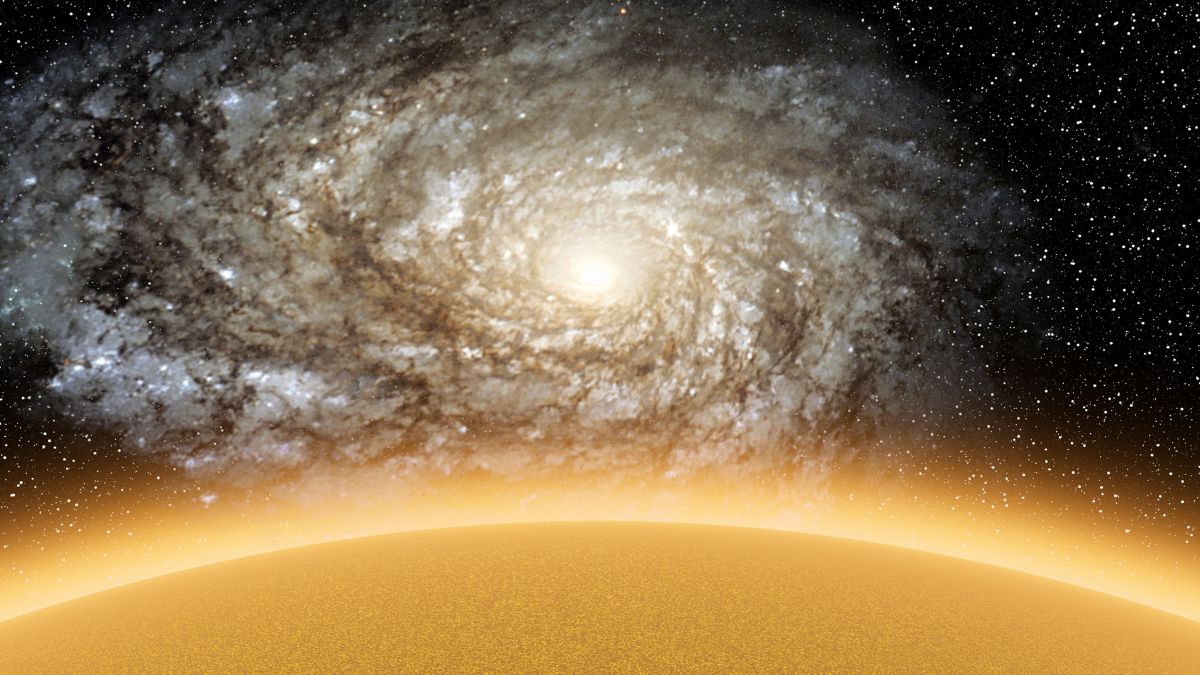
We live in a truly massive and beautiful collection of stars, dust, and gas called the Milky Way Galaxy. It is our home in the universe. For a very long time, people have looked up at the night sky and seen its faint, milky band stretching across the darkness. But our galaxy is not alone in space. We have a very large neighbor, the Andromeda Galaxy. It is the closest major galaxy to us and is even bigger than our own.
For decades, scientists have studied these two giant galaxies. They discovered something amazing: Andromeda is not moving away from us. In fact, it is racing toward our Milky Way at incredible speed. This discovery led to one of the most famous predictions in all of astronomy: a future, colossal collision between the two. This event would completely change our corner of the universe and reshape both galaxies forever.
This sounds like a distant problem, but the science behind it is fascinating. For years, this collision was talked about as a certainty, a definite date in the far future. However, new information from our most powerful telescopes is making the story even more interesting. So, what does the latest science in 2025 tell us about this cosmic event?
What Is the Andromeda Galaxy?
The Andromeda Galaxy, also known as M31, is our nearest large spiral neighbor. It is located about 2.5 million light years away from us. This distance is hard to picture. A light year is the distance light travels in one year, which is an incredibly long way. This means the light we see from Andromeda today actually left that galaxy 2.5 million years ago. Even though it is so far away, Andromeda is so big and bright that on a very dark, clear night, you can see it without a telescope. It looks like a small, faint, fuzzy cloud in the sky.
Andromeda is the true giant of our local galactic neighborhood. Our Milky Way is huge, containing an estimated 100 to 400 billion stars. But Andromeda is even bigger. Scientists believe it contains at least one trillion stars. It is wider and has more mass than our own galaxy. Just like the Milky Way, it is a spiral galaxy. This means it has a bright central core and long, sweeping arms that spiral around it. It is a beautiful city of stars, and it is heading right for us.
Why Did Scientists Believe a Collision Was Unavoidable?
For many years, the collision was not a question of “if” but “when.” The reason for this certainty comes down to a simple observation called “blueshift.” Most galaxies in the universe are moving away from us. As the universe expands, they get farther and farther. When an object moves away from you, the light it gives off gets stretched out. This stretched light shifts toward the red end of the color spectrum, so scientists call it “redshift.”
Andromeda is different. When scientists look at the light from Andromeda, they see the opposite. The light is not stretched; it is compressed. This compressed light shifts toward the blue end of the spectrum. This “blueshift” is the telltale sign that an object is moving toward you. It is the same idea as a siren on an ambulance. When the ambulance is coming toward you, the sound waves are compressed, and the pitch sounds higher. When it moves away, the waves stretch, and the pitch sounds lower. Andromeda’s light is “higher pitched,” telling us it is speeding in our direction at about 110 kilometers per second. That is over 245,000 miles per hour.
How Did We Confirm the Path of Andromeda?
Knowing Andromeda was moving toward us was only one part of the puzzle. For a long time, there was one piece of information missing. We knew its speed toward us (its radial velocity), but we did not know its speed sideways (its tangential velocity). This sideways motion is very important. If Andromeda had a large enough sideways motion, it might just be a glancing blow, or it might miss us entirely, like two cars speeding toward an intersection but one turns just in time.
Measuring this tiny sideways movement from 2.5 million light years away was incredibly difficult. It was like trying to watch a person take one step to the side from the other side of the country. To solve this, astronomers used the Hubble Space Telescope. Over several years, they took extremely high-precision pictures of stars inside Andromeda. By comparing these images, they could track the tiny, tiny shift in the stars’ positions against the background of even more distant galaxies.
In 2012, the results came in. The sideways motion was very, very small. It was not nearly fast enough for Andromeda to miss us. This measurement seemed to seal our fate. With this new data, scientists created computer models that showed a direct, head-on collision was unavoidable. This is when the 4.5 billion year timeline became the standard, accepted fact.
Is the Collision Still Guaranteed to Happen?
For over a decade, the “collision is certain” story was the one scientists told. But science is always learning and updating its information. As of 2025, the story has become more complicated and even more interesting, thanks to new data from both the Hubble Space Telescope and the Gaia space observatory. Gaia is a European space mission that is mapping the exact positions and movements of billions of stars in our own galaxy with amazing precision.
By combining this new, super accurate data about the Milky Way’s stars with the latest Hubble observations of Andromeda, scientific models have been updated. This new research, highlighted in 2025, suggests the collision might not be a 100 percent certainty after all. The latest calculations put the odds of a direct, head-on collision at closer to 50/50 within the next 10 billion years.
Why the change? One major factor is a better understanding of the mass of our Local Group of galaxies. This includes the major influence of the Large Magellanic Cloud (LMC), a smaller galaxy that orbits our Milky Way. The LMC’s gravity is pulling on the Milky Way, and this slightly changes our own galaxy’s path through space. When this new factor is added to the models, the future paths of the Milky Way and Andromeda are not as clear. It seems our own galaxy’s movement is more complex than we first thought, making the “certain” collision now more of a “maybe.”
So, What Is the New Timeline?
This new research does not mean the galaxies will ignore each other. They are still the two biggest objects in our cosmic neighborhood, and their gravity is undeniably pulling them together. The question now is whether they will have a head-on collision or a very close “near miss.”
If the collision does happen, the original timeline is still the best guess. The first close approach, where the outer edges of the galaxies start to touch and disrupt each other, would still begin in about 4 to 4.5 billion years. The full merger, where the two galaxies pass through each other and combine, would take hundreds of millions of years more to complete.
If it is a “near miss,” the two galaxies would still pass incredibly close to each other. Their immense gravity would pull on each other, warping their spiral shapes and flinging long streams of stars and gas out into space. They would pull apart, travel away, and then, like a giant cosmic dance, gravity would pull them back together again for another pass, millions of years later. In this case, they might still merge eventually, but it would take much longer, or they might end up in a strange, shared orbit around each other.
What Would Happen to Earth If They Do Collide?
This is the number one question most people ask. What happens to us? This question has two very different answers: one for life on Earth, and one for the planet Earth itself.
First, the bad news. By the time this collision is set to happen in 4.5 billion years, life on Earth will almost certainly be gone. This has nothing to do with Andromeda. The problem is our own Sun. The Sun is a star, and as it gets older, it gets hotter and brighter. In about 1 to 1.5 billion years, the Sun will be so bright and hot that it will boil away all of Earth’s oceans. Our planet will become a dry, scorched rock, completely unable to support life as we know it. So, no humans will be around to watch the collision from Earth.
Now, what about the planet itself and our Solar System? Here, the news is much better. Even if the galaxies merge, the Earth and the Solar System will almost certainly survive. This is because “space is mostly empty.” While a galaxy has a trillion stars, the distance between those stars is vast. A galaxy “collision” is not like two cars crashing. It is more like two huge, very thin clouds of sand passing through each other. The chances of two individual grains of sand (stars) actually hitting are almost zero. Our Solar System will be safe from any star-on-star collisions.
What Would the Night Sky Look Like During a Merger?
If humans could somehow survive and watch this event, it would be the most spectacular sight imaginable. The show would happen in slow motion, over millions of years. First, as Andromeda gets closer, it would grow in the night sky. For thousands of years, it would look like a large, fuzzy patch. Then, it would become a magnificent spiral, larger and larger, until it filled a huge part of our view.
As the two galaxies got their first “close pass,” about 4 billion years from now, the gravity would start to tear at both. The night sky would be filled with the bright, distorted shape of Andromeda. The immense gravitational pull would smash clouds of gas and dust together. This would trigger a massive burst of new star formation, a “starburst.” The sky would light up with billions of new, bright blue stars and glowing pink nebulas.
After the galaxies passed through each other, the sky would be a chaotic painting of two galaxies, warped and twisted. Our familiar constellations would be gone, replaced by new streams of stars. Our Solar System would be swept along by the new gravity. It is very likely our entire Solar System would be thrown into a new, completely different orbit, probably much farther away from the new galactic center.
What Is ‘Milkomeda’?
If the two galaxies do merge, they will form one new, even bigger galaxy. Scientists have given this future galaxy a few unofficial nicknames, with the most popular being “Milkomeda” or “Milkdromeda.” This new galaxy would not look like the two beautiful spirals that created it.
When two large spiral galaxies merge, the collision scrambles all the stars’ orbits. The gas clouds are used up in the giant starburst. The new, combined galaxy settles down into a new shape. It becomes a “giant elliptical galaxy.” This means it would be a massive, roundish, or football-shaped blob of stars.
This new Milkomeda galaxy would be much larger than either the Milky Way or Andromeda. It would contain over a trillion stars. However, after the initial starburst, most of the gas needed to make new stars would be gone. This means Milkomeda would become a quiet, “retired” galaxy, filled mostly with older, redder stars. It would be a bright, massive giant, but its days of forming beautiful new spiral arms would be over.
What Happens to the Giant Black Holes in a Merger?
At the center of almost every large galaxy, including our own, is a monster: a supermassive black hole. Our Milky Way has one called Sagittarius A* (pronounced “A-star”), which has the mass of four million suns. Andromeda has an even bigger one, with the mass of over 100 million suns. If the galaxies merge, what happens to these two giants?
As the two galaxies spiral together, their cores will eventually meet. The two supermassive black holes will “find” each other. They will be pulled together by gravity and begin a powerful cosmic dance, orbiting each other. For millions of years, they will spiral closer and closer. This process faces a challenge scientists call the “final parsec problem,” where it gets hard for the black holes to lose energy and get close. But scientists believe that surrounding gas and stars will create friction, slowing them down and allowing them to keep falling inward.
Eventually, the two black holes will merge. This event will be one of the most violent and powerful in the universe. The merging of two supermassive black holes will not create a flash of light. Instead, it will send out a tremendous, universe-shaking blast of gravitational waves. These are invisible ripples in the very fabric of space and time, carrying away an enormous amount of energy.
What Is the Role of the Triangulum Galaxy?
This cosmic story is not just about two galaxies. There is a third major player involved: the Triangulum Galaxy, also known as M33. This is the third-largest galaxy in our Local Group, after Andromeda and the Milky Way. It is much smaller than us, but it is still a significant spiral galaxy. Currently, Triangulum appears to be in orbit around the Andromeda Galaxy.
Its fate is tied directly to the great merger. As the Milky Way and Andromeda approach, Triangulum will be pulled by the gravity of both. Computer models show a few possibilities. In some scenarios, Triangulum might be pulled in and merge with the new Milkomeda galaxy, adding its stars to the new giant. This would be a “three-way” merger, though it would likely happen after the main event.
In other scenarios, the chaotic gravity of the merger might act like a slingshot. The Triangulum Galaxy could be flung out of its orbit and thrown far away, sent speeding out of the Local Group into the dark, empty space between galaxies. Whatever happens, its future path will be completely changed by the interaction between its two giant neighbors.
Conclusion
The future of our Milky Way and its neighbor Andromeda is a fantastic cosmic story. For a long time, we believed a spectacular collision in 4.5 billion years was our definite destiny. But as of 2025, with new data from our best telescopes, we have learned that the universe is even more complex. The collision is no longer a certainty, but a 50/50 possibility, with a close and disruptive “near miss” being just as likely.
This change does not make the science less exciting; it makes it more so. It shows that science is a process of discovery, always refining what we know. Whether our galaxy is set for a direct hit or a close cosmic dance, one thing is clear: billions of years from now, our corner of the universe will be a very different, and truly unrecognizable, place. What other big secrets about our universe are we on the verge of discovering?
FAQs – People Also Ask
Why is the new galaxy called Milkomeda?
This is an unofficial nickname that combines the names of the two merging galaxies: “Milky Way” and “Andromeda.” Another popular nickname is “Milkdromeda.” Scientists have not officially named the new galaxy, as it will not exist for billions of years.
How fast is the Andromeda galaxy moving?
Andromeda is moving toward our Milky Way galaxy at a speed of about 110 kilometers per second. This is roughly 245,000 miles per hour. Even at this incredible speed, it will take about 4.5 billion years to cover the 2.5 million light years of distance between us.
Will stars collide when the galaxies merge?
No, it is extremely unlikely that any stars will collide. A galaxy is mostly empty space. The distance between individual stars is vast. A galaxy merger is more like two clouds of smoke passing through each other; the individual particles (stars) will almost never hit.
What is the Local Group of galaxies?
The Local Group is the cluster of galaxies that includes our Milky Way. It contains over 50 galaxies, but most are small “dwarf” galaxies. The three largest members are the Andromeda Galaxy, the Milky Way, and the Triangulum Galaxy.
Can I see the Andromeda galaxy with my naked eye?
Yes, but only if you are in a very dark location, far away from city lights, and on a clear, moonless night. It is best seen in the autumn months in the Northern Hemisphere. It looks like a small, faint, fuzzy oval-shaped cloud in the constellation Andromeda.
What is a blueshift?
Blueshift is what happens to light from an object that is moving toward you. The light waves get compressed, or “squished,” which shifts their color toward the blue end of the light spectrum. It is the opposite of redshift, which happens when objects move away from you.
How long will the merger take to complete?
The merger is an extremely slow process. The first “pass” where the galaxies move through each other will take hundreds of millions of years. After that, it will take a few billion more years for the two scattered galaxies to fully settle down and combine into one new, stable galaxy.
What is Sagittarius A?*
Sagittarius A* (pronounced Sagittarius A-star) is the name of the supermassive black hole located at the very center of our own Milky Way Galaxy. It is about 26,000 light years away from Earth and has a mass equal to about four million times that of our Sun.
Will the new galaxy be a spiral?
No, scientists are very confident that the new “Milkomeda” galaxy will not be a spiral. When two large spiral galaxies merge, the intense gravity scrambles the stars’ orbits and uses up most of the gas. The new, combined galaxy will settle into a shape called a “giant elliptical galaxy,” which is a massive, roundish or football-shaped blob of stars.
Why is the collision less certain in 2025?
New data from the Gaia space telescope has given us a much better map of our own galaxy’s motion. When scientists added this new, more accurate data to their models, including the gravitational pull of other nearby galaxies like the Large Magellanic Cloud, the future path became less clear. The new models show a 50/50 chance of a direct hit or a very close near-miss.