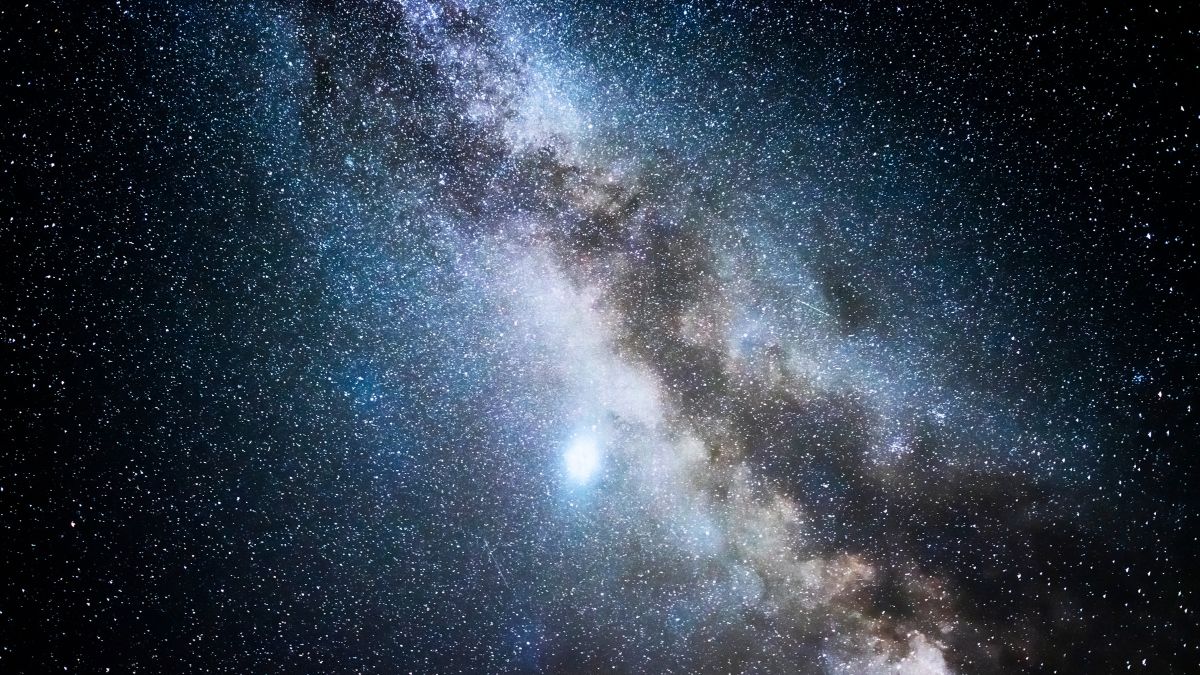
When we look up at a dark night sky, far away from city lights, we can see a beautiful, hazy band of light stretching across the heavens. This is the Milky Way, our home galaxy. It is a stunning sight, and it holds almost every star we can see with our naked eye. It is natural to look at that shimmering river of light and ask a very big question: just how many stars are in our galaxy? For decades, scientists have given a very big answer, but new data is starting to give us a clearer, and perhaps different, picture.
This question is one of the most difficult in all of astronomy. We cannot just point a telescope and count the stars one by one. The main reason is that we are inside the Milky Way, stuck in one of its outer suburbs. This makes it very hard to see the whole picture. Our view of the galaxy’s crowded center is blocked by enormous clouds of dust and gas. On top of that, many stars are simply too small, too dim, and too far away to be seen.
So, scientists have to be clever. They use different methods to estimate the number, not count it. For a long time, the most common answer you would hear was a huge range: between 100 billion and 400 billion stars. But in the last few years, and especially with new information in 2025, our understanding has changed. We now have a much better idea of our galaxy’s true size and structure. So, how do scientists figure this out, and what is the new, most accurate estimate?
What Is the Milky Way, Our Cosmic Home?
Before we can count the stars, we need to understand what we are counting. The Milky Way is a galaxy, which is a massive city of stars, gas, dust, and mysterious dark matter, all held together by gravity. Our galaxy is a specific type called a barred spiral galaxy. If you could fly far above it and look down, you would see a bright, yellowish, pill-shaped center, which is the “bar.” From the ends of this bar, several long, graceful “spiral arms” twist outwards, like a giant cosmic pinwheel. Our Sun, Earth, and the entire solar system are located in one of these spiral arms, called the Orion Arm, about 27,000 light years from the galaxy’s center.
The scale of the Milky Way is hard to grasp. The main, flat disk of the galaxy is about 100,000 light years across. A light year is the distance light travels in one year, which is about 5.88 trillion miles. So, even if you could travel at the speed of light, it would take you 100,000 years to cross our galaxy. The main disk is relatively thin, only about 1,000 light years thick. But the galaxy is much bigger than just the disk. Surrounding the disk is a giant, puffy cloud of scattered stars and ancient star clusters called the “stellar halo.” And at the very heart of the central bar, hidden from our view, is a supermassive black hole named Sagittarius A*, which has the mass of over 4 million Suns.
Why Can’t We Just Count the Stars One by One?
This is the most common question, and it highlights the three biggest challenges astronomers face. Trying to count every star in the Milky Way from Earth is like trying to count every single person in all of North America while standing in a forest in Ohio, at night, without a map. It is almost impossible, and here is why.
First, as we mentioned, our position is a problem. We are inside the galaxy’s disk, not above it. We can only see a tiny fraction of the galaxy’s stars with our naked eye, about 5,000 to 9,000 in the entire sky. All the other stars are either too far away or are hidden by what is in front of them. This is especially true when we look toward the galactic center. This region is the most crowded part of the galaxy, but it is completely hidden from our view.
Second, the galaxy is full of interstellar dust. Giant clouds of gas and dust, called nebulas, drift between the stars. These clouds act like a thick, cosmic fog. While they are beautiful when lit up by nearby stars, they are also very good at blocking visible light. This fog is so thick that it creates a dark band in the Milky Way’s glow, known as the “Zone of Avoidance.” This zone blocks our view of the galactic center and almost everything on the other side of it.
Third, and most importantly, the stars themselves are a problem. We tend to think of stars as big, bright objects like our Sun. But our Sun is actually larger and brighter than most. The vast majority of stars in our galaxy, about 75 percent of them, are tiny, cool, and dim stars called red dwarfs. These stars are so faint that we cannot see any of them with the naked eye, not even the closest one, Proxima Centauri. When we look at a distant part of our galaxy, we can easily see the few, rare blue giant stars, but we miss the thousands of red dwarfs that are hiding in the dark right next to them.
What Was the ‘Classic’ Estimate We Used for Decades?
For a long time, the most quoted number for the Milky Way’s stars was a very wide range: 100 billion to 400 billion stars. You will still see this number used by many reliable sources. This was not a random guess; it was based on the best science they had at the time, which involved measuring the galaxy’s mass. The method worked something like this: first, scientists measured how fast our galaxy spins. They did this by observing the motion of stars and gas clouds at different distances from the center.
They discovered that the galaxy was spinning so fast that the gravity from all the visible stars and gas was not nearly enough to hold it together. It should have flown apart. This led to the discovery of dark matter, an invisible substance that has gravity but does not produce or block light. Once they had the total mass (which is mostly dark matter), they tried to subtract the dark matter’s mass to get the remaining “normal” mass. Then, they had to guess the mass of an “average star.” If you divide the total mass of all stars by the mass of an “average” star, you get the total number of stars.
This method had two huge flaws. First, it was extremely difficult to separate the mass of the stars from the mass of the dark matter. Second, what is an “average” star? If you assume the average star is like our Sun, you get a lower number. But if, as we now know, the average star is a tiny red dwarf, the same amount of mass can be divided into a much larger number of stars. This uncertainty is why the estimate was such a huge range, from 100 billion (assuming more massive stars) to 400 billion (assuming many, many more tiny red dwarfs).
How Does the Gaia Space Telescope Give Us a Better Answer?
Everything we thought we knew about the Milky Way is being rewritten by a single mission: the European Space Agency’s Gaia space telescope. Launched in 2013, Gaia is a star-mapping machine. Its one and only job for ten years was to scan the sky over and over, creating an incredibly precise 3D map of the stars in our galactic neighborhood. The main science part of its mission just finished in early 2025, and scientists are now digging through the mountains of data it collected.
Gaia did not, and could not, see all the stars in the galaxy. But it did something just as good: it precisely measured the position, brightness, color, and motion of nearly 2 billion stars. This is the largest and most accurate stellar sample ever collected. It is like a massive galactic census. By taking this huge, detailed sample, scientists can now build powerful computer models that show how the galaxy is really structured.
Instead of just guessing, we can now see how many red dwarfs are in our neighborhood versus how many Sun like stars. We can see how the stars are moving, which helps us separate their gravity from the gravity of dark matter. Gaia’s data lets us build a “bottom up” model. We can now say, “This part of the galaxy has this many stars of this type,” and then add up all the parts to get a much more reliable total. Gaia is the new “gold standard” for understanding our galaxy’s population.
What Do New 2024 and 2025 Studies Tell Us?
The new data from Gaia, combined with other surveys, has led to some surprising discoveries. For years, we worked with an estimate that the stellar mass of our galaxy (just the mass of all its stars, not the dark matter) was somewhere around 50 to 60 billion times the mass of our Sun. However, new studies in 2024 and 2025 are challenging this. One new analysis, based on Gaia’s data and a new count of bright red giant stars, suggests the Milky Way is actually less dense than we thought.
Another 2025 era paper looked at all the new data and came to a stunning conclusion: the total stellar mass of the Milky Way may be as low as 26 billion solar masses. This is about half of the old estimate. This implies that our galaxy is a bit of a lightweight compared to what we believed. This new, lower mass estimate forces us to completely rethink the star count.
This new research is part of a trend. As our measurements get better, we are finding that the Milky Way may not be as big and bright as its neighbor, Andromeda. This new, lower mass estimate is a huge piece of the puzzle. It does not automatically mean the star count is cut in half, because we still have to account for all the tiny red dwarfs, but it strongly suggests the old high end estimate of 400 billion is almost certainly wrong.
So, What Is the New Star Count Estimate for 2025?
This brings us to the big answer. Given the new, much lower estimates for the Milky Way’s total stellar mass, the “classic” number of 100 to 400 billion stars is now very much in question. The 400 billion number is likely a major overestimate.
Today, based on the latest data from Gaia and the new mass studies, most astronomers are much more comfortable with the lower end of that range. The new estimate for the number of stars in the Milky Way is closer to 100 billion to 200 billion stars. Some scientists, based on the new, very low mass estimates, might even argue the number could be slightly under 100 billion, though this is still being debated.
Why is there still a range? The answer is still those pesky red dwarfs. The 26 billion solar mass estimate is the total weight of the stars. We still have to decide what the “average” star weighs. If the average star is very, very small (like a red dwarf), that 26 billion solar masses could be divided into 150 or 200 billion stars. If the average star is a little bigger, it might only be 100 billion. The new research has basically shrunk the entire playing field. The old, high guesses are no longer supported by the data.
Why Are Red Dwarfs the Key to This Whole Puzzle?
We have mentioned red dwarfs several times, and it is impossible to overstate their importance in this. These M type stars are the smallest, coolest, and dimmest type of “real” star (one that fuses hydrogen). They are also the most common, making up about three quarters of all stars in the galaxy. They are also the longest lived. Our Sun will live for about 10 billion years, but a red dwarf can live for trillions of years, meaning every red dwarf that has ever been born in our galaxy is likely still shining today.
Because they are so dim and small (some are barely larger than the planet Jupiter), they are incredibly hard to find. We can only see the ones that are very close to us. The rest are hidden in the darkness. This means the final, true star count of the Milky Way depends almost entirely on one question: “How many red dwarfs are there for every one Sun like star?”
This is why the new 2024 study on red giants was so important. It suggested that the galaxy’s central bulge is less dense than we thought. Since this bulge is packed with old, red stars, finding it is less dense means the total count is lower. The final answer to our galaxy’s population is not hidden in the bright lights we can see; it is hidden in the overwhelming darkness, populated by trillions of tiny, faint, and nearly invisible red stars.
Conclusion
So, how many stars are in our galaxy? For the first time, we have a scientifically strong answer that is not just a wide guess. We cannot count them one by one, because we are inside the galaxy and blocked by dust. The old method of “weighing” the galaxy gave a huge, uncertain range of 100 to 400 billion stars.
But thanks to the new, incredibly precise 3D map from the Gaia telescope, which completed its survey in 2025, we have a much better model. New studies based on this data show that the total mass of our galaxy’s stars is much lower than we previously thought. This means the new, best estimate for the star count is also lower. The most accurate number, according to 2025 science, is likely in the range of 100 billion to 200 billion stars. While we may never have an exact, final number, our picture of our cosmic home is getting clearer every day.
This new, more modest number for our own galaxy is still staggering. One hundred billion is a number so large our minds can hardly hold it. If 100 billion stars is the low estimate, how many planets, moons, and new possibilities are orbiting them?
FAQs – People Also Ask
What is the official number of stars in the Milky Way?
There is no “official” number because we cannot count them all. The number is a scientific estimate. For decades, the estimate was 100 to 400 billion stars, but new 2025 era data suggests the true number is on the lower end of that range, likely 100 to 200 billion.
How many stars can we see with the naked eye?
On a perfectly clear, dark night, we can see about 5,000 stars across the entire sky (or about 2,500 at any one time). Every single one of these individual stars is part of our own Milky Way galaxy.
How many galaxies are in the universe?
We used to estimate there were 100 to 200 billion galaxies. However, data from the James Webb Space Telescope has shown us there are many more tiny, distant galaxies than we knew, so the new estimate is as high as 2 trillion galaxies.
Is our Sun a rare type of star?
Our Sun is a G type star, often called a yellow dwarf. It is not the most common type; tiny, dim red dwarfs make up about 75 percent of all stars. However, G type stars are not extremely rare, and they are considered stable and good candidates for hosting life bearing planets.
What is the Gaia mission?
Gaia is a space telescope run by the European Space Agency (ESA). It spent ten years (from 2013 to 2025) scanning the sky to create an ultra precise 3D map of the positions, motions, and properties of nearly 2 billion stars in our galaxy.
What is the closest star to our Sun?
The closest star system to us is Alpha Centauri, which is about 4.24 light years away. It is a system with three stars. The closest of those three is Proxima Centauri, a small, dim red dwarf that is known to have planets orbiting it.
Will the Milky Way and Andromeda galaxies collide?
Yes. The Milky Way and the Andromeda galaxy are moving toward each other and are predicted to collide in about 4.5 billion years. The two spiral galaxies will merge to form a new, giant elliptical galaxy, which some astronomers have nicknamed “Milkomeda.”
How much of the Milky Way have we explored?
In terms of physical travel, humans have explored almost none of it; our most distant probes have just barely left our solar system. In terms of observing, telescopes like Gaia have mapped a very large sample of the galaxy, giving us a good idea of its overall structure.
How did scientists discover dark matter?
Scientists were measuring the spin of our galaxy and other galaxies. They found that the stars on the outer edges were moving just as fast as stars in the middle. The visible matter (stars and gas) did not have enough gravity to cause this; the galaxies should have flown apart. They concluded there must be an invisible “dark matter” providing the extra gravity.
Why is the new stellar mass estimate lower?
New, more precise data from the Gaia telescope and other surveys have allowed astronomers to build better models of our galaxy. These models can more accurately separate the mass of stars from the mass of dark matter, and they show that the galaxy’s disk and bulge are less dense with stars than was previously assumed.