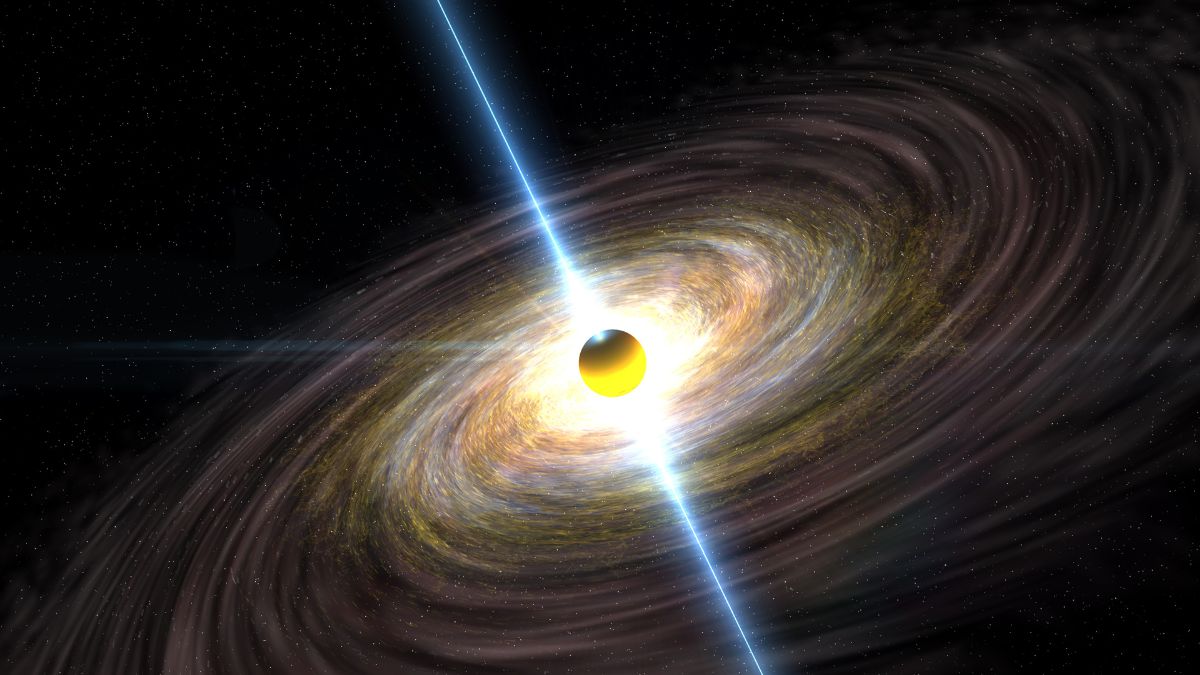
Black holes are some of the most famous and mysterious things in all of space. We hear about them in movies and books. They are often shown as scary space drains that suck everything up. But what are they really? They are not empty holes. They are places with so much gravity, or pull, that absolutely nothing can escape. Not even a beam of light.
This amazing power makes them very interesting. They are a real part of our universe. Scientists study them all the time. But this also makes us ask a big question. What would happen if a person or a spaceship got too close and started to fall in? It is a journey that is hard to picture.
We are going to explore this step by step. We will look at what science tells us about this one-way trip. We will separate the facts from the stories. It is a journey to the strangest place in the universe. So, what is the very first thing you would feel if you got too close?
What is a black hole in simple terms?
A black hole is a spot in space where matter has been squeezed into a tiny, tiny area. Think about our Sun. Now, think about crushing the whole Sun down to the size of a small city. This would make its gravity incredibly strong. A real black hole is formed from something even bigger than our Sun.
This gravity is so powerful that it creates a border around it. Anything that crosses this border is trapped forever. Even light, the fastest thing in the universe, cannot escape. This is why we call them “black.” They do not make their own light, and they do not reflect any light. They are completely invisible.
So how do we even know they are there? We find them by watching the things around them. We can see gas and stars moving very fast, orbiting a dark spot. Sometimes, as gas gets pulled in, it heats up and glows very brightly. We can see this glowing gas swirl around the edge, like water going down a drain.
How are black holes formed?
Most black holes are born from giant stars. These are stars that are many times bigger than our Sun. All stars use fuel to shine. When a very big star uses up all its fuel, it cannot support its own weight anymore. Its life ends in a giant explosion.
This explosion is called a supernova. It is one of the brightest events in the universe. The supernova blasts the star’s outer layers into space. But the center of the star, its core, does the opposite. It collapses in on itself. It keeps falling and crushing inward.
This core gets squeezed into a point with zero size and huge weight. This point becomes a black hole. Its gravity is now so strong that it has left our normal space. There are also giant black holes, called supermassive black holes. Scientists think these grew over billions of years, swallowing gas and stars at the center of galaxies.
What is the event horizon of a black hole?
You will hear the words “event horizon” a lot when people talk about black holes. This is the most important part of a black hole. It is not a wall or a surface you can touch. It is an invisible boundary in space. You can think of it as the “point of no return.”
Before you reach the event horizon, you could still escape. If you had a very powerful spaceship with strong rockets, you could turn around and fly away. You could even orbit the black hole safely from a distance, just like our planet orbits the Sun.
But the very second you cross the event horizon, you are trapped. To escape, you would need to travel faster than the speed of light. Since science tells us that nothing can travel faster than light, escape is impossible. Once you cross this line, your journey only goes one way: inward.
What happens as you get closer to a black hole?
Let’s start our journey. As your spaceship gets closer, you are still safe. But you would notice some strange things. The black hole’s gravity would be pulling on your ship. You would also see the stars around the black hole in a weird way.
The black hole’s huge gravity bends light. This is called “gravitational lensing.” The stars behind the black hole might look warped or smeared. You might even see multiple pictures of the same star, as its light bends around the black hole to reach your eyes.
The biggest danger as you get close is the “tidal force.” This is not like a wave in the ocean. It is a stretching force caused by gravity. The part of your spaceship that is closer to the black hole gets pulled much, much harder than the part that is farther away. This difference in pull is what causes big problems.
What does spaghettification mean?
“Spaghettification” is a real (and funny-sounding) word scientists use. It describes what happens because of those strong tidal forces. This is the part of the journey where things go very badly for any physical object.
Let’s say you are falling feet-first toward the black hole. The gravity pulling on your feet would be thousands of times stronger than the gravity pulling on your head. This huge difference in force would start to stretch your body.
You would be pulled apart, longer and longer. At the same time, the forces around you would squeeze you from the sides. This process would stretch any object, person, or planet into a long, thin stream of atoms. You would look like a piece of spaghetti. For most black holes, this would happen before you even reached the event horizon.
What would you see if you were falling into a black hole?
Let’s pretend you could survive spaghettification. Maybe you are falling into a supermassive black hole. These are so big that the stretching force at the edge is gentler. You could cross the event horizon in one piece. What would you see?
Looking forward, you would only see blackness. This is the center of the black hole, called the singularity, where everything ends up. You cannot see it, but you know you are falling toward it.
Looking back is where things get really strange. You would see the entire universe outside the black hole in a small patch of sky. Because of the weird way gravity bends time, time outside would speed up. You could see the entire future of the universe pass by in just a few moments. You would see stars being born, dying, and galaxies changing.
What would someone watching you fall into a black hole see?
Now, let’s change our view. Imagine your friend stays far away in a safe spaceship. They are watching you with a powerful telescope as you fall toward the event horizon. They would see something completely different.
As you got closer to the edge, your friend would see you start to slow down. It would look like you were moving in slow motion. The light coming from you would also get stretched by the gravity. This would make you look redder and redder. This is called “gravitational redshift.”
As you reached the event horizon, your friend would see you freeze. You would look like a frozen picture, stuck at the edge. You would get redder and fainter, until you just faded away into nothing. Your friend would never see you cross the line. But from your point of view, you crossed it and kept on falling.
What is inside a black hole?
This is the biggest mystery in all of science. We simply do not know. Our best rules for how the universe works, called physics, stop making sense at the center of a black hole.
Our science predicts that at the very center is a “singularity.” This is a single point that is infinitely small and infinitely dense (heavy). All the matter that has ever fallen into the black hole (the original star, gas, dust, and you) gets crushed into this one point.
But what is a singularity? Is it a hole to another universe? Is it a “white hole” that shoots things out somewhere else? Is it just the final end point for all matter? Right now, we donot have the answers. Scientists are working hard to find a new type of science, called quantum gravity, to try and understand it.
Can you survive falling into a black hole?
Sadly, the answer is a clear no. A human being could not survive this journey. There are two different ways the journey would end, depending on the black hole’s size.
If you fall into a “stellar-mass” black hole (one that is a few times heavier than our Sun), the tidal forces are extreme. You would be “spaghettified” and torn into a stream of atoms long before you even got to the event horizon. The journey would be over very quickly.
If you fall into a “supermassive” black hole (one that is millions of times heavier than our Sun), the story is different. These black holes are so huge that the event horizon is very far from the center. The stretching force at the edge is much gentler. You could cross the event horizon completely unharmed. But once inside, your fate is sealed. You would only have a short time before you reached the center and were crushed by the singularity.
Are there different types of black holes?
Yes, scientists put black holes into groups based on their size. There are three main types that we talk about.
- Stellar-Mass Black Holes: These are the most common. They are formed when a single, giant star dies. They are usually between 5 and 20 times the mass (the weight) of our Sun. Our galaxy, the Milky Way, is full of them.
- Supermassive Black Holes: These are the giants of the universe. They are millions or even billions of times the mass of our Sun. Scientists believe there is one at the center of almost every large galaxy, including our own. Ours is called Sagittarius A* (said “Sagittarius A-star”).
- Intermediate-Mass Black Holes: These are the middle-sized ones. They are bigger than stellar black holes but smaller than the supermassive ones. For a long time, we were not sure if they existed. But in recent years, scientists have found very good clues that they are real.
Conclusion
Black holes are not monsters. They are a normal, even important, part of how the universe works. They are the final stage of life for giant stars. They follow the laws of gravity, just like everything else. But they show us what happens when gravity becomes the most powerful force of all.
Falling into one is a true one-way trip. It is a journey that would stretch you apart, make time behave strangely, and end at a central point that we still do not understand. They are nature’s greatest puzzle.
We have learned so much about these dark objects, even without ever visiting one. But the biggest question remains. The singularity at the center is a place where all our rules break. It is a reminder that we still have so much to learn. What do you think is the biggest secret hidden inside a black hole?
FAQs – People Also Ask
What is the closest black hole to Earth?
The closest known black hole is called Gaia BH1. It is about 1,560 light-years away from us. It is a “dormant” black hole, meaning it is not actively swallowing gas, and it is not a danger to our solar system.
Could a black hole swallow the Earth?
This is very, very unlikely. There are no black holes close enough to us to be a danger. Even if our Sun magically turned into a black hole (which it cannot, it’s too small), Earth would be fine. We would just orbit the new, dark black hole in the same way we orbit the Sun now.
Has anyone ever fallen into a black hole?
No, absolutely not. The closest black holes are many light-years away. A light-year is the distance light travels in one year, which is a very, very long way. No human or spacecraft has ever traveled anywhere near one.
Do black holes last forever?
We used to think so, but a famous scientist named Stephen Hawking had a new idea. He suggested that black holes can slowly “evaporate” over a very, very long time. This process is called Hawking radiation. For big black holes, this would take longer than the current age of the universe.
What is a white hole?
A white hole is a “what if” idea from the mathematics of gravity. It would be the exact opposite of a black hole. Nothing could ever fall into a white hole, and matter would only shoot out of it. We have no proof that white holes exist in our universe.
How do scientists take pictures of black holes?
They cannot take a picture of the black hole itself, because it is black. Instead, they take a picture of its “shadow.” This is the dark area in the middle of the super-hot, glowing gas that is swirling right around the event horizon. A project called the Event Horizon Telescope connected many telescopes across the world to act like one giant telescope to take these amazing pictures.
What would happen if two black holes crashed?
When two black holes get too close, they will orbit each other and spiral inward. They eventually crash and merge together to become one, bigger black hole. This crash is an incredibly powerful event. It sends out ripples in the fabric of space and time called gravitational waves, which we can detect here on Earth.
Is the black hole at the center of our galaxy dangerous?
No, it is not dangerous to us. This supermassive black hole, Sagittarius A*, is about 26,000 light-years away. It is much too far to have any pulling effect on Earth or our solar system. We are in a safe and stable orbit far away from it.
What is the biggest black hole ever found?
One of the biggest black holes we know of is called TON 618. It is an extremely large, “ultramassive” black hole. Scientists estimate it is over 60 billion times the mass of our Sun. It is very, very far away in another galaxy.
Can light orbit a black hole?
Yes. There is a special distance from a black hole called the “photon sphere.” This is just outside the event horizon. At this exact distance, gravity is so strong that it can bend light into a circular path. A beam of light could orbit the black hole. However, this orbit is not stable, and the light would eventually fall in or escape.