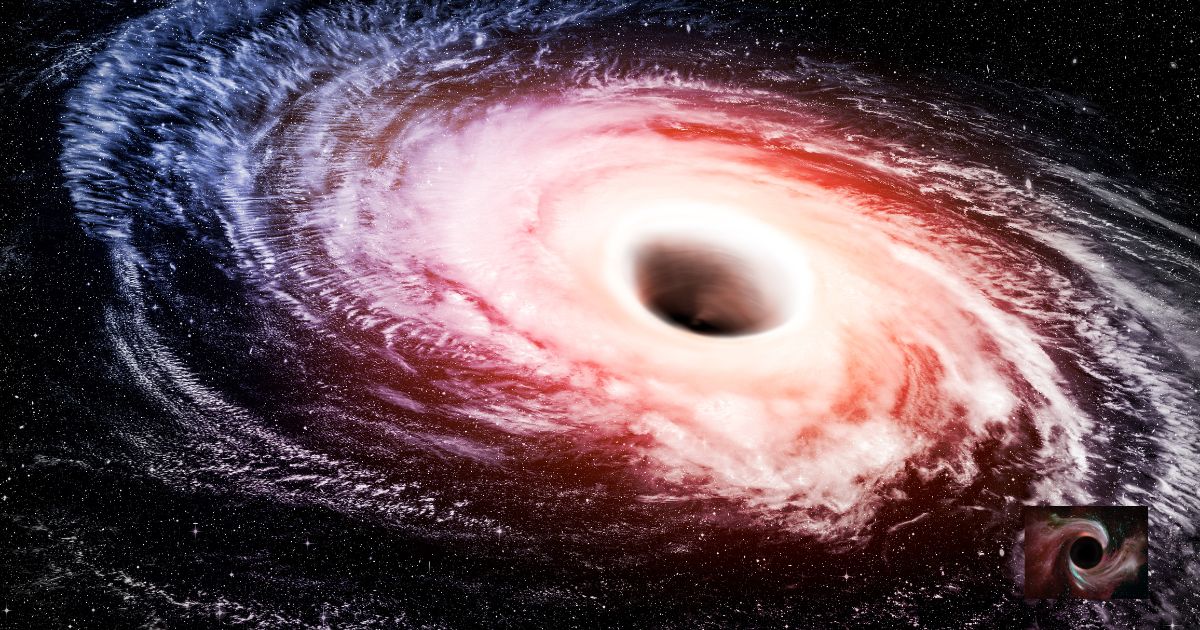
Spaghettification is caused by something called a gravitational gradient, and it is the key to understanding this whole topic. A gradient is simply a difference in a measurement from one point to another. In this case, it is the difference in the strength of gravity pulling on two separate parts of the same object, like the top and the bottom of your body. When you stand on Earth, gravity pulls on your feet a tiny bit more than it pulls on your head, but the difference is so small that you would never notice it. Your body’s own strength easily holds you together against this minor difference.
Now, imagine falling toward a black hole, which is an object where a huge amount of mass is squished into an incredibly small space. Gravity falls off very quickly the further you move away from it. If you were falling feet first, your feet would be much closer to the black hole’s center than your head. Because the gravity from a black hole is so concentrated, the difference in the pull between your feet and your head becomes enormous. Your feet are pulled much harder and faster than your head is, which immediately starts to stretch you out like a piece of taffy. This stretching is what creates the “spaghetti” shape, tearing the object apart into a long, thin stream of matter.
How Do Tidal Forces Relate to the Oceans and Black Holes?
The concept of tidal forces is not something only found near black holes; it happens everywhere in space, and we see its most common effect every day here on Earth: ocean tides. The Moon’s gravity pulls on Earth, but the pull is strongest on the side of Earth facing the Moon and weakest on the side farthest away. This difference in gravitational force creates a slight bulge in the oceans on both the near side and the far side of the planet.
This everyday effect is the mild-mannered cousin of spaghettification. The Moon is far away, so its gravitational gradient across the Earth is very gentle. Near a black hole, however, the object causing the gravity—the singularity at the center of the black hole—is incredibly dense and tiny. This small size means the distance between your head and your feet is a huge fraction of the total distance to the source of gravity, and the gravitational pull is therefore drastically different over just a couple of meters. Tidal forces are always proportional to the difference in gravity, and near a black hole, that difference is amplified by a factor that would completely destroy a star, let alone a human body.
Does the Size of the Black Hole Change the Spaghettification Risk?
Yes, and this is the most surprising fact about the whole process. When people think of black holes, they usually assume the biggest ones are the most dangerous and have the strongest stretching power. But when it comes to spaghettification, the opposite is actually true: smaller black holes are far more dangerous to a human than the biggest ones. The key lies in the steepness of the gravitational gradient, or how fast the gravity changes.
Black holes come in many sizes. A small one, called a stellar-mass black hole, might only have a mass a few times that of our Sun. A supermassive black hole, like the one at the center of our Milky Way galaxy, can have a mass of millions or even billions of Suns. The boundary around a black hole that marks the point of no return is called the event horizon. For a small, stellar-mass black hole, the event horizon is very close to the center, perhaps only a few kilometers wide. This means that the point where spaghettification happens is outside the event horizon. Tidal forces here are so extreme that you would be ripped apart long before you even reached the point of no return, which is a very quick and violent end.
Which Black Hole Type Offers the ‘Safest’ Passage Across the Horizon?
The black holes that offer the ‘safest’ passage—meaning the lowest chance of spaghettification before crossing the point of no return—are the supermassive ones. The reason is that these black holes are so huge that their event horizons are spread out across millions or even billions of kilometers. Think of the gravitational field like a huge, gentle hill instead of a tiny, steep cliff.
Because the event horizon is so far away from the incredibly dense center, the gravitational pull doesn’t change very quickly across the small distance of a human body. The gravitational gradient is much smoother. An astronaut falling toward a supermassive black hole might not even notice a change in the tidal forces as they cross the event horizon. They would feel a strong pull overall, like intense acceleration, but the difference in pull between their head and their feet would be very small, much less than what is needed to break the body apart. In this case, the unlucky person would cross the point of no return intact, only to face an inevitable end a bit later.
What is the Difference Between Tidal Force and Overall Gravitational Pull?
It is important to understand that the overall gravitational pull and the tidal force are two different things. The overall pull is the total acceleration pulling the object toward the black hole’s center. This pull is always incredibly strong near a black hole of any size. If you tried to hover just above the event horizon of any black hole, the force you would need to exert to stay still would be astronomical, in part because of the effects of time and space warping. You would be accelerated to near light-speed very quickly if you did not use a massive amount of thrust.
However, the tidal force is only about the difference in that pull across the object’s length. This difference is what matters for spaghettification. Near a stellar-mass black hole, both the overall pull and the tidal force are huge and deadly. Near a supermassive black hole, the overall pull is still immense, but the tidal force across a short distance is very small. The human body is only about two meters long, and this tiny distance means the difference in the huge black hole’s pull is negligible at the horizon. Therefore, you are still being pulled with incredible force, but you are not being stretched into a noodle.
If Spaghettification Doesn’t Kill You, What Does?
For an astronaut falling into a supermassive black hole, spaghettification does not happen right away. They cross the event horizon intact, which is the point where light itself cannot escape. Once inside this horizon, a person is committed to falling towards the singularity at the center—it is not possible to stay still or turn around, no matter how powerful their spaceship might be. The physics of spacetime inside the event horizon are warped in such a way that moving toward the center is as unavoidable as moving toward the future.
This journey is a one-way trip, and even if the person survived the initial crossing, they would still face an eventual spaghettification later on. As they fall deeper toward the center, the surrounding space begins to curve and compress them, and the gentle gravitational gradient starts to get steeper. The tidal forces increase exponentially as the object gets closer and closer to the singularity. Eventually, the person would reach a point where even the supermassive black hole’s tidal forces overcome the body’s internal strength, and they would be ripped apart, atom by atom. The main difference is simply that the death would be delayed and would happen after they had crossed the point of no return.
What Would the Experience of Spaghettification Actually Feel Like?
If a person were to experience spaghettification near a smaller, stellar-mass black hole, the feeling would be sudden and utterly catastrophic. The whole process would happen in a fraction of a second. Imagine your body is suddenly being pulled apart with the force of many thousands of Earth gravities. The force would instantly overwhelm the molecular bonds holding your body together—it is not a slow, painful stretching, but a violent, instantaneous tear.
First, the stretching would pull your body apart vertically, and at the same time, the gravitational field would compress your body horizontally. This is because all matter is being pulled toward the exact center of the black hole, which means that the sides of your body would be pulled inward toward each other. The result is a simultaneous stretching and squishing, turning the entire person into an extremely long, thin strand of atoms. Since the force is greater than the strength of human tissue, it would not feel like anything we can truly imagine. It is not an injury; it is a total disintegration of the object’s form.
Conclusion
Spaghettification is the intense and violent process where an object is stretched into a long, thin strand by a powerful gravitational gradient, particularly near a black hole. While it sounds like a purely fictional concept, it is a real prediction of Einstein’s General Theory of Relativity, caused by extreme tidal forces. The chance of surviving this process depends entirely on the size of the black hole. A human would be instantly shredded by a common, smaller stellar-mass black hole before reaching the event horizon. However, a supermassive black hole provides a different scenario: its vast size means the tidal forces at the point of no return are gentle enough to allow an object to cross the horizon intact. The survival, however, is short-lived, as the forces inside will eventually win. It is a powerful reminder that while space is full of wonders, it also holds forces that are beyond our everyday experience and utterly unforgiving.
Considering the extreme differences in black holes, and the way gravity is just a warped form of space itself, do you think future technology could ever create a shield or a field that could resist the forces that cause spaghettification?
FAQs – People Also Ask
Why is the stretching effect called spaghettification?
The process is called spaghettification because the resulting shape of the object being torn apart resembles a long, thin, stretched strand of spaghetti. The difference in gravitational pull, the tidal force, pulls the object vertically toward the black hole while simultaneously compressing it horizontally. This twin action turns any three-dimensional object, whether it is a star or a person, into a thin, long line of matter, which gives it its famous and descriptive name.
Can spaghettification happen anywhere else besides a black hole?
Yes, spaghettification can happen in theory near any object with an extremely strong and concentrated gravitational field, such as a neutron star. Tidal forces exist everywhere—they create Earth’s tides—but they only cause spaghettification when the gravitational source is incredibly dense and you are very close to it. A star that gets too near a neutron star, for example, would also be torn apart, though the black hole is the most famous and extreme example of this destructive process.
Is spaghettification an instantaneous event or a slow process?
For a human falling into a typical stellar-mass black hole, the event would be practically instantaneous. The gravitational forces at the point where spaghettification begins are so overwhelmingly powerful that the human body would be torn apart faster than a human nervous system could even register the pain. It would happen in the blink of an eye, a sudden and total disintegration of all chemical and atomic bonds, not a slow or drawn-out stretching.
What is the point of no return around a black hole?
The point of no return is called the event horizon. This is a boundary in space around the black hole where the escape velocity, the speed needed to escape the object’s gravity, is greater than the speed of light. Since nothing in the universe can travel faster than the speed of light, anything that crosses the event horizon is trapped forever and must eventually fall toward the singularity at the center.
Do all black holes have the same level of danger from tidal forces?
No, the danger from tidal forces is completely different depending on the black hole’s mass. Smaller black holes, like stellar-mass black holes, have a very small event horizon, which makes the gravitational change over a short distance extremely steep and deadly. Large, supermassive black holes have event horizons spread over millions of miles, making the gravitational change much more gradual and the tidal forces much weaker at the horizon itself.
What is the singularity inside a black hole?
The singularity is the point at the very center of a black hole where all of the black hole’s mass is thought to be concentrated. It is an infinitely dense point where the laws of physics as we know them break down. All the matter that has ever fallen into the black hole ends up at this single point, and it is the ultimate destination for anything that crosses the event horizon.
If a star gets spaghettified, what does the resulting material look like?
When a star gets spaghettified by a black hole, the material is pulled into a long, hot stream or filament. Astronomers call this a Tidal Disruption Event or TDE. The stretching and tearing of the star releases a massive amount of energy, causing the stellar material to heat up and glow brightly as it wraps around the black hole. This flash of light is often what allows scientists to detect and observe these violent cosmic events millions of light-years away.
Does spaghettification affect atoms or only large objects?
Spaghettification would affect every level of an object, including its atoms. The tidal forces are so extreme near a small black hole that the force difference between one side of an atom and the other would eventually break the internal bonds holding the nucleus and electrons together. It is not just the physical body that is ripped apart, but the entire structure of matter itself, reducing the object to its most fundamental particles in a long stream.
Is it possible to see spaghettification happening?
We cannot see a human being spaghettified, but we can see the effects of stars being spaghettified by supermassive black holes. A Tidal Disruption Event (TDE) is the bright flare of light created when a star gets too close and is torn apart. The resulting hot, glowing material is visible for a short time across vast cosmic distances. These TDEs are some of the only direct observations astronomers have of the spaghettification process in action.
Could a person in a very strong spaceship survive spaghettification?
No known material or technology could create a ship strong enough to resist the tidal forces of a stellar-mass black hole. The forces are so immense that they overcome the fundamental bonds of matter itself. The ship would be spaghettified just like the person inside. For a supermassive black hole, a ship could cross the event horizon intact, but the immense gravity and the inevitable eventual spaghettification deep inside the black hole would still destroy the ship and its occupant.