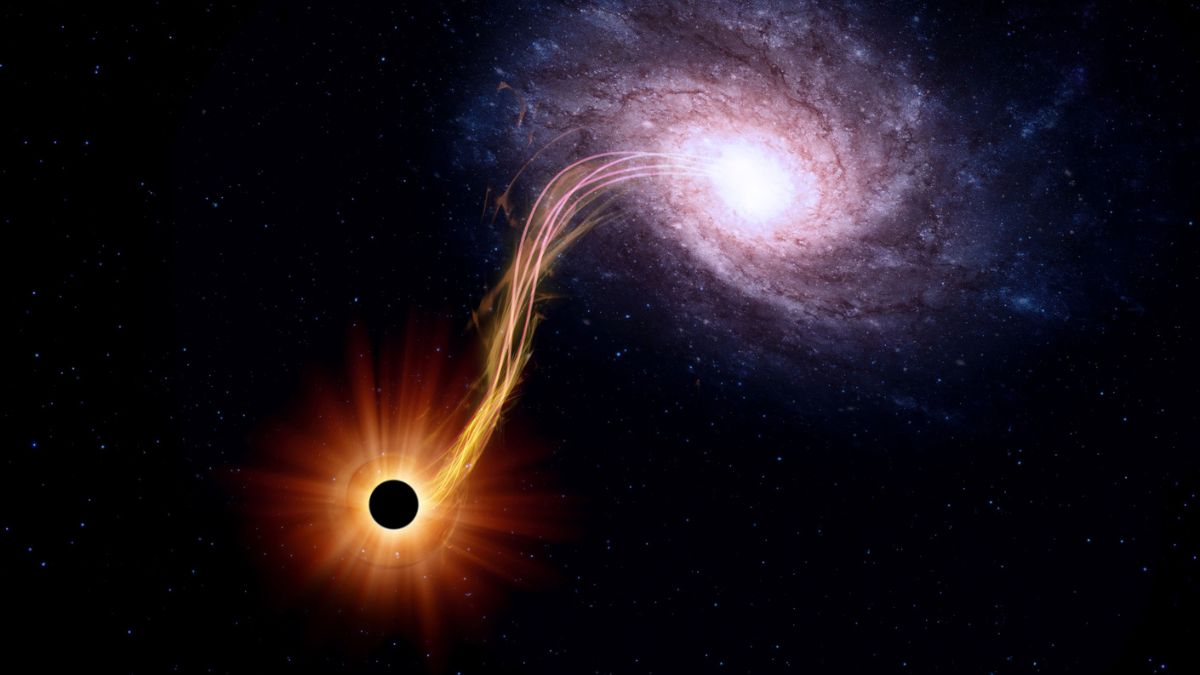
We often think of black holes as the unmovable centers of galaxies. Most large galaxies, including our own Milky Way, have a giant “supermassive” black hole sitting right at their core. This object acts like a gravitational anchor, holding the galaxy’s center together. These black holes are millions or even billions of times heavier than our Sun. They are the giants of the universe, and we expect them to stay put.
But the universe is a very busy and sometimes violent place. It is not quiet or still. Sometimes, truly massive events can happen that are powerful enough to unseat one of these giants. When this occurs, a supermassive black hole can be kicked completely out of its home galaxy. It stops being an anchor and starts being a wanderer.
These exiled giants are called “rogue” black holes. They are no longer at the center of a galaxy, but instead are flying through the empty darkness of intergalactic space at incredible speeds. They are cosmic ghosts, traveling alone. How is it possible for the heaviest object in a galaxy to be thrown out like a pebble?
What Exactly Is a Rogue Black Hole?
A rogue black hole is a black hole that is not gravitationally bound to a galaxy. It is moving freely through space. Think of it this way: most black holes are like the “pit” in the center of a peach, firmly attached. A rogue black hole is like a pit that has been shot out of a cannon. It is traveling so fast that the gravity of its home galaxy can no longer pull it back. It has escaped. These objects are sometimes called wandering, homeless, or runaway black holes. They are moving at tremendous speeds, often hundreds or even thousands of kilometers every single second.
This can happen to black holes of any size. A smaller “stellar mass” black hole, which is the remains of a single dead star, can be kicked out of its star cluster. But the most dramatic and powerful events involve the supermassive black holes. These are the ones that should be the heart of their galaxy. When they get ejected, it is a truly cosmic event. Finding one of these is incredibly difficult, because they are completely dark and no longer have a bright galaxy of stars surrounding them. They are invisible monsters moving through the void.
What Is the Gravitational Wave ‘Rocket Kick’?
This is one of the most powerful and fascinating ways a black hole can be ejected. This method is a direct result of Albert Einstein’s theory of general relativity. It does not involve anything “pushing” the black hole in the traditional sense. Instead, the push comes from ripples in the fabric of space itself. This “kick” happens when two supermassive black holes merge into one. This is a common event in the universe, as galaxies themselves often collide and merge. When two galaxies merge, their central black holes will slowly spiral in toward each other over millions of years.
As they get closer, they spin around each other faster and faster. This violent dance creates powerful ripples in spacetime called gravitational waves. These waves fly out in all directions, carrying away enormous amounts of energy. For the final moments before they combine, the two black holes are releasing more energy in gravitational waves than all the stars in the universe combined. If this process is perfectly symmetrical, with the waves going out evenly in all directions, the new, combined black hole stays put.
But the universe is rarely perfect. If the two merging black holes have different sizes, or are spinning in different directions, the gravitational waves will be shot out more strongly in one direction than in others. It becomes an uneven, lopsided explosion of spacetime waves. Because of the law of conservation of momentum, if you shoot enormous energy out in one direction, you must recoil in the opposite direction. The new, single black hole gets a “kick.” It is just like a rocket, which pushes exhaust down to fly up. The merging black holes push gravitational waves out in one direction, and the new black hole recoils in the other. This kick can be so powerful it sends the black hole flying at millions of miles per hour, easily fast enough to escape its galaxy forever.
How Does the ‘Three Body Problem’ Kick Out a Black Hole?
This second method is a bit different. It is less about a single powerful kick and more about a chaotic gravitational dance. This mechanism is often called a “gravitational slingshot.” It happens when three massive objects get too close to each other. In physics, predicting the dance of two objects (like the Earth and the Sun) is very stable and predictable. We know their orbits perfectly. But as soonas you add a third object, the system becomes chaotic. This is known as the “three body problem.” Their motions become wild and impossible to predict long term.
This chaos is the key. When three massive objects, like three supermassive black holes, interact in a small space, the situation cannot last. The system will always try to find stability. The most common way it does this is by forming a stable, tight pair (a binary) and violently ejecting the third object. It is a cosmic game of musical chairs. Two black holes will “partner up,” and in the process, all the extra speed and energy get transferred to the third one. This third black hole is flung away at an incredible speed.
Imagine three professional ice skaters spinning in a circle while holding hands. The system is unstable and they are likely to crash. A stable solution is for two of the skaters to clasp hands tightly and spin together, while at the same time, they use that momentum to fling the third skater away from them across the ice. In space, this slingshot is strong enough to send the third black hole careening out of the galaxy entirely. This scenario often happens after a galaxy merger, when a third galaxy collides with a system that already has two black holes at its center.
Why Are Galaxy Mergers the Main Cause?
Galaxy mergers are the root cause of almost all rogue supermassive black holes. These are the events that set the stage for the two main ejection methods. A single, stable galaxy like our Milky Way will not suddenly kick out its central black hole. Sagittarius A*, our galaxy’s anchor, is safe and sound. The danger comes from collisions. The universe is full of galaxies, and over billions of years, they often crash into each other. Our own Milky Way is on a collision course with the Andromeda galaxy, set to merge in about 4.5 billion years.
When two galaxies collide, their stars mostly pass right through each other like ghosts, but their central supermassive black holes are drawn together by gravity. This event directly causes the first ejection mechanism. The two black holes spiral in and merge, leading to the “gravitational wave kick.” If the merger is lopsided, the new black hole is ejected.
Galaxy mergers also cause the second mechanism. Imagine the two galaxies merge, and their black holes also merge, but the “kick” is not strong enough to eject the new black hole. It stays in the center of the new, combined galaxy. But what happens a billion years later when a third galaxy collides with this new galaxy? Now, the black hole from the third galaxy falls into the center. This creates the “three body problem” we just discussed. You now have the big, combined black hole, and the new, smaller black hole, and maybe even a third one from another small galaxy. This chaotic dance begins, and one of them is almost certain to be slingshotted out. So, galaxy mergers are the engines of chaos that bring these giants together and make their ejection possible.
How Do Scientists Actually Find These Invisible Wanderers?
This is one of the biggest challenges in modern astronomy. How do you find a single, dark object the size of our solar system when it is flying through the blackness of space, millions of light years away? Rogue black holes are not shining, and they are not surrounded by a bright galaxy of stars. We cannot see them directly. Instead, scientists have to become cosmic detectives, looking for the effects the black hole has on the things around it.
The most promising method today is called “gravitational microlensing.” This is another prediction from Einstein’s theories. A black hole’s gravity is so strong that it bends light. If a rogue black hole, by pure chance, passes directly in front of a distant star, the black hole’s gravity will act like a giant magnifying glass. It will bend and focus the light from the background star. From our perspective on Earth, it will look like the star suddenly gets very bright, and then fades back to normal over a few weeks or months. This specific pattern of brightening and fading is a unique signature of a massive, dark object passing by. Telescopes like the Hubble Space Telescope and the upcoming Nancy Grace Roman Space Telescope are designed to stare at millions of stars at once, just waiting to catch one of these rare microlensing events.
A second way is to look for an “accretion disk” in the middle of nowhere. As the rogue black hole travels, it might pass through a cloud of interstellar gas. If it captures some of this gas, the gas will swirl around the black hole in a hot, fast disk. This material gets so hot that it shines brightly in X-rays or radio waves. If astronomers spot a very bright, very small source of X-rays with no galaxy around it, it could be a sign of a hungry rogue black hole having a snack on its lonely journey.
Are There Any Rogue Black Holes in Our Milky Way?
It is almost a certainty that our own Milky Way galaxy contains many rogue black holes. Our galaxy has a long and violent history. It has grown to its current size by “eating” or merging with hundreds of smaller dwarf galaxies over the past 10 billion years. Each of these smaller galaxies likely had its own central black hole. This long history of mergers provides all the right conditions for creating rogue black holes.
Scientists have run complex computer simulations to estimate the numbers. The results suggest there could be thousands, or perhaps even millions, of smaller stellar-mass rogue black holes wandering the Milky Way. These are the leftover cores of massive stars that died and were then ejected from their original star clusters by gravitational interactions. In 2022, scientists announced the potential discovery of the very first one, found using the gravitational microlensing technique. This was a huge breakthrough, proving that these objects are out there and that we can find them.
It is also possible, though likely rarer, that there are larger rogue black holes in our galaxy. If a dwarf galaxy with a medium sized black hole merged with the Milky Way, that black hole could have been slingshotted into a wide, looping orbit. It might still be inside our galaxy’s “halo,” the vast, sparse region that surrounds the main disk, but it is no longer at the center. These objects are part of the “dark” population of our galaxy, and finding them is a major goal for astronomers in the coming decades. They pose absolutely no threat to us; space is simply too big for a random encounter.
What Happens to a Galaxy That Loses Its Supermassive Black Hole?
This is a fascinating question that scientists are actively studying. The supermassive black hole at the center of a galaxy is not just a passive anchor. It plays an active role in the galaxy’s life. This process is called “feedback.” When the black hole “feeds” on nearby gas, it often blasts out huge jets of energy and radiation. These jets are so powerful they can blow away the gas from the entire central region of the galaxy. By blowing away the gas, the black hole stops new stars from being born. The black hole acts like a regulator, or a thermostat, for star formation in the galaxy’s core.
So, what happens if you suddenly remove that regulator? If the supermassive black hole is violently ejected, the galaxy becomes an “orphan” or “coreless” galaxy. Without the black hole’s feedback, the gas in the central region is no longer being cleared out. This gas can now cool and collapse, triggering a massive, uncontrolled burst of new star formation. The center of the galaxy might light up brightly for millions of years, creating billions of new stars in a short time.
Over the long term, the galaxy’s shape might also change. The stars in the very center, which were once orbiting the black hole, will have their orbits disrupted. They will start to spread out, and the galaxy’s dense central “bulge” might become less defined. The galaxy itself will not fly apart, as its main structure is held together by the combined gravity of all its stars and, more importantly, its massive halo of dark matter. But its heart will be gone, and its life cycle will be permanently changed. Scientists are actively searching the skies for galaxies that look like they have a missing core, as this would be strong evidence that a black hole ejection has happened there.
Conclusion
The universe is far more dynamic than it appears. The idea that a black hole, the most massive and gravitationally powerful object in a galaxy, can be thrown out of its home is a stunning example of the power of cosmic forces. These events are not science fiction; they are a natural consequence of the laws of physics.
Through chaotic three body dances or powerful rocket kicks from merging gravitational waves, these giants are exiled. They are reminders that the cosmos is constantly changing, driven by massive collisions and the fundamental forces of nature. These invisible, wandering giants are a key part of the universe’s story, and finding them is helping us understand just how wild and active the universe truly is. What other incredible, invisible objects are wandering the vast, dark oceans between the galaxies?
FAQs – People Also Ask
Is a rogue black hole dangerous to Earth?
A rogue black hole poses no realistic danger to Earth. Space is incredibly vast, and the distances between stars are enormous. The chance of a rogue black hole, even a small one, passing close enough to our solar system to cause any disruption is almost zero. We are safe from these wanderers.
How fast do rogue black holes travel?
Rogue black holes can travel at astonishing speeds. The “kick” they receive can accelerate them to hundreds or even thousands of kilometers per second. That is fast enough to travel from New York to Los Angeles in just a few seconds. This incredible speed is why they are ableto escape the powerful gravity of their home galaxy.
What is the difference between a rogue black hole and a normal black hole?
The only difference is its location and motion. A “normal” black hole is gravitationally bound to a system, such as a supermassive black hole at the center of a galaxy or a stellar-mass black hole orbiting another star. A “rogue” black hole has been ejected from such a system and is traveling alone through space, not bound to any galaxy.
Are all rogue black holes supermassive?
No, rogue black holes can come in all sizes. Smaller “stellar mass” black holes (a few times the mass of the Sun) can be ejected from crowded star clusters. However, the most powerful ejections involve the “supermassive” black holes (millions of times the mass of theSun), which are kicked out of the centers of galaxies.
Why are rogue black holes so hard to see?
Black holes are already invisible because their gravity is so strong that not even light can escape. We normally find them by seeing the bright, hot material swirling around them, or by observing the stars orbiting them. A rogue black hole is traveling alone in empty space, so it has no light and often no material around it to give away its location.
Could our own supermassive black hole, Sagittarius A*, be ejected?
It is extremely unlikely. For our black hole to be ejected, our Milky Way galaxy would have to collide with another large galaxy. That galaxy’s black hole would need to merge with Sagittarius A* in a very specific, lopsided way to create a gravitational wave kick. While we are merging with Andromeda in 4.5 billion years, it is impossible to predict if the merger will result in an ejection.
How common are rogue black holes?
Scientists believe they are very common. Computer simulations suggest there could be millions or even billions of smaller, stellar-mass rogue black holes just within our own Milky Way galaxy. Rogue supermassive black holes are much rarer, but there are likely many thousands of them wandering the vast empty space between galaxies.
What are gravitational waves?
Gravitational waves are invisible “ripples” in the fabric of space and time. They are created by the most violent and energetic events in the universe, such as two black holes colliding or two neutron stars merging. They travel outward from the source at the speed of light, stretching and squeezing spacetime as they pass.
Will the Andromeda merger create a rogue black hole?
It is possible, but not guaranteed. When the Milky Way and Andromeda galaxies merge in billions of years, their central supermassive black holes will eventually find each other and merge. Whether this merger creates a “kick” strong enough to eject the new, combined black hole depends on their masses and how they are spinning.
Has a rogue black hole ever been officially discovered?
Yes, in 2022, astronomers announced the first strong candidate for a single, isolated stellar-mass rogue black hole within our galaxy. It was discovered using the gravitational microlensing technique, where the black hole’s gravity magnified the light of a star behind it. This discovery confirms that these objects exist and that we have the technology to find them.