When we think of outer space, the first thing that often comes to mind is silence. For the most part, that is correct. Sound, as we know it, is a vibration that needs something to travel through, like air or water. The vast emptiness of space is a vacuum, which means there is no air for sound to travel. This is why the idea of a “singing” quasar sounds like something from a science fiction movie. How can an object in the deep, silent vacuum of space make any sound at all?
The truth is, these cosmic giants are not “singing” like a person does. We cannot fly a spaceship near one and hear music. Instead, scientists are using a creative and powerful method to understand them. They are detecting deep, rhythmic patterns coming from these objects. These patterns are hidden in the light and energy that quasars blast out across the universe. Scientists then take this data, these patterns, and translate them into sounds we can hear. This process, called sonification, turns complex data into audio.
This “cosmic music” is more than just a fun experiment. It is a new way to study the most extreme and mysterious objects in the universe: supermassive black holes. By listening to the “song” of a quasar, astronomers can learn things about the black hole that they could not easily see with their eyes alone. This is the fascinating new field of black hole acoustics. But what exactly is this “music,” and what is creating the rhythm?
What exactly is a quasar?
Before we can understand its “song,” we need to know what a quasar is. A quasar is not really a single “thing.” It is the name for a process, an event that happens at the very center of some distant galaxies. At the heart of almost every large galaxy, including our own Milky Way, there is a supermassive black hole. These are not a few times heavier than our sun; they are millions or even billions of times heavier. For most of a galaxy’s life, this central black hole is quiet and dark.
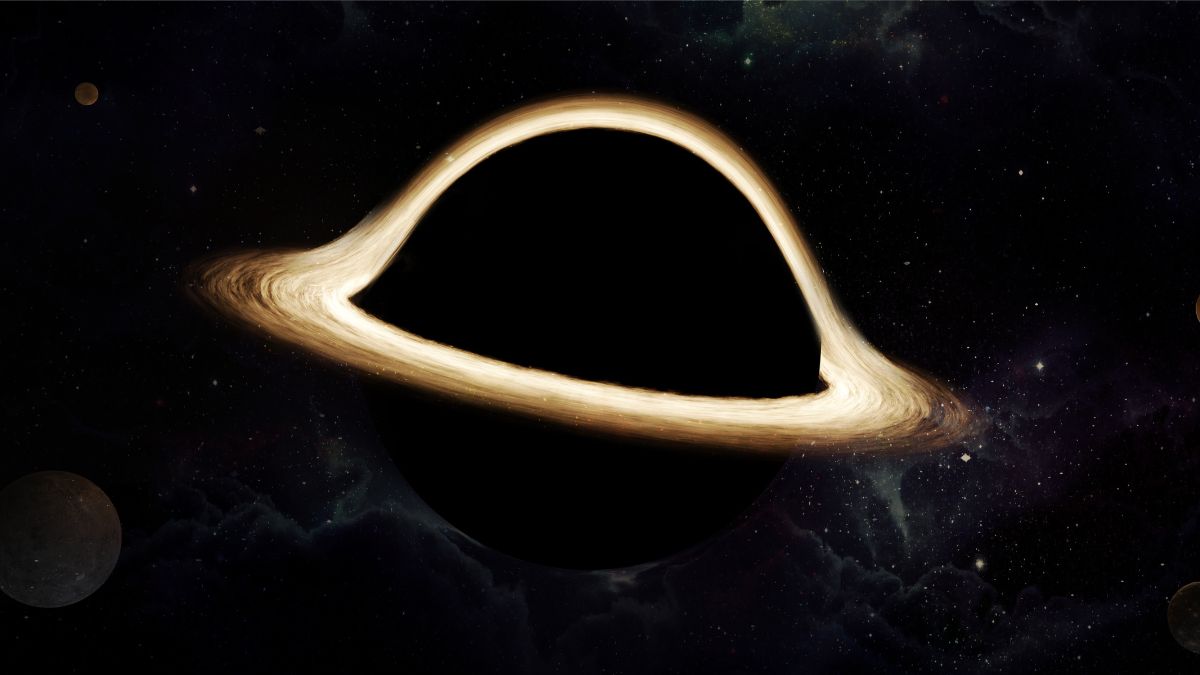
But sometimes, a huge amount of material—gas, dust, and even whole stars—gets too close. The black hole’s immense gravity grabs this material and pulls it in. This material does not fall straight in. Instead, it forms a massive, spinning, flat disk around the black hole. This structure is called an “accretion disk.” Think of it like water swirling down a drain, but on a cosmic scale, spinning at almost the speed of light.
As all this gas and dust rubs together in the disk, friction heats it up. It does not just get warm; it gets heated to millions of degrees. This superheated material, the accretion disk, begins to glow with incredible intensity. It becomes so bright that it can outshine the entire host galaxy it lives in, which contains hundreds of billions of stars. When we look from Earth, this incredibly bright, tiny point of light from the feeding black hole is what we call a quasar. It is essentially the most powerful and luminous “engine” in the entire universe.
How can a black hole make a sound if space is silent?
This is the most important question, and it has a two-part answer. You are right: space is a vacuum, and sound waves cannot travel through it. If a quasar exploded, you would not hear a “bang.” The “singing” we are talking about is not sound traveling from the quasar to our ears on Earth. It is a translation. Scientists have two main ways of “hearing” the activity of black holes, and both are often called “black hole acoustics.”
The first method involves translating light patterns. As the quasar’s accretion disk spins, the light it gives off is not perfectly steady. It flickers, brightens, and dims. Scientists observing this light, especially in X-rays, have found that this flickering is not random. It often has a beat, a rhythm, or a specific “note.” These regular patterns are called “quasi-periodic oscillations,” or QPOs. Scientists take the frequency of this flicker—say, ten times per second—and translate that frequency into a sound wave we can hear. We are essentially listening to the rhythm of the light.
The second method involves actual sound waves, just not in a vacuum. Sometimes, a supermassive black hole is not in empty space. It is at the center of a galaxy cluster, which is filled with a gigantic cloud of very thin, very hot gas (plasma). This gas acts as a medium, just like air. The black hole, especially when it shoots out powerful jets of energy, pushes on this gas. This pushing creates massive ripples, or pressure waves, in the gas. These are, by definition, real sound waves. We just cannot hear them.
What is the famous sound from the Perseus black hole?
This second method is what led to the most famous “black hole sound” ever released by NASA. Scientists were studying the Perseus galaxy cluster using the Chandra X-ray Observatory. They saw that the central supermassive black hole was sending out jets that created huge ripples in the hot gas cloud filling the cluster. These ripples were giant sound waves, propagating outwards for hundreds of thousands of light-years.
Scientists were able to calculate the “note” of this sound wave. It turned out to be a B-flat, but it was about 57 octaves below middle C. This frequency is so incredibly low, so deep, that it is impossible for any living creature to hear. One single vibration of this sound wave takes about 10 million years to complete. For comparison, the lowest sound a human can hear vibrates 20 times per second.
To make this audible, NASA scientists “rescaled” the note. They took the original data and raised its pitch by 57 and 58 octaves, making it millions of billions of times higher. What we hear in that famous, eerie audio clip is a representation of the real sound wave found in the Perseus cluster. It is the universe’s deepest note, just translated up into the range of human hearing. This is a real sound wave, but the “singing” of a quasar’s disk is slightly different.
What causes the ‘flickering light’ from a quasar’s disk?
Let’s go back to the first method: the flickering light from the quasar itself. This is where the term “acoustics” gets really interesting. These regular beats, the QPOs, are the true “song” of the quasar’s accretion disk. Scientists are still figuring out the exact cause, but the leading theories all relate to the extreme physics right near the black hole’s edge, a place called the event horizon.
The accretion disk is not a solid object like a CD. It is a fluid, a plasma, behaving under the rules of gravity and magnetism. Just like sound waves can travel through air, other types of waves can travel through the disk itself. This is where the “acoustics” part comes in. Scientists study “diskoseismology,” which is like seismology for earthquakes but applied to accretion disks. They are studying the “quakes” and vibrations of the disk.
These vibrations, or oscillations, can be caused by a few things. One theory suggests that the inner part of the disk gets “puffed up” by the intense radiation. This puffed-up ring can then wobble, or “precess,” like a spinning top that is starting to tip over. As it wobbles, it gives off a rhythmic pulse of light, which we detect as a QPO. The incredible gravity of the black hole, as described by Albert Einstein’s Theory of General Relativity, is what “traps” the disk in this wobbling pattern.
How does this ‘singing’ tell us about the black hole?
This is the real reason scientists are so excited. The “note” that the quasar “sings” is not random. The frequency of the QPO, or the pitch of the song, is directly tied to the properties of the black hole itself. Specifically, it tells scientists two of the most important things they want to know: the black hole’s mass and its spin.
Think of it like a musical instrument. A very large, long guitar string will vibrate at a lower note than a short, small one. In the same way, a very massive black hole will have an accretion disk that “sings” at a lower frequency. A smaller black hole will have a “song” with a higher pitch. By finding the main “note” of the quasar’s QPO, scientists can effectively “weigh” the supermassive black hole.
Even more exciting is the black hole’s spin. Einstein’s theories predict that as a black hole spins, it twists the very fabric of spacetime around it. This “frame-dragging” effect will change the “notes” the disk can play. The disk gets trapped in a specific resonance, or vibrational pattern, that is only possible at a certain distance from a black hole spinning at a certain speed. By listening to the harmonics—the different notes playing at the same time—scientists can figure out how fast the black hole is spinning. This is like listening to a chord and identifying the individual notes to understand the instrument.
Why do scientists turn this space data into sound?
This process of sonification is not just a gimmick to get public attention, although it is very effective at that. Scientists use sonification as a serious research tool. The reason is simple: the human ear is an incredibly powerful pattern-detection machine. In some cases, our ears are much better than our eyes at picking out subtle changes and complex rhythms.
Imagine you are looking at a graph of a quasar’s brightness. It might just look like a very messy, jagged line. It would be very difficult to spot a faint, repeating pattern buried in all that “noise.” Now, imagine you translate that jagged line into sound. All the random noise would sound like static, or “white noise.” But that faint, repeating pattern? You would hear it instantly. It would sound like a clear “beep,” a “drumbeat,” or a “wobbling tone” hidden inside the static.
By listening to the “music” of quasars, astronomers can discover QPOs they might have missed just by looking at graphs. They can hear when the “song” changes. For example, if a black hole swallows a large clump of gas, the “note” might suddenly jump, or the rhythm might change. Listening to the data allows for a more intuitive and faster way to understand the complex events happening millions of light-years away. It is a new way of “seeing” the universe.
What is the future of black hole acoustics?
This field is just getting started, but it is growing quickly. As our telescopes, especially our X-ray telescopes in space, get more sensitive, they can collect more detailed data from quasars. This means we will get “higher-fidelity” recordings of their “songs.” Instead of just hearing one or two simple notes, we might be able to hear complex harmonies and changing melodies.
Scientists are building new computer models to simulate exactly how these accretion disks vibrate. They can create a virtual black hole, give it a certain mass and spin, and then calculate what “song” its disk should sing. They can then compare their computer-generated “music” to the real “music” they detect from quasars in deep space. When the two songs match, they know they have correctly figured out the black hole’s properties.
This is a revolutionary way to test Albert Einstein’s Theory of General Relativity in the most extreme environments possible. These theories predict exactly how matter should behave at the very edge of a black hole, and the “notes” we hear are a direct test of those predictions. So far, Einstein’s theories have passed every test. This new field of black hole acoustics gives us a brand new orchestra to listen to, confirming the fundamental laws of our cosmos.
Conclusion
The idea of “singing” quasars bridges the gap between the silent, vast universe and our own human experience. While space itself remains a vacuum, the objects within it are alive with activity, blasting out energy in complex rhythms and patterns. The “song” of a quasar is our human translation of these powerful cosmic beats. It is the sound of matter falling into a supermassive black hole, a rhythm dictated by the black hole’s own mass and spin.
This “black hole music” is more than just an awe-inspiring concept. It is a vital scientific tool. By translating the flickering light of an accretion disk into sound, scientists can use their ears to discover patterns that their eyes might miss. It is how they weigh these cosmic monsters and measure their spin. And in the case of the Perseus cluster, it is how they detected a real, ultra-deep sound wave echoing through a cloud of galactic gas. Black hole acoustics is teaching us to listen to the universe in a completely new way.
As our technology improves and we capture these cosmic “songs” in even greater detail, what other complex melodies are waiting to be heard in the data?
FAQs – People Also Ask
What is a quasar?
A quasar is the extremely bright and energetic center of a distant galaxy. It is powered by a supermassive black hole in the process of actively feeding on a massive amount of gas and dust, which forms a superheated “accretion disk” that outshines the entire galaxy.
Is a quasar just a black hole?
No, a quasar is not the black hole itself. The black hole is the “engine,” but the quasar is the light and energy produced by the material (the accretion disk) before it falls into the black hole. The black hole itself is dark, but the process of it feeding is the brightest thing in the universe.
Can you really hear sound in space?
No, the vacuum of space cannot carry sound waves as we know them. However, sound waves can travel through the massive clouds of gas (plasma) that exist inside galaxy clusters. NASA famously detected real, ultra-low frequency sound waves in the Perseus galaxy cluster.
What is the loudest thing in the universe?
Quasars are often considered the “loudest” things in the universe, not in terms of audible sound, but in terms of the sheer power and energy they output. The “sound” from the Perseus black hole is also incredibly powerful, but its frequency is far too low for humans to hear.
What does sonification mean?
Sonification is the process of translating data into sound. Scientists use it to represent information, like the brightness of a quasar, as an audible sound. This allows them to use their hearing to detect patterns, rhythms, or changes in data that might be difficult to see on a graph.
How big is a supermassive black hole?
Supermassive black holes are enormous. Their size is measured by their mass. They range from millions to tens of billions of times the mass of our Sun. The black hole at the center of our own Milky Way, Sagittarius A*, has a mass of about 4 million suns.
What is an accretion disk?
An accretion disk is a flat, spinning structure made of gas, dust, and other material that forms around a massive object, like a black hole or a new star. As the material swirls inward, friction heats it to extreme temperatures, causing it to glow brightly.
What is the sound from the Perseus black hole?
The sound from the Perseus black hole is a real sound wave (a pressure wave) that the black hole’s jets created in the hot gas cloud filling the galaxy cluster. Scientists detected this wave and translated its frequency—a B-flat 57 octaves below middle C—up into the range of human hearing.
Why are quasars so bright?
Quasars are bright because of the extreme friction in their accretion disks. As material spins into the black hole at nearly the speed of light, it rubs together and heats up to millions of degrees. This superheated plasma glows with more light than trillions of stars combined.
Do all black holes “sing”?
All black holes that are actively feeding (pulling in material) likely have “songs” in the form of QPOs, or flickering light patterns from their accretion disks. Quiet, dormant black holes, like the one in our galaxy is (mostly), would not be “singing” because their accretion disks are not active.