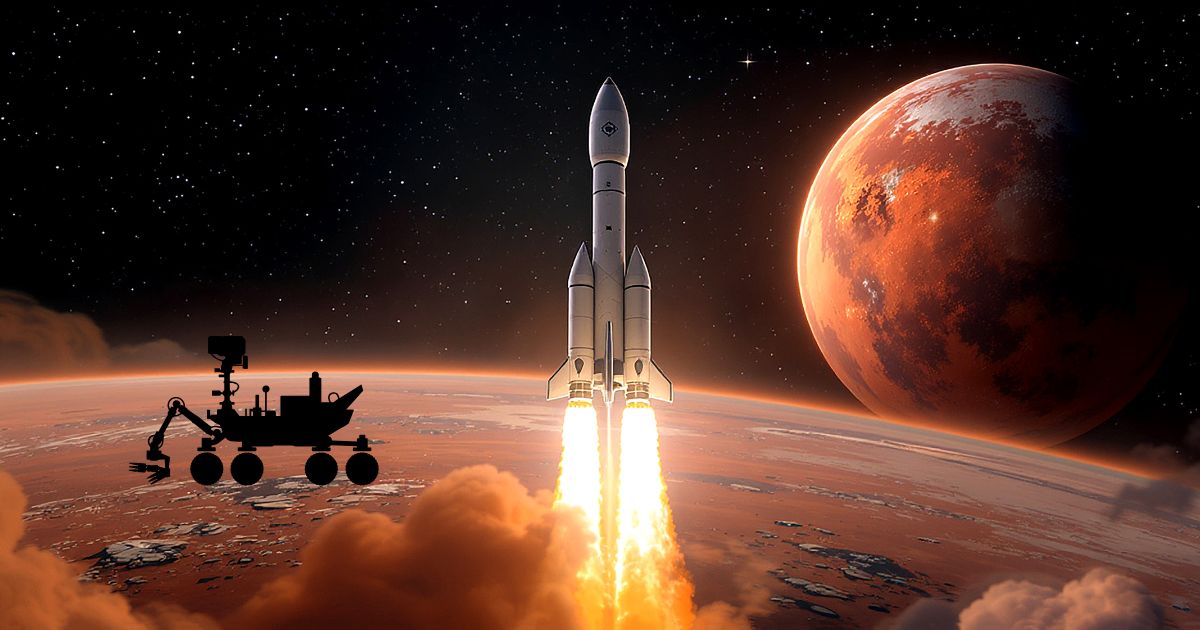
For decades, we have sent robotic explorers to Mars. Orbiters fly high above, mapping the planet’s surface. Landers have touched down to study the weather. Rovers, like the famous Perseverance, act as robotic geologists, driving across the red sand to analyze rocks. These robots have taught us so much, including the fact that Mars was once a warm, wet world with rivers, lakes, and all the right ingredients for life.
These robots do amazing work, but they have a big limitation. They can only carry small, simple laboratories with them. The most powerful scientific tools on Earth are huge, often the size of a room or even a building. We can’t send these giant, power-hungry instruments to Mars. So, scientists decided on a new, incredibly bold plan. If we cannot take our best labs to Mars, we will bring Mars to our best labs.
This is the whole idea behind the Mars Sample Return mission. It is not just one spacecraft; it is a multi-part, international campaign to collect pieces of Martian rock, soil, and atmosphere and bring them back to Earth. This is one of the most complex and ambitious robotic missions ever attempted. It is a cosmic relay race that involves multiple launches, brand new technologies, and a partnership between NASA and the European Space Agency (ESA). The goal is to get the first-ever “fresh” samples from another planet into the hands of scientists here. But what makes these few handfuls of rock worth such an effort?
Why is bringing Mars rocks to Earth so important?
The simple answer is to search for life. The Perseverance rover is in Jezero Crater, a place that we know was once a river delta and a deep lake. This is exactly the kind of place where tiny, simple life (like microbes) might have lived billions of years ago. Perseverance is drilling rocks that may hold tiny, fossilized signs of this ancient life, which are called “biosignatures.” But the rover’s tools can only suggest that these signs are present. They cannot prove it. To be 100 percent sure, we need to study those rocks with incredibly powerful microscopes and testing equipment that only exist on Earth. Bringing samples back is the only way to finally answer the big question: “Are we alone in the universe?”
But it is not just about looking for life. These samples are like a history book. By testing them, scientists can figure out the exact age of different parts of Mars. This will help them build a clear timeline of the planet’s past. They can learn why Mars changed from a warm, wet planet into the cold, dry desert we see today. This teaches us how planets, including our own, can change over time. Finally, these samples are vital for planning future human missions. Astronauts going to Mars will face many dangers. We need to study the Martian dust and soil to see if it is toxic or harmful to breathe. We also need to see if the soil contains resources, like frozen water, that astronauts could use to drink or make rocket fuel. These samples are the key to answering all these questions.
How is NASA collecting the samples on Mars right now?
This first step of the mission is already happening. The NASA Perseverance rover, which landed on Mars in 2021, is the sample collector. It is a scientific masterpiece on six wheels. On the end of its robotic arm, it has a complex drill. This drill does not just grind up rock; it can carefully cut out a small, clean core of rock, about the size of a piece of chalk. The rover also has a tool to scoop up loose soil, called “regolith,” and can even suck in a sample of the thin Martian atmosphere.
Once a sample is collected, a whole robotic factory inside the rover’s belly swings into action. The sample is passed to another small arm, photographed, and sealed inside a special container. These containers are small titanium tubes, built to be ultra-clean and super tough. They are designed to protect the sample from contamination and keep it safe for decades. The rover’s sealing system places a cap on the tube and hermetically seals it shut. Perseverance is carrying a set of these tubes, collecting different types of rocks from the ancient river delta and lakebed. As a backup plan, Perseverance has driven to a flat, safe spot called “Three Forks” and has carefully dropped ten of its sealed sample tubes onto the ground. This collection is called a “sample depot,” like a treasure chest left in a safe spot for a future explorer to find.
What is the plan to pick up the samples?
This is where the next part of the mission, which is still being built, comes in. In the next few years, NASA will launch a new, large lander called the Sample Retrieval Lander. This spacecraft will land on Mars near Perseverance and its sample depot. This lander is the “hub” for the entire pickup operation. It carries two very important pieces of equipment: a robotic arm and the rocket that will launch the samples into space.
There are two separate plans to get the samples to this lander. Plan A is the simplest: the Perseverance rover, which is still healthy and strong, will use its remaining sample tubes (the ones still inside its belly) and drive them over to the new lander. It will then use its own robotic arm to hand the tubes, one by one, to the lander’s robotic arm. This is the most direct and preferred method.
But what if something happens to Perseverance? That is why there is a Plan B. The Sample Retrieval Lander will also carry two small, advanced helicopters. These “Sample Recovery Helicopters” are based on the design of the incredibly successful Ingenuity helicopter, which proved that flight on Mars is possible. If Perseverance cannot deliver the samples, these two helicopters will fly out to the sample depot. They are designed with tiny, strong grippers that can swoop down, grab one of the tubes from the ground, and fly it back to the lander. They will drop the tube near the lander, where the robotic arm can then pick it up. This clever backup plan ensures the mission can succeed even if Perseverance is unable to help.
How will the samples get from Mars into space?
Once the sample tubes are safely delivered to the Sample Retrieval Lander, the next historic step begins. The lander carries a special robotic arm, built by the European Space Agency (ESA). This arm, called the Sample Transfer Arm, is very precise. It will pick up each sample tube, whether it came from Perseverance or the helicopters, and carefully load it into a container at the top of a small rocket.
This rocket is called the Mars Ascent Vehicle, or MAV. It is a small, two-stage rocket, but it is one of the most important parts of the entire mission. When it is time to go, the MAV will fire its engines and launch straight up from the top of the lander. This will be a monumental moment in human history: the very first rocket launch from the surface of another planet. The MAV will blast through the thin Martian atmosphere, shedding its first stage, and continue pushing upward until it reaches orbit high above Mars. Once in orbit, it will release its precious cargo: a basketball-sized, sealed container holding all the sample tubes. This container, called the Orbiting Sample, will then be floating in space, waiting for the next leg of its relay race home.
How will the samples travel from Mars back to Earth?
Long before the MAV even launches, another huge spacecraft will already be on its way. This is the Earth Return Orbiter (ERO), and it is also being built by the European Space Agency. The ERO is a very large, solar-powered spacecraft. Its job is to get to Mars, enter a stable orbit, and wait. After the MAV launches and releases the sample container, the ERO’s mission becomes a high-stakes search. It must find this tiny container, which is floating in the vastness of space hundreds of miles above Mars.
The ERO will use its advanced cameras and sensors to track the container. This part of the mission is called an orbital rendezvous, and it has to happen completely automatically, with no real-time help from humans on Earth. The ERO will slowly and carefully fly toward the container, matching its speed and path. Once it is close enough, it will open its doors and “swallow” the container, capturing it safely inside. The ERO will then use robotic systems to seal the container inside another, much larger and stronger biocontainment system. This “seal within a seal” is critical for planetary protection, making sure no unsterilised Martian material can escape. With the samples safely secured, the ERO will fire its powerful and efficient solar-electric engines and begin the long journey back to Earth, a trip that could take more than a year.
What happens when the samples finally land on Earth?
The Earth Return Orbiter is a giant spacecraft, and it is not designed to land. As it approaches our home planet, it will perform its final, critical task. It will aim very carefully and then release a special capsule, called the Earth Entry Vehicle (EEV). This capsule is like a time machine, built with a thick heat shield, similar to the capsules that brought the Apollo astronauts home from the Moon. The EEV, which holds the precious sealed sample container, will slam into Earth’s atmosphere at a speed of thousands of miles per hour.
The heat shield will glow red hot as it burns through the air, protecting the samples inside from the extreme temperatures. After the capsule has slowed down significantly, a series of parachutes will deploy, slowing its fall even more. It is designed to have a soft-impact landing in a very specific, secure, and remote location: the Utah Test and Training Range. A highly trained recovery team will be waiting to get to the capsule immediately. They will carefully collect it, making sure it remains sealed, and transport it to a brand new, special laboratory. This laboratory, called the Mars Sample Receiving Facility, is being built at NASA’s Johnson Space Center. It is a high-security lab designed to handle materials from another world, protecting the samples from Earth’s germs and protecting Earth from any potential, though very unlikely, Martian contamination. Only inside this secure lab will scientists finally, carefully open the container and get their first look at the pieces of Mars.
What makes this mission so difficult and expensive?
The Mars Sample Return mission is incredibly hard because it is not just one mission; it is a whole campaign of different missions that must all work perfectly in a specific order. It is like building three separate, complex spaceships that must all meet up and hand off a baton in a relay race that spans millions of miles. A failure at any single step could jeopardize the entire chain of events.
Many of the technologies being used are brand new and have never been tried before. The Mars Ascent Vehicle will be the first-ever rocket launch from another planet. The robotic rendezvous in Mars orbit, where the ERO must find and catch the sample container, has to be done automatically from millions of miles away. The sample-grabbing helicopters are a new technology. The Sample Transfer Arm has to work perfectly in the frigid, dusty Martian environment. Even the landing on Earth is complex, as the capsule must hit a precise target. Because it involves so many different spacecraft, multiple launches from Earth, and a long-term partnership between NASA and ESA, the mission takes many years and costs billions of dollars. It is the single most complex robotic space mission ever designed, which is why it is also one of the most exciting.
What questions will scientists try to answer first?
When the samples are finally secure in the Mars Sample Receiving Facility, the science will begin. The first thing scientists will do is catalog every tiny piece of rock and dust. They will then begin a series of careful tests. The highest priority will be the search for life. Using powerful electron microscopes, they will scan the samples for any shapes that look like fossilized bacteria or other microbes. They will also use chemical tests to look for complex organic molecules that are telltale signs of living things. This investigation will be slow, careful, and checked by many different teams to be sure of the results.
At the same time, other teams of geologists will start to work on the rocks. They will use a method called radiometric dating to determine the exact age of the rocks. This will finally tell us, for example, exactly when water flowed in Jezero Crater. This will help create a precise timeline for all of Mars. Other scientists will study the chemistry of the soil to understand the weather of ancient Mars. And teams preparing for human exploration will get their first chance to test the Martian soil directly. They will find out how sharp or toxic the dust is and what challenges it might pose for astronaut spacesuits and habitats. These first samples will keep scientists busy for decades, likely leading to discoveries we cannot even predict yet.
Conclusion
NASA’s Mars Sample Return mission is the next great leap in our exploration of the red planet. It is a complex, multi-step plan that pushes the limits of our technology. The mission is like a long-distance relay race, starting with the Perseverance rover drilling rocks, handing off to a lander and a small rocket, which then passes the samples to an orbiter for the long flight home.
This incredible effort is all for one purpose: to bring a small piece of Mars back to Earth. By studying these precious samples in our advanced labs, we hope to answer some of the biggest questions humanity has ever asked. We will learn about the history of our neighbor planet, prepare for the day we send astronauts there, and perhaps, just perhaps, find out if life ever existed on a world beyond our own.
FAQs – People Also Ask
What is a sample depot on Mars?
A sample depot is a special collection of sample tubes that the Perseverance rover placed on the ground. The rover carefully dropped ten of its sealed tubes in a flat, safe area. This depot, named “Three Forks,” acts as a backup so that if Perseverance can no longer move, a future mission (like the Sample Recovery Helicopters) can still fly to this spot and pick up the samples.
How big are the Mars sample tubes?
The sample tubes are surprisingly small and light. They are made of titanium and are just a bit thinner than a pencil and about six inches (15 centimeters) long. Each empty tube weighs very little. They are designed to hold a small, drilled core of rock or a scoop of soil, about the size of a piece of chalk.
What is the European Space Agency’s (ESA) role in this mission?
The European Space Agency (ESA) is NASA’s main partner. ESA is building two critical parts of the mission. First, they are building the large Earth Return Orbiter (ERO), the spacecraft that will fly to Mars, capture the samples in orbit, and fly them back to Earth. Second, they are building the precise robotic arm (the Sample Transfer Arm) that will sit on the lander and load the samples into the Mars rocket.
Is there life in the Mars samples?
Scientists do not expect to find living life in these samples. Mars’s surface is extremely cold, dry, and flooded with radiation, which is harmful to life as we know it. Instead, scientists are looking for “biosignatures,” which are signs of ancient life that may have existed billions of years ago when Mars had water. This would likely be in the form of fossilized microbes or specific chemical patterns left by life.
What is the Mars Ascent Vehicle (MAV)?
The Mars Ascent Vehicle (MAV) is a small, two-stage rocket that will be carried to Mars on the Sample Retrieval Lander. Its job is to launch the sealed container of samples from the surface of Mars into orbit. This will be the very first time humans have ever launched a rocket from another planet.
What is planetary protection?
Planetary protection is a set of very strict rules to prevent contamination. It works in two ways. First, we protect Mars from Earth by making sure our spacecraft are extremely clean, so we do not accidentally send Earth germs to Mars. Second, we protect Earth from Mars. This is why the samples will be sealed in multiple containers and brought back to a special, high-security lab to be opened.
How many samples is Perseverance collecting?
The Perseverance rover has the ability to collect over 40 samples in total. It is currently using these tubes to collect rock cores, soil (regolith), and even samples of the Martian atmosphere. It has already collected dozens of samples from different, interesting geological sites within Jezero Crater, ten of which have been placed in the backup depot on the ground.
How long will the entire Mars Sample Return mission take?
The entire campaign is very long. The first step, collecting samples with Perseverance, began in 2021. The next missions, the Sample Retrieval Lander and the Earth Return Orbiter, are planned to launch later this decade. If all goes well, the samples are expected to land back on Earth in the early 2030s.
What happens if the Sample Recovery Helicopters fail?
The mission has multiple backup plans. The primary plan is for the Perseverance rover to drive the samples to the lander. The helicopters are themselves the backup for that plan. The mission’s success relies on having these multiple options. Engineers design the mission so that the most important parts have at least one backup way of working.
What is the Mars Sample Receiving Facility?
This is a new, highly secure laboratory that NASA is building at the Johnson Space Center in Houston, Texas. This is where the samples will be taken immediately after they land on Earth. It is designed to be one of the cleanest and safest labs in the world, allowing scientists to study the samples without contaminating them with Earth’s air and also protecting Earth’s environment from the samples.