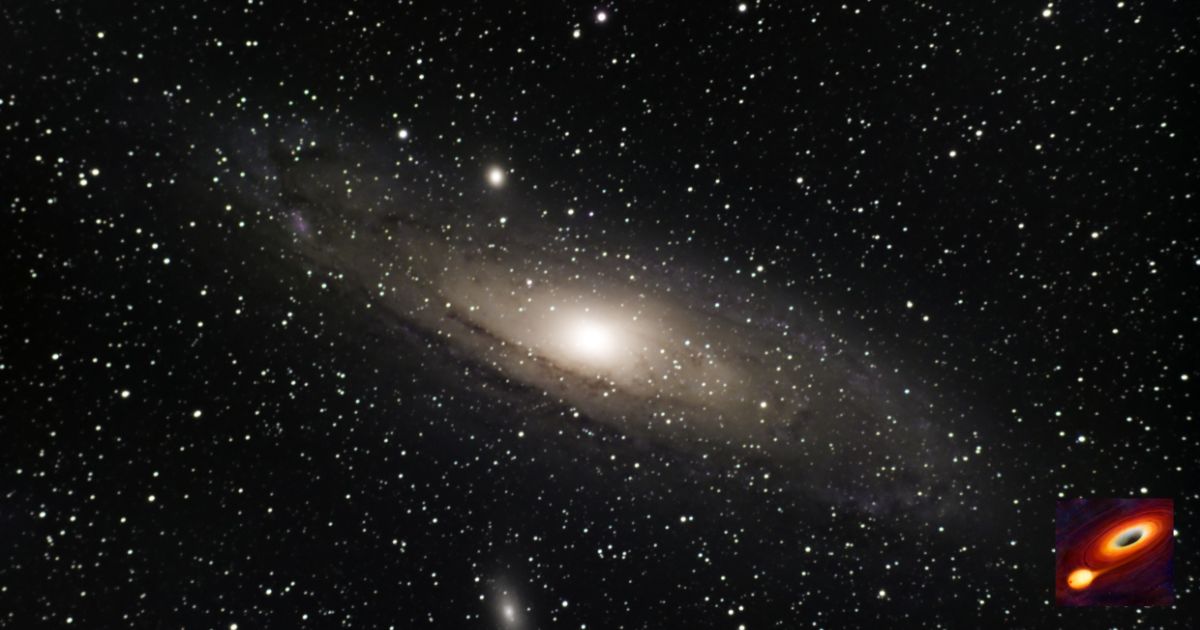
A Tidal Disruption Event happens when a star gets too close to a black hole. It’s a bit like Earth’s ocean tides, but taken to the extreme. The force of gravity from the black hole is so much stronger on the side of the star facing it than on the side facing away. This difference in pull creates a massive stretching force, which astronomers playfully call “spaghettification.” The star is literally stretched out into a long, thin stream of gas.
About half of the star’s material gets thrown out into space, but the other half falls back toward the black hole. As this stellar debris spirals inward, it slams into itself, heats up to millions of degrees, and forms a bright, temporary accretion disk around the black hole. This disk glows fiercely, releasing a massive flare of X-rays, UV light, and visible light that can outshine the entire galaxy for months or even years. This is the luminous signal that telescopes on Earth and in space catch, alerting us that a TDE has occurred. TDEs are important because they are the only way to “see” a black hole that isn’t actively feeding. Most black holes are “dormant” or “quiescent,” meaning they are hidden in the dark, but a TDE makes them suddenly and spectacularly visible.
Why Is Finding a TDE Outside a Galaxy’s Center So Unexpected?
For decades, the standard model of galaxy evolution said that all large galaxies have one Supermassive Black Hole (SMBH) sitting right in the middle, or the galactic nucleus. Since the nucleus is the densest part of the galaxy, packed with millions of stars, it is the place where a star is most likely to wander off course and be captured by the SMBH. This is why almost every TDE we’ve ever found—and there have been over a hundred now—has been right at the brightest, central point of a galaxy. When a bright, flaring TDE is found thousands of light-years away from the center, it defies this expectation. It’s like finding a 100-story skyscraper in the middle of a desert.
The surprise location of an off-nuclear TDE immediately suggests the existence of a “wandering” or “rogue” Massive Black Hole (MBH). This black hole is massive enough to shred a star, but it is not the primary one at the galaxy’s core. Astronomers have calculated that these black holes could be from a lower-mass galaxy that was completely swallowed by the larger host galaxy in a past cosmic collision. The small galaxy’s central black hole then became a traveler in the new, bigger galaxy’s halo, taking a long time to spiral in toward the new center. An event like AT2024tvd, observed just a few thousand light-years from its galaxy’s core, strongly supports this idea of galactic mergers leaving behind massive, homeless black holes.
What Does an Off-Nuclear TDE Reveal About Black Hole Mergers?
The location of these off-nuclear TDEs is a direct clue about how galaxies grow. Galaxies merge all the time. When two galaxies collide, their central black holes start a slow, gravitational dance. They get closer and closer, eventually merging to form one bigger supermassive black hole. However, during this process, the secondary black hole—the one from the smaller, consumed galaxy—doesn’t immediately plunge to the center. Instead, it orbits and wanders in the outer regions of the newly formed galaxy.
An off-nuclear TDE is a unique way to spot these wandering black holes during their long spiral inward. The black hole is revealed only when it disrupts a star, like a single burst of light announcing its presence in a dark corner of the galaxy. Studying the mass of the black hole involved in the off-nuclear TDE—which can be measured by the brightness and speed of the flare—tells us the mass of the secondary black hole. For example, observations suggest the black hole responsible for the famous off-nuclear TDE 3XMM J215022.4−055108 is an Intermediate-Mass Black Hole (IMBH), weighing perhaps $10,000$ to $50,000$ times the mass of our Sun. This is much smaller than a supermassive black hole (millions to billions of solar masses) but far bigger than a stellar-mass black hole (less than $100$ solar masses). These IMBHs are considered the “missing link” in black hole evolution, and TDEs may be the best way to find them.
Why Are Intermediate-Mass Black Holes Considered the Missing Link?
Black holes come in two main flavors: stellar-mass black holes, which are $5$ to $100$ times the Sun’s mass and are formed when a single large star dies in a supernova, and supermassive black holes, which are millions or billions of times the Sun’s mass and live at the centers of galaxies. For a long time, there was a huge gap in the middle, known as the “black hole mass gap.” This is where Intermediate-Mass Black Holes (IMBHs) are supposed to be, with masses ranging from about $100$ to $100,000$ solar masses.
Scientists believe IMBHs must exist, but they are incredibly hard to find because they are too small and too far from bright gas clouds to be easily seen. They are crucial because they could be the “seeds” that grew into the enormous supermassive black holes we see today. The fact that the black holes in some off-nuclear TDEs, like 3XMM J2150, have masses that fall perfectly into the IMBH range makes these events groundbreaking. They provide strong, direct evidence that this missing link is real and that these black holes are lurking in unexpected places, often in the dense star clusters orbiting the outskirts of galaxies, which are likely the cores of old, swallowed dwarf galaxies.
Can These Off-Nuclear Events Also Be Caused by Recoiling Black Holes?
The wandering black hole from a galaxy merger is one possibility, but another exciting idea is that an off-nuclear TDE is caused by a recoiling black hole. This happens when two supermassive black holes merge, and the resulting, single, new black hole gets a powerful gravitational kick that sends it hurtling out of the galactic center.
Think of it like a cosmic sling-shot. When two black holes merge, they send out waves in the fabric of space-time, called gravitational waves. If the merger is not perfectly symmetrical, the black hole gets a powerful push in one direction. This kick can be so strong that the black hole is ejected from the galaxy’s center entirely and sent flying through the surrounding star-filled halo at incredible speeds. If this runaway black hole, which is still incredibly massive, shreds a star on its way out, we see an off-nuclear TDE. Astronomers can often tell the difference between a simply “wandering” black hole and a “recoiling” black hole by looking at the TDE’s light curve and jet properties. A recoiling black hole is a temporary phenomenon, and finding a TDE linked to one would be direct proof of a very recent and violent supermassive black hole merger, which is one of the most energetic events in the universe.
How Are Astronomers Searching for More Wandering Black Holes in 2025?
Finding off-nuclear TDEs is not easy. They are very rare, and they are mixed in with millions of other temporary cosmic flares, such as supernovae, which are exploding stars. In the past, astronomers focused their searches only on the very centers of galaxies to find the expected TDEs. Now, major sky surveys like the Zwicky Transient Facility (ZTF) and future projects like the Vera C. Rubin Observatory’s Legacy Survey of Space and Time (LSST) are changing the game.
These powerful telescopes are designed to scan the entire sky rapidly, detecting countless transient events. Astronomers are now using new computer algorithms that specifically look for TDE-like flares away from the central nucleus. They look at the color and the fading pattern of the light. A supernova cools down and turns red, but a TDE stays consistently hot and blue for months or years. By filtering the data for these blue, long-lasting flares in the outer regions of galaxies, scientists are starting to find more off-nuclear candidates. As the surveys continue and machine learning tools improve, we expect to see a surge in these discoveries, helping us finally map the population of wandering and intermediate-mass black holes across the universe.
What Do Off-Nuclear TDEs Tell Us About Galaxy Evolution?
The discovery of off-nuclear TDEs is a massive step forward in our understanding of hierarchical galaxy formation. This theory suggests that large galaxies, like our Milky Way, grew to their current size by repeatedly merging with and consuming smaller dwarf galaxies over billions of years. Each of those small galaxies likely brought its own black hole along for the ride.
If we can accurately count and map the location of all the wandering black holes found through these off-nuclear TDEs, it will confirm the core idea of this hierarchical model. It will provide a “census” of the black holes leftover from past galactic mergers. Furthermore, the number and mass of these black holes will give us clues about how the original seed black holes formed in the very early universe. If many small black holes merge quickly to form an IMBH, and those IMBHs then merge to form SMBHs, the universe should be populated with many wandering IMBHs. The off-nuclear TDE is the crucial flash of light that turns an invisible, theoretical puzzle piece into a concrete, observable reality, painting a clearer picture of the violent history and future of all galaxies.
Conclusion
The discovery of an “off-nuclear” Tidal Disruption Event is a thrilling moment in astronomy. It takes a textbook phenomenon—a black hole shredding a star—and turns it on its head by moving the event to the “wrong” place. These powerful flashes of light, found far from the traditional galactic centers, are providing smoking-gun evidence for two of the universe’s most elusive objects: wandering massive black holes left over from galactic mergers and the long-sought Intermediate-Mass Black Holes that are the missing link in black hole evolution. By combining the data from these rare, off-center TDEs with new, wide-field sky surveys, astronomers are finally starting to map out the hidden black hole population of the cosmos. This research confirms that our universe is far more dynamic and populated with unexpected cosmic wanderers than we ever imagined.
What other secrets about black hole formation are currently hidden in the dark, quiet corners of our galaxies?
FAQs – People Also Ask
What is the mass range for Intermediate-Mass Black Holes (IMBHs)?
The mass range for Intermediate-Mass Black Holes (IMBHs) is generally considered to be between $100$ and $100,000$ times the mass of our Sun. This is significantly higher than the stellar-mass black holes, which are typically under $100$ solar masses, but much lower than the supermassive black holes found at galactic centers, which can be millions or even billions of solar masses. IMBHs fill the long-standing “mass gap” in black hole classifications.
Are off-nuclear TDEs more common in merging galaxies?
Yes, it is highly theorized that off-nuclear TDEs are much more common in galaxies that have recently undergone a merger. The primary mechanism for placing a black hole far from the center is the process of a smaller galaxy being absorbed by a larger one, which causes the smaller black hole to wander in the host galaxy’s halo as it slowly spirals inward. Therefore, galaxies showing signs of recent or ongoing merging activity are the most likely places to find these off-center events.
How is the mass of an off-nuclear black hole determined from the TDE flare?
The mass of the black hole is estimated by analyzing the properties of the TDE flare, specifically the peak luminosity (how bright it gets) and the rate at which the light decays. The physics of how the stellar debris forms the accretion disk and radiates light is directly related to the mass of the compact object doing the shredding. For example, a lower-mass black hole (like an IMBH) often produces a softer, less energetic X-ray or UV flare compared to a supermassive black hole.
What is “spaghettification” in simple terms?
Spaghettification is the term used by scientists to describe what happens when a star or any object gets too close to a black hole. Because the gravitational pull is so much stronger on the side of the object closer to the black hole, the object is stretched and squeezed, becoming long and thin like a strand of spaghetti before it is completely torn apart into a stream of hot gas.
How far away from the center of a galaxy are off-nuclear TDEs usually found?
Off-nuclear TDEs are typically found at projected distances ranging from a few hundred light-years up to several thousand light-years from the host galaxy’s central nucleus. For example, one of the most famous off-nuclear events, AT2024tvd, was found to be about $2,600$ light-years away from the center of its galaxy, which is quite a significant distance in the context of where TDEs are normally detected.
Can a stellar-mass black hole cause an off-nuclear TDE?
While a stellar-mass black hole (less than $100$ solar masses) can definitely disrupt a star, the resulting flare, or TDE, would be much fainter and shorter-lived than those currently classified as off-nuclear TDEs. The brightest, most long-lasting off-nuclear flares observed so far, like 3XMM J2150, require a much more massive object, most likely an Intermediate-Mass Black Hole, to generate the enormous, long-lasting energy outburst that is seen by our telescopes.
What is the role of the Hubble Space Telescope in finding these events?
The Hubble Space Telescope plays a crucial role in confirming the location of an off-nuclear TDE. Initial detection is usually done by wide-field survey telescopes like ZTF. However, due to its very high resolution, Hubble can precisely pinpoint the location of the flare and confirm that it is indeed far away from the galaxy’s center, which is necessary to rule out other nearby events and confirm the black hole is a true wanderer.
What is the difference between a “wandering” and a “recoiling” black hole?
A wandering black hole is the core black hole of a smaller galaxy that was merged and absorbed by a larger galaxy; it is slowly spiraling inward toward the new galactic center. A recoiling black hole is the product of two supermassive black holes merging, and the resulting single, new black hole is violently ejected from the center by a powerful gravitational wave kick, moving at very high speed away from the nucleus.
Are off-nuclear TDEs rarer than nuclear TDEs?
Yes, off-nuclear TDEs are much rarer than the standard TDEs found at the center of galaxies. Astronomers have found well over a hundred nuclear TDEs, but only a handful of confirmed off-nuclear candidates have been discovered so far. This rarity is a key reason why they are so important, as each discovery represents a significant piece of evidence for the existence of wandering or intermediate-mass black holes.
How do new sky surveys help find TDEs that were previously missed?
New sky surveys like ZTF and LSST are designed to scan the entire visible sky much more quickly and deeply than previous surveys. Their fast, wide-field coverage ensures that they catch the initial, rapid rise in brightness of a TDE flare before it fades away. Crucially, they cover vast areas of a galaxy, allowing them to spot the relatively faint events that happen thousands of light-years away from the bright galactic nucleus, which is a key requirement for finding off-nuclear TDEs.