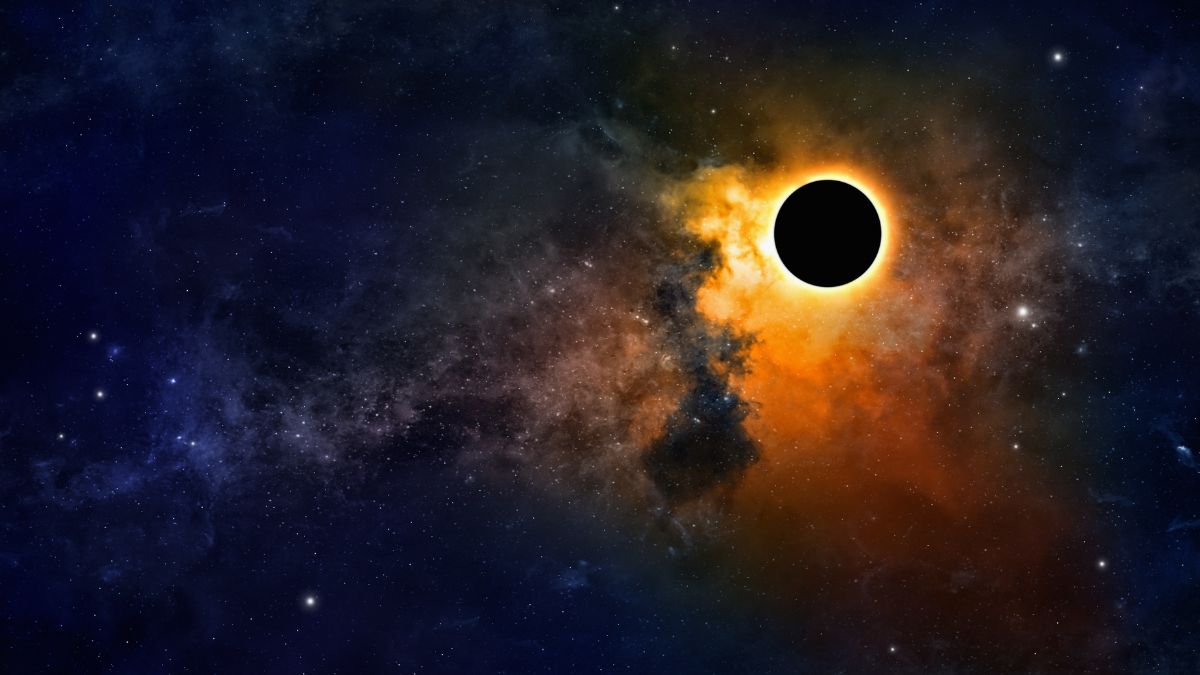
Black holes are one of the most famous and most mysterious objects in the entire universe. We hear about them in movies and science shows, often described as giant cosmic vacuum cleaners that suck up everything in their path. While that’s not perfectly accurate, the truth is just as strange. A black hole is a place where gravity is so incredibly strong that nothing can escape its pull. Once something gets too close, it’s pulled in, and it can never leave. Not even light, the fastest thing in the universe, can get away.
This is why they are called “black” holes—they don’t reflect any light, so we can’t see them directly. We only know they are there because we can see how their powerful gravity affects the stars and gas around them. But this raises the big question. We know what happens near a black hole, but what happens if you actually fall inside one? What is past the point of no return? This is one ofthe biggest unsolved puzzles in all of science. Because we can’t send a camera or a person to look, scientists must use their most powerful tools—mathematics and theories—to predict what lies in the center.
The truth is, this is where our current understanding of the world breaks down. The center of a black hole is a place where the laws of physics as we know them seem to stop working. This makes the question of what’s inside more than just a simple curiosity; it’s a clue that could unlock a whole new way of understanding reality. So, what do our best theories predict is waiting in the dark heart of a black hole?
What Is the Event Horizon?
Before we can talk about what is inside a black hole, we have to understand the “door” to the inside. This door is called the event horizon. It’s not a physical, solid surface that you could touch. You can’t stand on it or knock on it. The event horizon is an invisible boundary in space. It is the exact point where the black hole’s gravity becomes so strong that the “escape velocity”—the speed you need to go to get away—becomes faster than the speed of light. Since nothing in the universe can travel faster than light, anything that crosses this line is trapped forever.
A good way to think about it is to picture a very wide, fast-moving river that leads to a massive waterfall. You can be in a boat far away from the waterfall, and you are safe. You can easily paddle back to shore. As you get closer, the water speeds up. You can still escape, but you have to paddle much harder. Eventually, you reach a point where the water is moving so fast that no matter how hard you paddle, you will be pulled over the edge. The event horizon is that exact point of no return.
For someone watching from a safe distance, something strange would happen. If they watched your spaceship fall toward the black hole, they would not see you cross the event horizon. Instead, they would see your ship appear to slow down, get dimmer, and stretch. Your image would look “frozen” in time at the edge, fading away over an extremely long time. This is because the intense gravity warps time itself, making time slow down for you relative to the person watching. For you, however, you would cross the event horizon in a normal amount of time, feeling fine (at first).
What Happens If You Fall Into a Black Hole?
So, you’ve crossed the event horizon. You are now officially inside the black hole, and you can never go back. What happens next? The answer depends on the size of the black hole. If you fell into a “small” black hole (one that is only a few times the mass of our Sun), you would have a very bad time, very quickly. You would be destroyed by a process that scientists colorfully call “spaghettification.” This happens because of tidal forces. Gravity pulls on every part of your body, but its strength changes with distance.
Imagine you are falling in feet-first. The black hole’s gravity would be pulling on your feet much more strongly than it would be pulling on your head. This massive difference in force would stretch your body, pulling it apart like a piece of spaghetti. At the same time, the gravity from the sides would be squeezing you. You would be stretched longer and thinner until you were just a stream of atoms, all heading toward the center. This process would happen almost instantly, even before you reached the event horizon of a small black hole.
However, if you fell into a supermassive black hole, the story is different. These are the giants that live at the center of galaxies, including our own Milky Way. They are millions or even billions of times the mass of the Sun. Because they are so huge, their event horizon is much, much farther away from their center. The “slope” of gravity is more gentle at the edge. The difference in gravity between your head and your feet would be so tiny that you wouldn’t even feel it. You could cross the event horizon of a supermassive black hole without knowing it. You would just be floating in empty space, perfectly safe. For a while.
What Is the Singularity?
Once you are inside, no matter what, all paths lead to one place: the center. According to our current best theory of gravity, Einstein’s General Relativity, the center of a black hole is a place called the “singularity.” This is the “classic” answer to what’s inside a black hole. General Relativity predicts that all the matter that has ever fallen into the black hole—entire stars, planets, and gas clouds, all crushed down—gets squeezed into an infinitely tiny point. This point has zero size and infinite density.
It’s hard to wrap your head around “infinite density.” It means you have a huge amount of “stuff” (mass) packed into zero “space.” This is not just very dense, like a rock; it is infinitely dense. At this point, all the concepts we use to describe the world, like space and time, stop making sense. Time itself comes to an end at the singularity. If you were unlucky enough to be falling toward it, you would eventually hit this “end of time” and be crushed out of existence.
However, scientists are very uncomfortable with the idea of “infinity.” When a an answer like “infinite” or “zero” pops up in a physics equation, it’s usually a giant red flag. It doesn’t mean the universe is actually infinite at that point. It means the theory itself has broken. General Relativity is an amazing theory for describing big things like planets and galaxies, but it can’t handle the physics of the infinitely small. It’s giving us an error message. This tells scientists that to truly understand the singularity, we need a new, better theory.
Why Do We Need New Theories for Black Holes?
To understand why the singularity is such a problem, we need to look at the two great pillars of modern physics. The first is General Relativity, which we just discussed. It’s Einstein’s masterpiece for understanding gravity and the universe on a very large scale. The second pillar is Quantum Mechanics. This is the theory for understanding the universe on a very tiny scale—the world of atoms, electrons, and particles. Both of these theories have been tested thousands of times and work perfectly in their own areas.
Here’s the problem: a black hole singularity is the one place in the universe where these two theories are forced to meet. The singularity is created by a huge amount of mass (gravity), so we need General Relativity. But all of that mass is crushed into an incredibly tiny point, so we also need Quantum Mechanics. When scientists try to use both theories at the same time to describe the singularity, the math falls apart. The theories give results that make no sense.
This clash tells us that our understanding is incomplete. We are missing a “Theory of Everything,” also known as Quantum Gravity. This single, undiscovered theory would be ableto unite the large-scale world of gravity with the small-scale world of quantum particles. Finding this theory is the biggest goal in physics today. Scientists are not just studying black holes because they are weird; they are studying them because they are the key. They are the natural laboratory where we can find clues to this new, ultimate theory. The “inside” of a black hole is where the answer is hidden.
Could a Black Hole Be a “Fuzzball” Instead?
Since General Relativity breaks, scientists have come up with new ideas that come from theories of quantum gravity. One of the most popular and strangest ideas comes from String Theory. This is a complex idea, but the basic concept is that everything in the universe—every particle, every force—is not a “point” but is actually made of tiny, vibrating “strings” of energy. Different vibrations of these strings make different particles, just like different vibrations of a guitar string make different musical notes.
In String Theory, a black hole might not be an empty void with a singularity at the center at all. Instead, it might be a “fuzzball.” According to this idea, when a star collapses, it doesn’t form an empty hole. It turns into a giant, tangled ball of these fundamental strings. This fuzzball would be about the same size as the black hole’s event horizon. So, there would be no “inside” to fall into. The event horizon is the surface of this messy, stringy star.
If you fell into a fuzzball, you wouldn’t be spaghettified in empty space. You would simply hit this surface and be absorbed. Your information and matter would become part of the fuzzball itself, just a new set of tangled strings. This idea is very popular with many physicists because it neatly solves two problems at once. First, it gets rid of the singularity—there is no infinite point, just a very dense but normal object. Second, it solves a puzzle called the “Information Paradox,” because the information of the things that fall in isn’t destroyed; it’s just stored on the surface.
What Is a “Planck Star”?
String Theory isn’t the only new idea. A rival theory of quantum gravity is called Loop Quantum Gravity, or LQG. This theory has a different view of the universe. Instead of saying everything is made of strings, LQG says that space itself is not smooth and continuous. It predicts that if you could zoom in far, far, far more than we can with any microscope, you would see that space is made of tiny, indivisible “loops” or “atoms of space.” There is a minimum possible size for everything. Space itself is “pixelated.”
This “minimum size” rule changes everything for black holes. In this theory, when a star collapses, it can’t be crushed down to an infinitely small point. It can only be crushed down until it’s as small as these “atoms of space” will allow. The matter can’t get any smaller. So, instead of forming a singularity, the collapsing matter forms an object called a “Planck Star.” This would be an object of unbelievable density, far denser than anything else we know of, but it would not be infinite. It would be a real, physical object.
What happens next is even stranger. According to Loop Quantum Gravity, this Planck Star is not stable. The crushed matter “bounces.” The incredible pressure of gravity squeezing it in is met by an even more incredible “quantum pressure” pushing back out. This bounce might be very, very slow from our perspective (due to time dilation), but eventually, the black hole would “rebound” and explode. This theory suggests that the black hole is actually a portal. Matter falls in, gets compressed into a Planck star, bounces, and then gets spewed back out of a “white hole”—the exact opposite of a black hole.
Could a Black Hole Be a Wormhole?
This brings us to one of the most popular ideas in science fiction: the wormhole. Is it possible that a black hole is not an end point, but a tunnel? The idea is that when you fall into a black hole, you don’t hit a singularity; you instead travel through a “throat” and come out somewhere else entirely. This “somewhere else” could be a different part of our own universe, or maybe even a completely different universe. This concept is technically called an “Einstein-Rosen bridge,” and it is allowed by Einstein’s theory of General Relativity.
The math shows that this could be possible. A black hole would be the entrance, and a “white hole” (a place where things can only come out, never go in) would be the exit. This sounds like the perfect galactic transportation system. However, further calculations have shown that this type of wormhole would be hopelessly unstable. The “tunnel” connecting the two ends would collapse the instant anything—even a single particle of light—tried to pass through it. It would shut faster than you could travel through it.
So, a “classical” wormhole probably won’t work. But some of the new quantum gravity theories, like Loop Quantum Gravity, bring this idea back. The “bounce” of the Planck star could be what holds the tunnel open. Some theories suggest that our entire universe might have been born from the “bounce” of a Planck star inside a black hole in a different, older universe. This is a very speculative and wild idea, but it shows how scientists are thinking about these objects as creators, not just destroyers.
What Is the Black Hole Information Paradox?
We’ve mentioned “information,” but why is it so important? This is one of the deepest problems in physics. There is a fundamental rule in quantum mechanics that states information can never be destroyed. You can change it, scramble it, or hide it, but you can never erase it from the universe. For example, if you burn a book, the information in the book (the words, the story) seems to be gone. But in physics, the information is still there, just in a different form. It’s in the heat of the fire, the chemical composition of the ash, and the pattern of the smoke. A powerful enough computer could, in theory, piece it all back together.
Here is the paradox: In the 1970s, Stephen Hawking discovered that black holes are not completely “black.” They slowly “leak” a tiny bit of energy, called Hawking radiation. Over an incredibly long time (trillions and trillions of years), this leaking will cause the black hole to completely evaporate and disappear, leaving nothing behind. So, what happens to the information of all the stars and planets that fell into it? If the black hole disappears, does all that information get destroyed forever?
This is a massive problem. If information can be destroyed, then our entire understanding of quantum mechanics is wrong. This “Information Paradox” is what drives scientists to find new theories. The “fuzzball” theory solves it by saying the information never truly went inside; it got stuck on the surface and is slowly released as the fuzzball evaporates. The “Planck star” theory solves it by saying the information isn’t destroyed; it’s just held inside until the black hole bounces and releases it from a white hole. The solution to this paradox is directly tied to what is physically happening at the center of the black hole.
Conclusion
So, what is inside a black hole? The most honest and accurate answer is that we do not know for certain. It remains one of the greatest mysteries in science. It is not just an empty hole, but a place where our two best descriptions of the universe, General Relativity and Quantum Mechanics, go to war. The answer is not simple. What’s inside could be an infinitely dense point that marks the end of time, as Einstein’s theory predicts. Or, it could be something even stranger.
It might be a “fuzzball,” a gigantic, messy ball of strings with a solid surface. It could be a “Planck star,” a super-compressed object that is constantly “bouncing” and could one day re-emerge as a white hole. Or it could be an unstable tunnel to another place in the cosmos. Scientists are working hard to find the answer, because they know that whichever theory turns out to be right, it will completely change our understanding of space, time, and reality itself.
If we finally discover the true nature of what lies at the heart of a black hole, what other secrets of the universe will that new knowledge unlock?
FAQs – People Also Ask
Can we see inside a black hole?
No, we can never see inside a black hole. The event horizon is the boundary past which light cannot escape. Since no light can get out to reach our telescopes, it is impossible to see what is happening on the other side.
What is a black hole made of?
A black hole is made of matter that has been crushed down to an incredibly small space. Most black holes are formed from the collapse of a massive star, so they are made of the same “stuff” as stars—hydrogen, helium, and heavier elements—just in a an extremely dense and different form.
What is the closest black hole to Earth?
As of 2025, the closest known black hole to Earth is called “Gaia BH1.” It is located about 1,560 light-years away. It is “dormant,” meaning it is not actively feeding on nearby material, which made it very difficult to find.
Do black holes live forever?
No, they do not. According to Stephen Hawking’s theory of Hawking radiation, black holes very slowly lose mass over time by “leaking” tiny particles. This process is incredibly slow for large black holes, taking trillions of years, but it means that they will all eventually evaporate and disappear.
What is a white hole?
A white hole is the theoretical opposite of a black hole. It is a place where matter can only come out and can never go in. It is a solution that exists in the mathematics of General Relativity, but we have never found one in the universe. Some theories suggest they might be the “exit” for a wormhole or the end-product of a black hole’s life.
Is spaghettification a real thing?
Yes, spaghettification (or the “tidal effect”) is a very real physical process. It is caused by a strong gravitational gradient, meaning the pull of gravity is much stronger at one point than another nearby point. While we only associate it with black holes, this effect happens everywhere, but it’s just too weak to notice, even from our Sun or the planet Jupiter.
What’s the difference between a black hole and a singularity?
A black hole is the entire object, which includes its event horizon (the “point of no return”) and whatever is inside. The singularity is the theoretical center of the black hole, where all the mass is predicted to be compressed into an infinitely small point. You can think of the black hole as the whole “area” and the singularity as the tiny “pinpoint” at its very heart.
How do we know black holes exist if we can’t see them?
We know they exist by observing their effects on the things around them. We can see stars orbiting an empty, invisible point in space at very high speeds. We can see gas and dust being pulled into a disk around the black hole, heating up and glowing brightly. We have also detected gravitational waves—ripples in space-time—that are created when two black holes merge.
What is a supermassive black hole?
A supermassive black hole is the largest type of black hole, with a mass that is millions or even billions of times greater than our Sun. We believe that one of these giants exists at the center of almost every large galaxy, including our own Milky Way. The one in our galaxy is called Sagittarius A* (pronounced “A-star”).
Could a black hole destroy the Earth?
No, there is no danger of a black hole destroying the Earth. The closest black holes are still many light-years away, far too distant to have any effect on our solar system. Also, our Sun is not big enough to become a black hole when it dies; it will become a white dwarf instead.