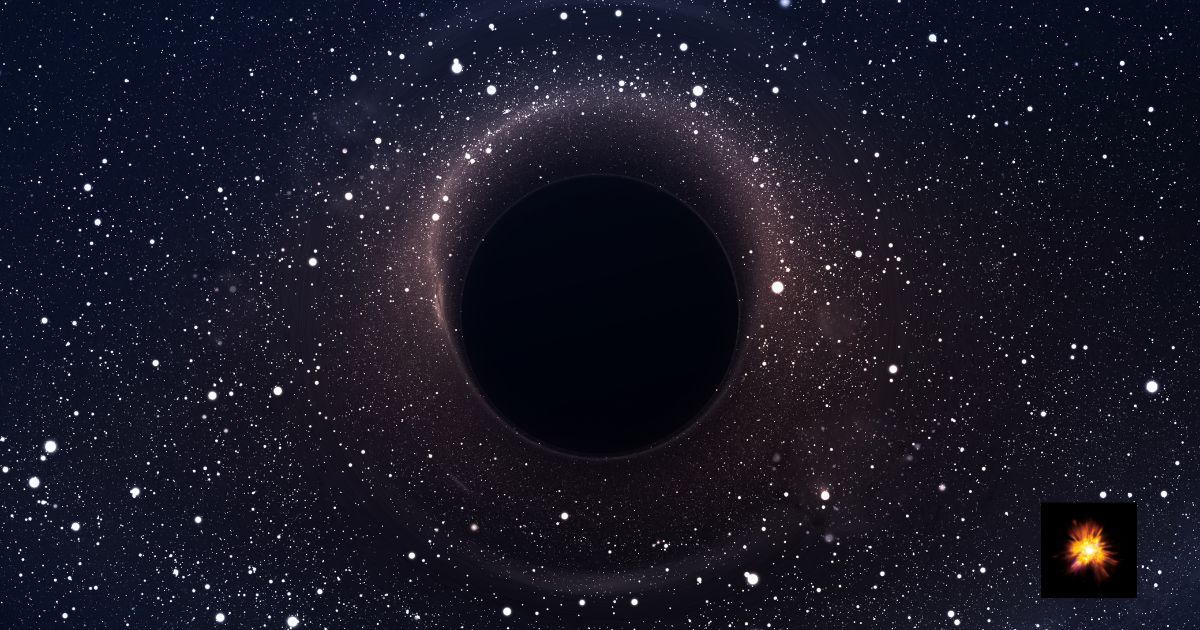
Primordial black holes are hypothetical black holes that were formed less than one second after the Big Bang. This makes them fundamentally different from the stellar black holes we observe, which only form much later after stars have lived and died. Because they formed so early, they are not bound by the same size limits as stellar black holes. Stellar black holes have a narrow mass range, but a primordial black hole could theoretically be as light as a tiny atom or as heavy as thousands of Suns, depending on the exact moment in the universe’s expansion that they formed. The fact that they aren’t limited to the sizes we expect from collapsed stars makes them a fascinating candidate for solving some of the biggest puzzles in cosmology. If they exist, they are truly fossils of the early universe, giving us a direct window into a time we cannot observe with telescopes alone. These objects represent a connection between the physics of the incredibly small (the quantum world) and the physics of the incredibly large (gravity and the universe).
How does the early universe allow for black hole formation?
The very early universe, particularly during a stage called the radiation-dominated era, was extremely hot and dense. Scientists believe that immediately after the Big Bang, there was a period of rapid expansion called inflation. This period would have amplified tiny, naturally occurring quantum fluctuations in the density of matter. Think of it like a sound wave. In some parts of the universe, the “waves” of matter density were slightly taller or more compressed than average. If the density contrast in these regions was high enough—about 50% more dense than the background—their gravity would have immediately overcome the outward pressure of the expansion. There was simply no time for stellar processes to begin; the material was already dense enough to cause gravitational collapse, instantly forming a black hole. The key here is the incredible pressure and density. It took a much smaller amount of material to form a black hole back then than it takes today, which explains how black holes could have formed with masses much smaller than a star.
Can primordial black holes be a candidate for dark matter?
One of the most compelling reasons scientists are searching for primordial black holes is their potential connection to dark matter. Dark matter is the invisible substance that makes up about 85% of the total matter in the universe, and we know it’s there only because of its gravitational pull on visible matter. We still don’t know what dark matter is made of. It is considered “non-baryonic,” meaning it’s not made of the regular protons and neutrons that form atoms. Primordial black holes are also non-baryonic, and if they are massive enough, they are also stable and do not interact much with light or other forces, only through gravity. This perfectly matches the properties we observe for dark matter. The most exciting possibility is that a large fraction, or even all, of the dark matter in the universe is simply a vast population of asteroid-mass primordial black holes, each about as heavy as a small car or an asteroid. While current observations limit the percentage of dark matter they could account for across most mass ranges, a small window between about $10^{17}$ grams and $10^{23}$ grams (the asteroid-mass range) remains wide open.
Do all primordial black holes still exist today?
No, not all primordial black holes would have survived the billions of years since the Big Bang. This is based on the groundbreaking work of physicist Stephen Hawking, who proposed in 1974 that black holes are not perfectly “black” but actually emit radiation, now known as Hawking radiation. According to this theory, a black hole slowly loses mass over time by emitting particles. The smaller the black hole, the faster this process happens. A primordial black hole with a mass less than about $10^{11}$ kilograms—roughly the mass of a small mountain—would have evaporated completely by now, long before the present age of the universe. In the final moments of their lives, these tiny black holes would “explode” in a burst of gamma rays. Therefore, only the heavier primordial black holes, those initially formed with a mass greater than that threshold, would still exist today, quietly floating in space as a potential part of dark matter.
How can scientists try to detect these ancient black holes?
Since primordial black holes don’t emit their own light, detecting them is incredibly challenging. Scientists must look for the unique effects they have on the matter and space around them. One major way is through gravitational lensing, specifically microlensing. This happens when a black hole passes directly in front of a distant star. Its gravity bends and focuses the light from the star, making the star briefly appear much brighter. Astronomers are running large surveys to watch millions of stars, looking for these characteristic temporary brightness changes. Another powerful detection method comes from gravitational waves. If two primordial black holes collide and merge, they would create a burst of ripples in spacetime that detectors like LIGO and Virgo can sense. The mass and spin of the merging black holes might be different from those of stellar black holes, providing a distinct signature that could confirm their primordial origin.
What observational evidence supports the idea of PBHs?
As of today, there is no definitive, confirmed evidence that proves the existence of primordial black holes. However, there are a few interesting observations that they could help explain. For example, some gravitational wave events detected by LIGO and Virgo involve black holes that are much heavier or much lighter than what is typically expected from stellar collapse, and these “outlier” black hole mergers are consistent with predictions for primordial black holes. Furthermore, some models suggest that primordial black holes might have acted as seeds for the supermassive black holes found at the centers of almost all large galaxies. Since these supermassive black holes appear to have formed incredibly early in the universe’s history, having a population of PBHs already in place would give them a head start on growth, something that is difficult to explain with standard star-death black holes. While each piece of evidence is not yet conclusive, the idea that PBHs play a role remains a strong area of research.
What are the mass constraints on primordial black holes right now?
Through various observations, scientists have been able to rule out primordial black holes making up $100\%$ of the dark matter across many mass ranges. These are called observational constraints. For instance, surveys looking for the gamma-ray bursts of evaporating light PBHs have ruled out the lightest ones. Microlensing surveys have placed strong limits on black holes in the solar-mass range. The tightest constraints have ruled out PBHs as the sole component of dark matter for masses outside a specific window, which is often called the asteroid-mass window. This range is roughly from $10^{17}$ grams to $10^{23}$ grams, where current detection methods are less effective. If primordial black holes exist and are a major part of dark matter, they are most likely lurking within this narrow mass band, silently waiting to be discovered by a new generation of high-precision telescopes and gravitational wave detectors. The search continues to narrow this window further.
In summary, the concept of primordial black holes takes us back to the ultimate beginning of the cosmos, suggesting that the universe was forming black holes less than a second after its birth. These ancient objects are not just a fascinating theoretical idea; they offer a potential explanation for one of the universe’s greatest mysteries: the nature of dark matter. While we lack direct proof, observations like certain gravitational wave events and the search for microlensing signals keep the possibility alive and fuel new research. Finding just one confirmed primordial black hole would revolutionize cosmology and cement our understanding of the universe’s initial moments.
If these cosmic fossils did form in the first fraction of a second, what other secrets from the very, very beginning of time might be encoded within their gravity?
FAQs – People Also Ask
Why is the asteroid mass range the only open window for primordial black holes as dark matter?
The asteroid mass range, approximately $10^{17}$ to $10^{23}$ grams, is the most viable range because black holes lighter than this would have evaporated entirely by now due to Hawking radiation, and black holes heavier than this have been largely ruled out as the sole component of dark matter by multiple observational studies. Specifically, very light PBHs are constrained by gamma-ray background measurements, while heavier ones (like solar-mass PBHs) are constrained by the lack of microlensing events observed in large surveys.
How did Stephen Hawking contribute to the theory of primordial black holes?
Stephen Hawking’s primary contribution was the discovery of Hawking radiation, which states that black holes slowly emit thermal radiation and, therefore, lose mass and eventually evaporate. He realized that this evaporation process would be much faster for the tiny primordial black holes, meaning only those above a certain mass threshold (around $10^{11}$ kg) would have survived to the present day. This gave a crucial time constraint to the PBH theory, changing the focus of where astronomers should search for them.
What is the difference between stellar black holes and primordial black holes?
The main difference is their formation time and process. Stellar black holes form millions or billions of years after the Big Bang from the gravitational collapse of massive stars at the end of their lives, giving them a mass typically greater than three times the Sun. Primordial black holes, on the other hand, are hypothesized to have formed in the first second after the Big Bang from high-density fluctuations in the early universe, allowing them to exist across a much wider and mostly smaller range of masses, independent of the life cycle of stars.
Could a primordial black hole hit the Earth?
While theoretically possible, the probability of Earth being hit by a primordial black hole is extremely low, virtually zero. Even if dark matter were entirely made up of asteroid-mass primordial black holes, they are sparsely distributed across space. Furthermore, if a small one were to pass through Earth, the high speed and small size mean it would likely pass right through without causing major, noticeable damage, perhaps leaving only a microscopic tunnel in solid materials due to its intense gravity.
What is the relationship between primordial black holes and gravitational waves?
Primordial black holes are strongly linked to gravitational waves because if they form a binary system, their eventual merger creates powerful ripples in spacetime that detectors like LIGO and Virgo can pick up. Research in this area is focused on checking if the observed gravitational wave signals have characteristics (like specific mass or spin distributions) that point towards a primordial origin rather than a stellar one. Additionally, the formation of PBHs themselves could generate a faint, continuous background of gravitational waves.
Can primordial black holes form the seeds of supermassive black holes?
Yes, this is one of the leading theories for the origin of the supermassive black holes found at the centers of galaxies. Since supermassive black holes are observed to have existed very early in the universe’s history, their rapid growth is a cosmic mystery. Primordial black holes, already formed in the first second, could act as the initial, massive seeds that quickly grew into the huge structures we observe today, solving the problem of how the largest black holes grew so quickly.
What is microlensing and how does it help find primordial black holes?
Microlensing is a type of gravitational lensing where the gravity of a compact, unseen object (like a primordial black hole) passes between Earth and a much more distant star. The black hole’s gravity acts as a lens, briefly brightening the distant star’s light as it passes. Scientists look for this unique, temporary brightening pattern in wide-area stellar surveys. The duration of the brightening is directly related to the mass of the lensing object, allowing scientists to set limits on the existence of PBHs in specific mass ranges.
Are there any theories that oppose the existence of primordial black holes?
The main arguments against primordial black holes come from the lack of strong observational evidence and the tight constraints placed on their possible abundance across most mass ranges. For example, some theories for the early universe struggle to naturally produce the high-density fluctuations required for PBH formation without contradicting other established cosmological observations, such as the uniformity of the cosmic microwave background. The lack of detected gamma-ray bursts from evaporating PBHs also argues against the lighter ones.
What is the QCD epoch and how does it relate to primordial black holes?
The QCD epoch, or Quantum Chromodynamics epoch, was a tiny fraction of a second after the Big Bang (around $10^{-5}$ seconds) when the universe cooled enough for quarks and gluons to combine and form protons and neutrons (baryons). This period is significant for PBH theory because the rapid changes in the speed of sound and the properties of matter during this phase transition could have naturally enhanced the density fluctuations, making it a very likely time for the formation of primordial black holes, specifically in the solar-mass range.
Will the James Webb Space Telescope help in the search for primordial black holes?
The James Webb Space Telescope (JWST) may help indirectly. JWST is designed to look back at the very first galaxies. If primordial black holes acted as the seeds for the first supermassive black holes, then JWST’s observations of these very early galaxies and their central black holes could provide key supporting evidence. Finding unexpectedly massive black holes in the ancient universe would strongly suggest that non-stellar seeds, like PBHs, were necessary to kickstart their growth.