The universe is a very busy place. Far beyond our quiet solar system, massive and powerful events are happening all the time. We see distant stars explode and galaxies collide. But of all the events out there, the most powerful and energetic of all are known as gamma-ray bursts. These are the biggest explosions humans have ever observed, shining brighter than a million galaxies combined for just a few moments.
These incredible bursts of energy are linked to some of the most extreme objects in the cosmos: black holes. When a giant star dies and its core collapses, it can form a new black hole and launch one of these focused, high-energy beams. This connection makes us wonder about our own safety in the galaxy. We know black holes exist. We know gamma-ray bursts happen.
This leads to a big question: could one of these cosmic blasts, born from a black hole, ever be pointed at us? What would happen if a gamma-ray burst hit Earth?
What Exactly Is a Gamma-Ray Burst?
A gamma-ray burst, or GRB, is an extremely intense blast of high-energy light. The light in this burst is called “gamma-rays,” which are the most energetic form of light, far more powerful than visible light, or even X-rays. You cannot see a gamma-ray burst with your eyes. We can only detect them with special space telescopes, like NASA’s Swift Observatory or the Fermi Gamma-ray Space Telescope, which are orbiting high above Earth’s atmosphere.
The energy packed into one of these bursts is truly hard to imagine. A typical gamma-ray burst can release more energy in just ten seconds than our Sun will produce during its entire 10-billion-year lifetime. Think about all the heat and light the Sun gives off, and then imagine all of that energy concentrated into a single beam lasting only a few moments. That is the power of a GRB.
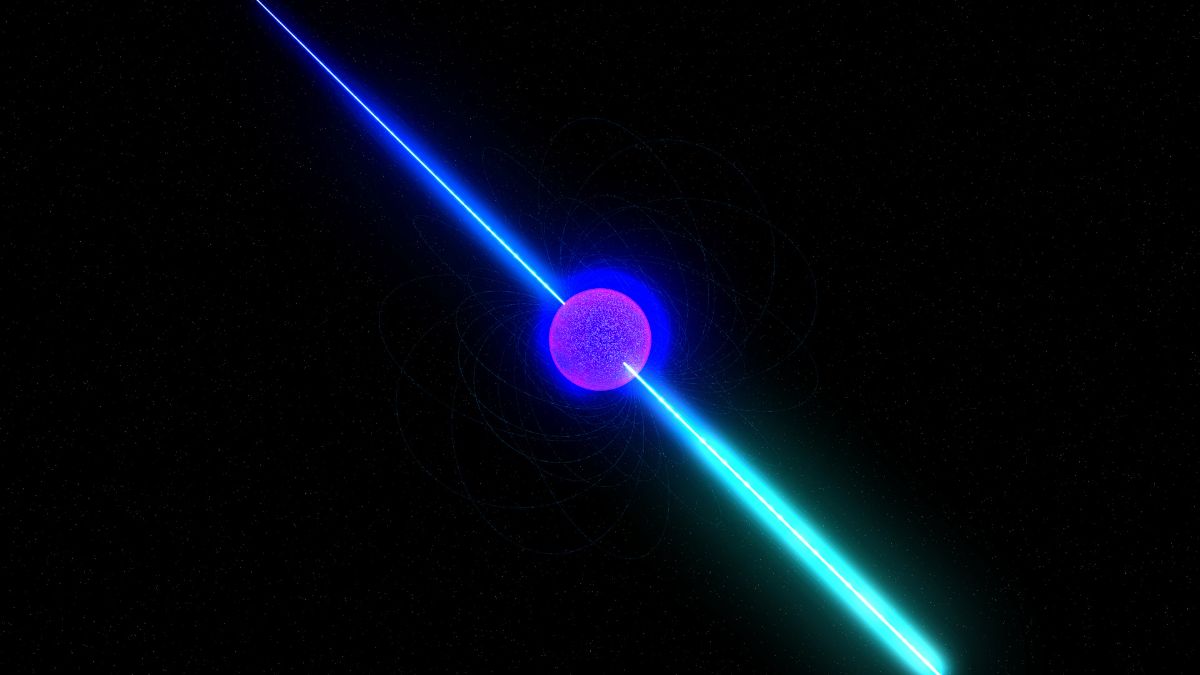
A very important fact about GRBs is that they are not like a normal explosion. A bomb or a firework explodes in all directions at once. A gamma-ray burst is different. It is a highly focused beam, or jet, of energy. Think of it like a powerful flashlight or a laser pointer. The energy bursts out from two opposite ends of the event, like the beams from two flashlights taped back-to-back. This “beaming” is a key part of the story. It means that to see a GRB, or to be in danger from one, you have to be looking directly down the barrel of one of its jets.
How Do Black Holes Create These Powerful Bursts?
This is a key part of the question. A gamma-ray burst is not something that a normal, stable black hole shoots out. Our galaxy’s central black hole, Sagittarius A*, is not firing gamma-ray bursts. Instead, these bursts are created during the violent birth of a brand new black hole, or when two dead stars merge to become a black hole. Scientists have identified two main ways this can happen, which create two different types of bursts.
The first type is called a “long-duration” gamma-ray burst. These bursts can last from a few seconds to several minutes. They are created during a specific type of stellar explosion called a “hypernova.” This only happens to a very specific kind of star: a star that is absolutely massive, perhaps 30 to 40 times heavier than our Sun. On top of being huge, the star must also be spinning extremely fast. When this giant, fast-spinning star runs out of fuel, its core can no longer support its own weight. The core collapses instantly, crushing down to form a new black hole. The star’s outer layers then begin to fall inward toward this new black hole, forming a spinning disk of super-hot material. The intense magnetic fields of the new, spinning black hole get twisted and super-charged, acting like a cosmic cannon. This cannon fires two extremely powerful jets of particles and energy out of the star’s north and south poles. These jets travel at nearly the speed of light. They blast completely through the collapsing star and shoot far out into space. If Earth happens to be in the path of one of those jets, we see it as a long-duration gamma-ray burst.
The second type is called a “short-duration” gamma-ray burst. These are much faster, often lasting less than two seconds. For a long time, scientists were not sure what caused them. Now, thanks to new discoveries, we know they are created by an even more violent event: the collision of two neutron stars. Neutron stars are the super-dense, leftover cores of medium-sized stars that have already exploded. They are so dense that a single spoonful of neutron star material would weigh as much as a mountain. Sometimes, two neutron stars are orbiting each other. Over millions of years, they spiral closer and closer until they finally crash together and merge. This collision is so extreme that it creates a new, heavier object—often a brand new black hole. This merger event is what sends out a short, intense burst of gamma-rays.
What Would Happen If a Gamma-Ray Burst Hit Earth?
The gamma-ray bursts we detect are almost all from extremely distant galaxies, billions of light-years away. At that vast distance, they are completely harmless. They are just fascinating signals that tell us about the early universe. But what if one happened much closer to home, right here in our own Milky Way galaxy, and it was pointed directly at us? The results would be a global disaster.
The gamma-rays themselves would not burn the surface of the planet directly. Most of them would be absorbed by our atmosphere. The real danger comes from the chemical reaction that happens when that much energy hits our air. The gamma-rays would blast apart molecules of nitrogen and oxygen, which make up most of the air we breathe. These broken atoms would then reform into new, dangerous chemicals, primarily “nitrogen oxides.” You might know this as the brown, toxic gas in smog.
This sudden creation of massive amounts of nitrogen oxides in the upper atmosphere would cause two major problems. First, these chemicals would rapidly destroy the ozone layer. The ozone layer is our planet’s natural shield, its “sunscreen,” which protects all life on the surface from the Sun’s harmful ultraviolet (UV) radiation. Scientists estimate a nearby GRB could destroy over 90 percent of the ozone layer within seconds. Without the ozone layer, deadly UV light from our own Sun would scorch the planet, causing severe sunburns in moments, killing off crops, and damaging the DNA of nearly all living things. The microscopic plankton in the ocean, which form the base of the entire marine food web and produce much of our oxygen, would be wiped out.
The second problem is that all that newly created smog would spread through the atmosphere, blocking out sunlight. This would trigger a “cosmic winter,” causing global temperatures to drop rapidly and starting a sudden ice age. This one-two punch of intense UV radiation followed by a dark, global freeze would likely cause a mass extinction event, one of the worst in Earth’s history. Some scientists have suggested that a mass extinction that happened about 450 million years ago might have been caused by a gamma-ray burst in our galaxy.
How Close Would a Burst Need to Be to Cause Damage?
Distance is everything in space. As a beam of light travels, it spreads out and gets weaker. This is why a flashlight looks bright up close but is dim from a mile away. The same is true for a gamma-ray burst. To be a real threat, the burst would have to come from a source relatively close to us, meaning inside our own Milky Way galaxy.
Scientists have done the math to figure out the “kill zone.” The general agreement is that a gamma-ray burst originating within about 8,000 light-years of Earth could be catastrophic. An event from that close would have enough power to strip away our ozone layer and cause the mass extinction event described earlier. Even a burst from farther away, perhaps 50,000 light-years (which is the distance to the other side of our galaxy), could still cause major environmental damage and might trigger a smaller extinction or a global crisis.
This might sound worrying, but it is important to remember the scale of the universe. The closest gamma-ray burst we have ever detected was still over 100 million light-years away, in a completely different galaxy. It was far, far too distant to have any effect on us at all. The vast majority of bursts we see are from billions of light-years away. So, for Earth to be in danger, we would need to have one of these very rare events happen right in our own galactic neighborhood.
Are There Any Dangerous Stars Near Us?
Since the most likely threat comes from a long-duration GRB (a hypernova), scientists have looked for potential “progenitor” stars nearby. A progenitor is a star that has the right conditions to produce such an event. We are looking for a very rare type of star: a massive, rapidly spinning star known as a Wolf-Rayet star. These stars are ticking time bombs, as they are very old and near the end of their lives.
For a long time, one star system in particular was a major topic of discussion: WR 104. This is a massive star system located about 7,500 to 8,000 light-years away, which is right inside that potential danger zone. Early observations of WR 104 were not clear enough to show which way it was spinning. Scientists were concerned that its axis of rotation—the line from which the jets would burst—might be pointed directly at Earth. If WR 104 were to go hypernova while aimed at us, it would be exactly the kind of event that could cause a mass extinction.
However, as our technology has improved, we have been ableto get a much better look at this star system. More recent and precise measurements, especially from the Keck Observatory in Hawaii, have given us a clearer picture. The current scientific understanding, as of 2025, is a lot less worrying. These studies show that the spin axis of WR 104 is not aimed at us. It appears to be tilted at an angle of about 30 to 40 degrees away from our line of sight. This is a huge relief. If and when WR 104 does explode, its incredibly powerful gamma-ray jets will miss Earth completely, shooting harmlessly off into a different part of space. We will be safe from it. Another famous massive star, Eta Carinae, is also unstable, but it is also not aimed at us. As of today, astronomers do not know of any massive star in our galaxy that is both set to go hypernova and aimed in our direction.
So, Should We Be Worried About a Gamma-Ray Burst?
The simple answer is no, you should not be worried about a gamma-ray burst. While the idea is scary, the actual risk to Earth is vanishingly small. We are protected by a “safety net” of three powerful factors that make the odds of this happening incredibly low.
First, these events are extremely rare. A hypernova, the kind of explosion that creates a long, powerful burst, only happens to a tiny fraction of stars. Most stars, including our Sun, are far too small to ever produce one. Even neutron star mergers are thought to be rare in a galaxy like ours. Scientists estimate that a potentially dangerous GRB might happen in our galaxy only once every few million years.
Second, the event must be close. As we learned, the universe is vast. The overwhelming majority of these bursts happen in distant galaxies, billions of light-years away, where they can do us no harm. The chances of one happening right in our own small corner of the Milky Way are very low.
Third, and most importantly, the event must be aimed perfectly at us. This is the biggest safety factor of all. These bursts are not giant explosions; they are pencil-thin jets. The jet of a GRB is very narrow, perhaps only a few degrees wide. For it to hit Earth, the star’s spin axis would have to be pointed exactly at our tiny planet across thousands of light-years of space. This is like trying to hit a single speck of dust on the other side of a country with a laser pointer. The odds of this alignment are almost zero.
When you combine all three factors—the rarity of the event, the need for it to be close, and the need for it to be aimed perfectly—the total risk to Earth becomes so small that it is not considered a practical threat. It is something for scientists to study, but not for us to fear in our daily lives.
Conclusion
Gamma-ray bursts are the most powerful explosions in the universe, and they are directly connected to the creation of new black holes. They are a fascinating and extreme example of physics at work. If a close-by GRB, from a dying massive star in our own galaxy, were to strike Earth, the consequences would be devastating for our atmosphere and the ozone layer, likely causing a mass extinction.
However, the reality is that we are protected by the sheer scale of the cosmos. These events are rare, they must be very close to be dangerous, and their narrow jets must be aimed with impossible precision to hit a small target like Earth. The chances of all these things lining up are incredibly small. We can continue to look up at the stars with wonder, not with fear, as the universe continues its grand, distant, and powerful dance.
Knowing our planet is so well-protected by these cosmic odds, what other powerful secrets do you think the universe is still waiting to show us?
FAQs – People Also Ask
What is the difference between a black hole and a gamma-ray burst?
A black hole is an object in space with gravity so strong that nothing, not even light, can escape it. A gamma-ray burst is a brief, intense flash of high-energy light. They are related because a gamma-ray burst is an event that often happens during the creation of a new black hole, such as when a massive star collapses or two neutron stars merge.
Can a gamma-ray burst be seen with the naked eye?
No, you cannot see the gamma-rays themselves. They are a form of light that is invisible to our eyes. However, some GRBs produce an “afterglow” in visible light as the jet slams into surrounding gas. If a burst were to happen in our own galaxy, this afterglow might be briefly visible as a “new star” in the sky, but the most dangerous part of the burst would remain invisible.
How often do gamma-ray bursts happen?
Our telescopes detect gamma-ray bursts quite often, about once per day. However, these are all coming from very distant galaxies, spread all across the universe. The chances of one happening close to us, within our own Milky Way galaxy, are estimated to be very rare, perhaps only once every few hundred thousand or few million years.
What is the closest gamma-ray burst ever detected?
The closest gamma-ray burst ever confirmed came from a galaxy about 130 million light-years away. This is still an incredibly safe distance. Another event in 2020 from a magnetar (a different type of dead star) inside our own galaxy was detected, but it was thousands of times weaker than a true GRB and posed no threat.
Could a black hole itself shoot a gamma-ray burst at us?
Not in the way most people think. A stable, existing black hole, like the supermassive one at our galaxy’s center, is not shooting out gamma-ray bursts. The bursts are created only during the chaotic and violent moments of a black hole’s birth or when two compact objects, like neutron stars, merge to form one.
Is the black hole at the center of our galaxy dangerous?
The supermassive black hole at the center of the Milky Way, called Sagittarius A*, is not a threat to Earth. It is very far away, about 26,000 light-years, and it is relatively quiet. It is not consuming large amounts of material and is certainly not producing gamma-ray bursts that could harm us.
What is a hypernova?
A hypernova is a “super-supernova.” It is an extremely powerful and rare type of stellar explosion that happens when a star 30 or more times more massive than our Sun collapses at the end of its life. Unlike a normal supernova, a hypernova is so powerful that its core collapses directly into a black hole, and it is this process that is believed to launch long-duration gamma-ray bursts.
How long does a gamma-ray burst last?
Gamma-ray bursts have two main types. “Short-duration” bursts are very fast, lasting less than two seconds, and are caused by merging neutron stars. “Long-duration” bursts, caused by the collapse of massive stars, can last anywhere from two seconds to several minutes.
How do we know a gamma-ray burst caused an extinction in the past?
Scientists are not certain, but it is a leading hypothesis for the Ordovician-Silurian extinction event, which happened about 450 million years ago. The evidence is not direct, but the pattern of that extinction, which badly affected surface-dwelling and shallow-water life, matches the effects expected from a severe depletion of the ozone layer, which a nearby GRB would cause.
What protects Earth from space radiation?
Earth has two main shields that protect us. The first is the ozone layer, which is high in our atmosphere and absorbs most of the Sun’s harmful ultraviolet (UV) radiation. The second is Earth’s magnetic field, which creates a “bubble” around our planet called the magnetosphere. This magnetic field deflects most of the dangerous charged particles from the Sun (the solar wind) and from deep space.